

Logo

American Heart Association

  18
  0


Final ID: MP1208

Routine Use of Epicardial Atrial Pacing After Cardiac Surgery: Impact on In-Hospital Outcomes in a Community Hospital in Argentina

Abstract Body (Do not enter title and authors here): Introduction:
Epicardial atrial pacing (EAP) is selectively used in cardiac surgery, but its routine postoperative application lacks robust supporting evidence.

Objectives:
To compare in-hospital clinical outcomes in patients undergoing cardiac surgery with and without epicardial atrial pacing.

Methods:
We conducted a retrospective cohort study at a high-complexity community hospital in Argentina, including adult patients who underwent cardiac surgery. Patients were divided into two groups: those who received EAP (EAP group) and those who did not (control group). Preoperative data included age and comorbidities. Intraoperative and postoperative variables such as inotrope use, surgery type, complications, and length of stay were recorded. Multivariate logistic regression was used to identify independent predictors of EAP use. Model performance was evaluated with the Hosmer-Lemeshow test and ROC curve.

Results:
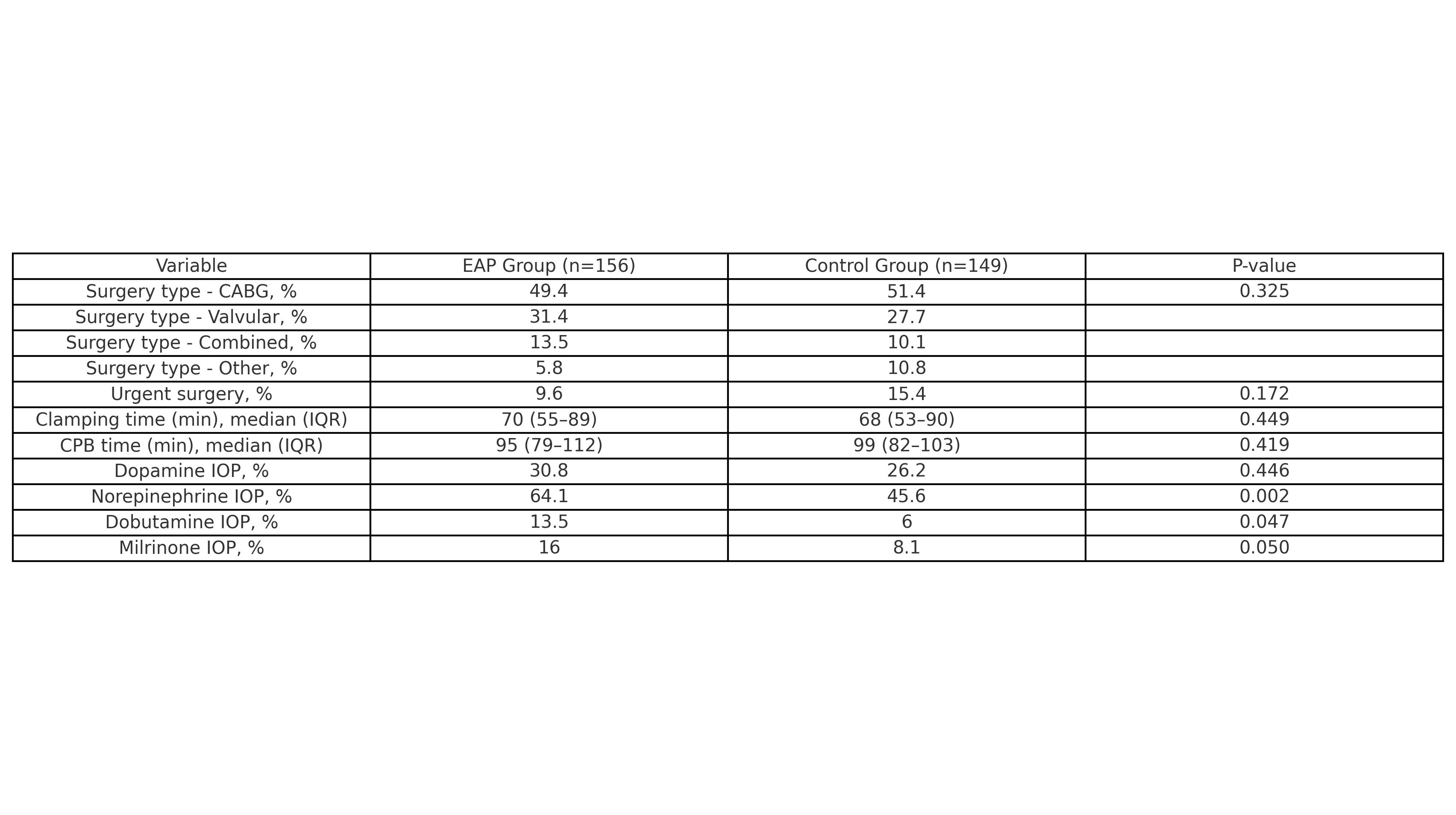
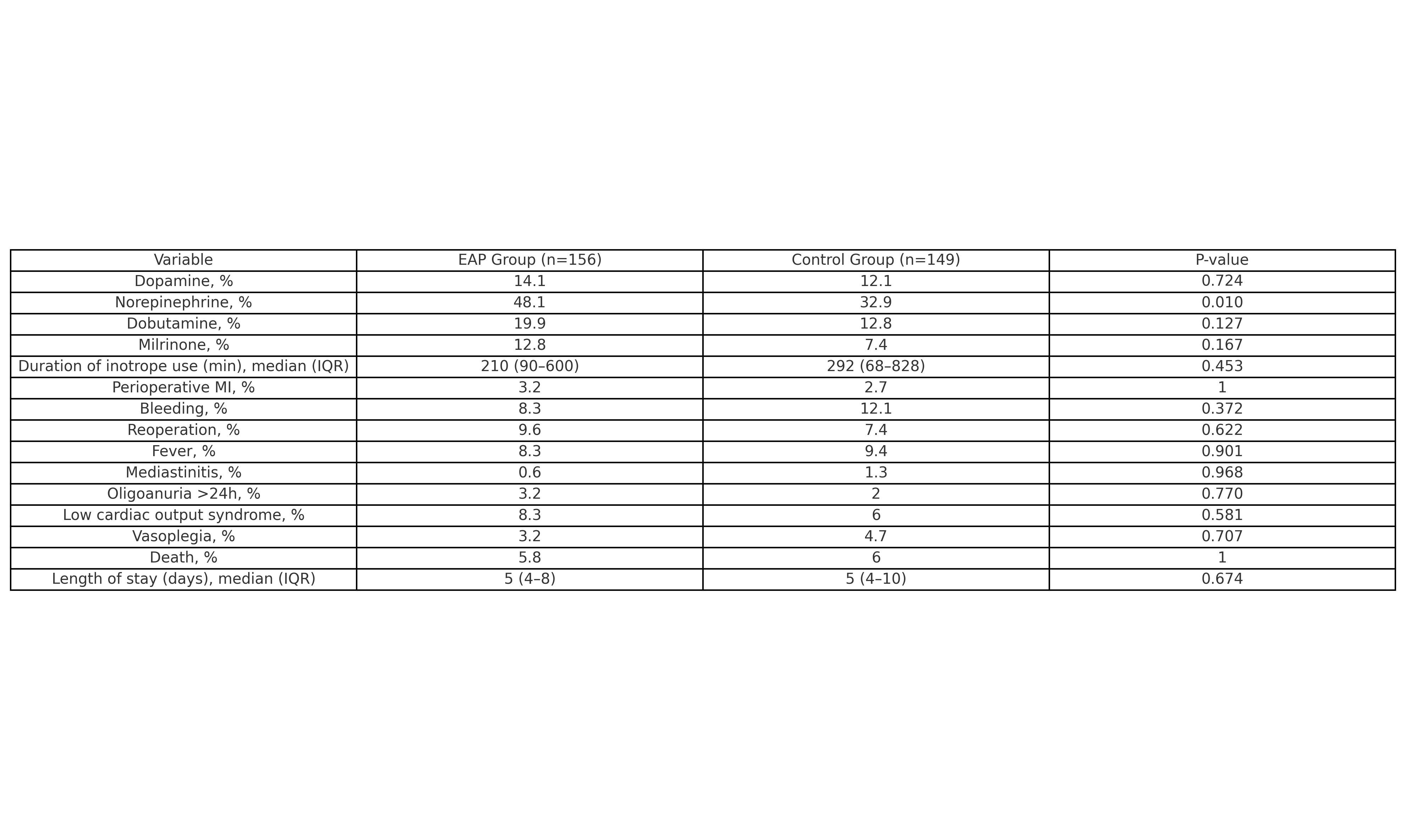
A total of 305 patients were analyzed: 156 in the EAP group and 149 in the control group. The EAP group was older (mean 68 ± 9.5 vs. 64 ± 12 years; p < 0.001), with no other significant differences in baseline characteristics. Intraoperative inotrope use was more frequent in the EAP group: norepinephrine (64.1% vs. 45.6%; p = 0.02), dobutamine (13.5% vs. 6%; p = 0.047), and milrinone (16% vs. 8.1%; p = 0.05). Postoperatively, norepinephrine use remained higher in the EAP group (48.1% vs. 32.9%; p = 0.010), but no differences were found in complications, mortality, or length of stay. In multivariate analysis, age (p = 0.005) and intraoperative inotrope use (p = 0.008) were independent predictors of EAP use. Postoperative inotrope use was included in the model as a confounder (p = 0.161). The model showed moderate discrimination (ROC = 0.67; Hosmer-Lemeshow p = 0.30).

Conclusions:
Routine epicardial atrial pacing following cardiac surgery was not associated with improved in-hospital clinical outcomes. While its primary indication remains postoperative rhythm disturbances, its use may be justified in selected patients—particularly older individuals or those requiring intraoperative inotropic support—based on clinical judgment. Importantly, the procedure demonstrated a favorable safety profile.
  • Alvarez Amuchastegui, Ignacio  ( Hospital Britanico de Buenos Aires , Ciudad Autonoma de Buenos Aires , Ciudad Autonoma de Buenos Aires , Argentina )
  • Gingins, Mauro  ( Hospital Britanico de Buenos Aires , Ciudad Autonoma de Buenos Aires , Ciudad Autonoma de Buenos Aires , Argentina )
  • Sorensen, Pablo  ( Hospital Britanico de Buenos Aires , Ciudad Autonoma de Buenos Aires , Ciudad Autonoma de Buenos Aires , Argentina )
  • De Titta, Mariano  ( Hospital Britanico de Buenos Aires , Ciudad Autonoma de Buenos Aires , Ciudad Autonoma de Buenos Aires , Argentina )
  • Brunel, Eduardo Miguel  ( Hospital Britanico de Buenos Aires , Ciudad Autonoma de Buenos Aires , Ciudad Autonoma de Buenos Aires , Argentina )
  • Avaca, Horacio  ( Hospital Britanico de Buenos Aires , Ciudad Autonoma de Buenos Aires , Ciudad Autonoma de Buenos Aires , Argentina )
  • Smith, Christian  ( Hospital Britanico de Buenos Aires , Ciudad Autonoma de Buenos Aires , Ciudad Autonoma de Buenos Aires , Argentina )
  • Author Disclosures:
    Ignacio Alvarez Amuchastegui: DO NOT have relevant financial relationships | MAURO GINGINS: No Answer | Pablo Sorensen: No Answer | Mariano De Titta: DO NOT have relevant financial relationships | EDUARDO MIGUEL BRUNEL: No Answer | Horacio Avaca: DO NOT have relevant financial relationships | Christian Smith: No Answer
Meeting Info:

Scientific Sessions 2025

2025

New Orleans, Louisiana

Session Info:

Beyond the Scalpel: Innovations in Safer, Smarter Cardiac Surgery

Sunday, 11/09/2025 , 11:50AM - 01:00PM

Moderated Digital Poster Session

More abstracts on this topic:
A Case of Spike-on-T Phenomenon and Polymorphic Ventricular Tachycardia

Tran Brittany, Thimmiah Harun, Rosenthal Lawrence

Impact of Hemodynamic Management on Early Mortality in Patients Undergoing Radiofrequency Catheter Ablation for Ventricular Tachycardia: A Single Center Experience

El Rafei Abdelghani, Varosy Paul, Von Johannes, Ashur Carmel, Adewumi Joseph, Padalia Kishan, Grubb Alex, Varela Daniel, Rosenberg Michael, Tzou Wendy, Sandhu Amneet, Cerbin Lukasz, Aleong Ryan, Zipse Matthew, Tumolo Alexis, Sabzwari Syed Rafay Ali, Garg Lohit, Barrett Christopher

You have to be authorized to contact abstract author. Please, Login
Not Available