
Logo

American Heart Association

  17
  0


Final ID: MP2131

Echocardiographic Differences Between Acute Cellular and Antibody-Mediated Rejection in Heart Transplant Recipients

Abstract Body (Do not enter title and authors here): Background: Echocardiography is routinely used to evaluate heart transplant rejection, but phenotypic differences between acute cellular rejection (ACR) and antibody-mediated rejection (AMR) are poorly characterized. We aimed to assess echocardiographic features associated with each rejection type and identify differential patterns of structural and functional change.
Methods: We included 144 heart transplant recipients (ACR: n = 74, AMR: n = 70) with an echocardiogram at the time of rejection between 2009–2021. ACR was defined as ISHLT grade ≥2R and AMR as pAMR ≥1. Echocardiographic parameters included LVEF, wall thickness, internal diameters, and diastolic indices when available. Baseline echocardiograms performed ≥30 days (or ≥7 days in cases of early rejection) prior to rejection were available in 112 cases, and changes from baseline were calculated. Within-group changes were assessed using the Wilcoxon signed-rank test. Between-group differences at the time of rejection and in change from baseline were analyzed using the Mann-Whitney U test.
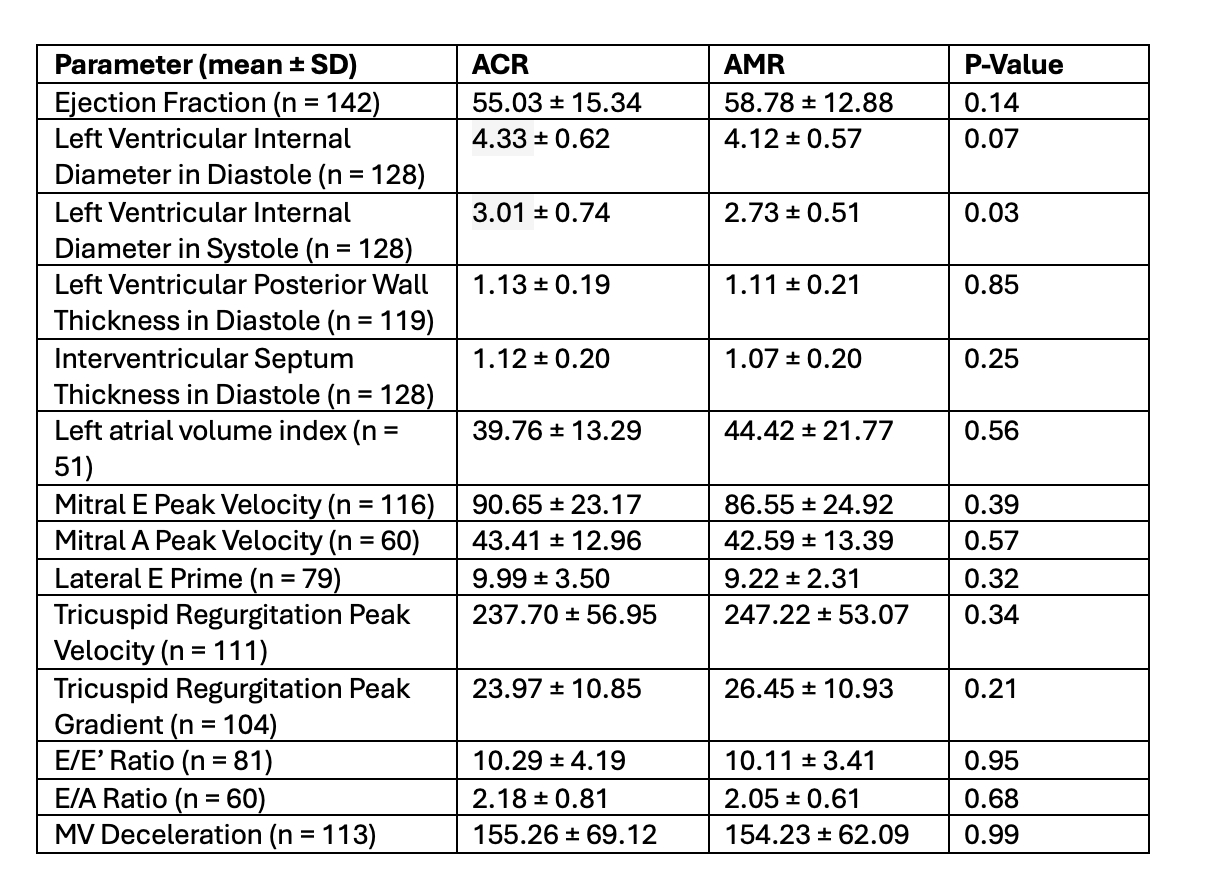
Results: At the time of rejection, patients with AMR had a significantly smaller left ventricular systolic dimension compared to ACR (2.73 ± 0.51 cm vs. 3.01 ± 0.74 cm, p = 0.03). Within the ACR group, ejection fraction declined from 61.8 ± 8.6% at baseline to 55.0 ± 15.3% at rejection (p = 0.0007), and lateral e′ velocity decreased from 11.7 ± 3.3 cm/s to 10.0 ± 3.5 cm/s (p = 0.005). In the AMR group, the E/e′ ratio declined significantly from 10.8 ± 3.8 to 10.1 ± 3.4 (p = 0.03). Delta comparisons showed that lateral e′ increased in AMR (+1.46 cm/s) but decreased in ACR (–1.70 cm/s), with a significant between-group difference (p = 0.005). E/e′ ratio decreased in AMR (–2.81) and slightly increased in ACR (+0.32), also differing significantly between groups (p = 0.04). Additionally, LVIDd showed a small increase in ACR (+0.10 cm) and a decrease in AMR (–0.09 cm; p = 0.03).
Conclusion: Echocardiographic changes in heart transplant rejection differ by rejection type. ACR was associated with declines in systolic and diastolic function, while AMR showed preserved systolic function and opposing patterns in tissue Doppler indices. Dynamic changes in diastolic velocities may aid in distinguishing ACR from AMR, potentially improving diagnostic phenotyping beyond static measurements alone.
  • Velarde, Nathan  ( Cedars Sinai Medical Center , Los Angeles , California , United States )
  • Ouyang, David  ( Kaiser Permanente , Pleasanton , California , United States )
  • Kobashigawa, Jon  ( CEDARS-SINAI HEART INSTITUTE , Los Angeles , California , United States )
  • Nikolova, Andriana  ( CEDARS SINAI MEDICAL CENTER , West Hollywood , California , United States )
  • Author Disclosures:
    Nathan Velarde: DO NOT have relevant financial relationships | David Ouyang: DO have relevant financial relationships ; Consultant:InVision:Active (exists now) ; Consultant:Pfizer:Past (completed) ; Consultant:Ultromics:Past (completed) ; Consultant:EchoIQ:Past (completed) ; Consultant:AstraZeneca:Active (exists now) | Jon Kobashigawa: No Answer | Andriana Nikolova: No Answer
Meeting Info:

Scientific Sessions 2025

2025

New Orleans, Louisiana

Session Info:

Echoes of Progress: Innovation, Automation and Disease Specific Insights

Monday, 11/10/2025 , 12:15PM - 01:30PM

Moderated Digital Poster Session

More abstracts on this topic:
A RARE CARDIAC COMPLICATION OF LEGIONNAIRES' DISEASE: LEFT VENTRICULAR APICAL THROMBUS WITH SEVERE CARDIOMYOPATHY

Ramalingam Archana, Shabnam Arshiya, Devi Reddy Akhila Reddy, Nookala Vinod

A human cardiomyocyte model of CD36 haploinsufficiency uncovers fatty acid oxidation deficits driving dilated cardiomyopathy

Al Sayed Zeina, Klattenhoff Carla, Aragam Krishna, Ellinor Patrick, Willcox Jon, Zheng Alice, Koledova Vera, Srivastava Salil, Yin Xiaofei, Chaffin Mark, Rigaud Vagner, Kovacs-bogdan Erika

More abstracts from these authors:
Predictors of Developing Ischemia-Reperfusion Injury Immediately after Heart Transplantation

Manla Yosef, Patel Jignesh, Kittleson Michelle, Nikolova Andriana, Chang David, Kransdorf Evan, Stern Lily, Czer Lawrence, Kobashigawa Jon

Highly Sensitized Heart Transplant Recipients Who Have Undergone Pre-Transplant Desensitization Therapies Demonstrate Acceptable Medium-Term Outcomes

Jain Rashmi, Nikolova Andriana, Kransdorf Evan, Kittleson Michelle, Chang David, Patel Jignesh, Kobashigawa Jon

You have to be authorized to contact abstract author. Please, Login
Not Available