Social Isolation, Social Support, and Cardiovascular Disease Outcomes and Risk Prediction: The Atherosclerosis Risk in Communities Study
Abstract Body (Do not enter title and authors here): Abstract Body: Background: Social isolation and perceived social support have been linked to adverse cardiovascular outcomes particularly in older adults. However, their value in cardiovascular disease (CVD) risk prediction remains unclear.
Hypothesis: Adding measures of social isolation and social support to the PREVENT risk equation improves prediction of incident CVD events.
Methods: We analyzed data from 11,070 adults in the Atherosclerosis Risk in Communities Study (57% women, 23% Black, mean age 56.7 years (SD 5.8)) who were free of CVD at baseline (Visit 2; 1990 - 1992). Social isolation (low, moderate, high, socially isolated) was assessed using the Lubben Social Network Scale, and social support (quartiles) was assessed through of the Interpersonal Support Evaluation List Short Form. We used Cox proportional hazards models, adjusted for covariates of the PREVENT score, to assess the association between social connection and all-cause CVD (myocardial infarction, stroke, or heart failure) and all-cause mortality. We also examined whether the addition of social isolation and social support improved risk discrimination and calibration of PREVENT score.
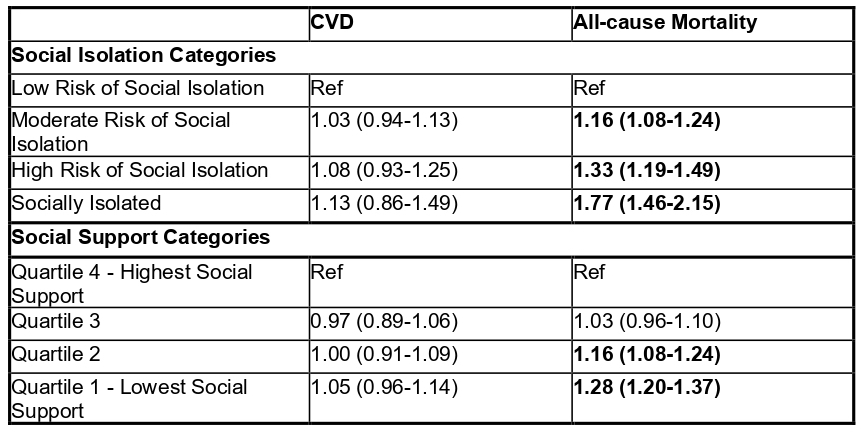
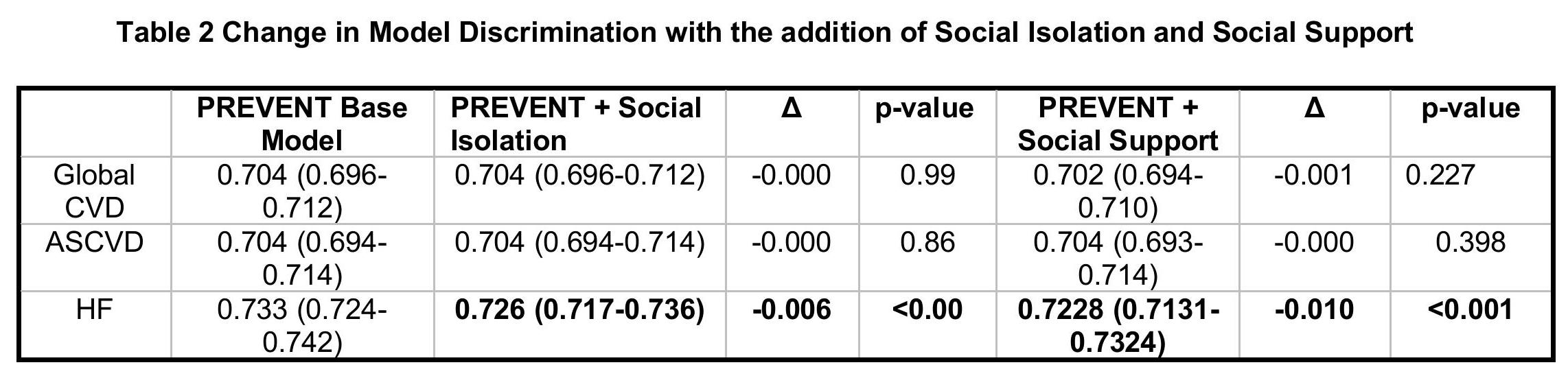
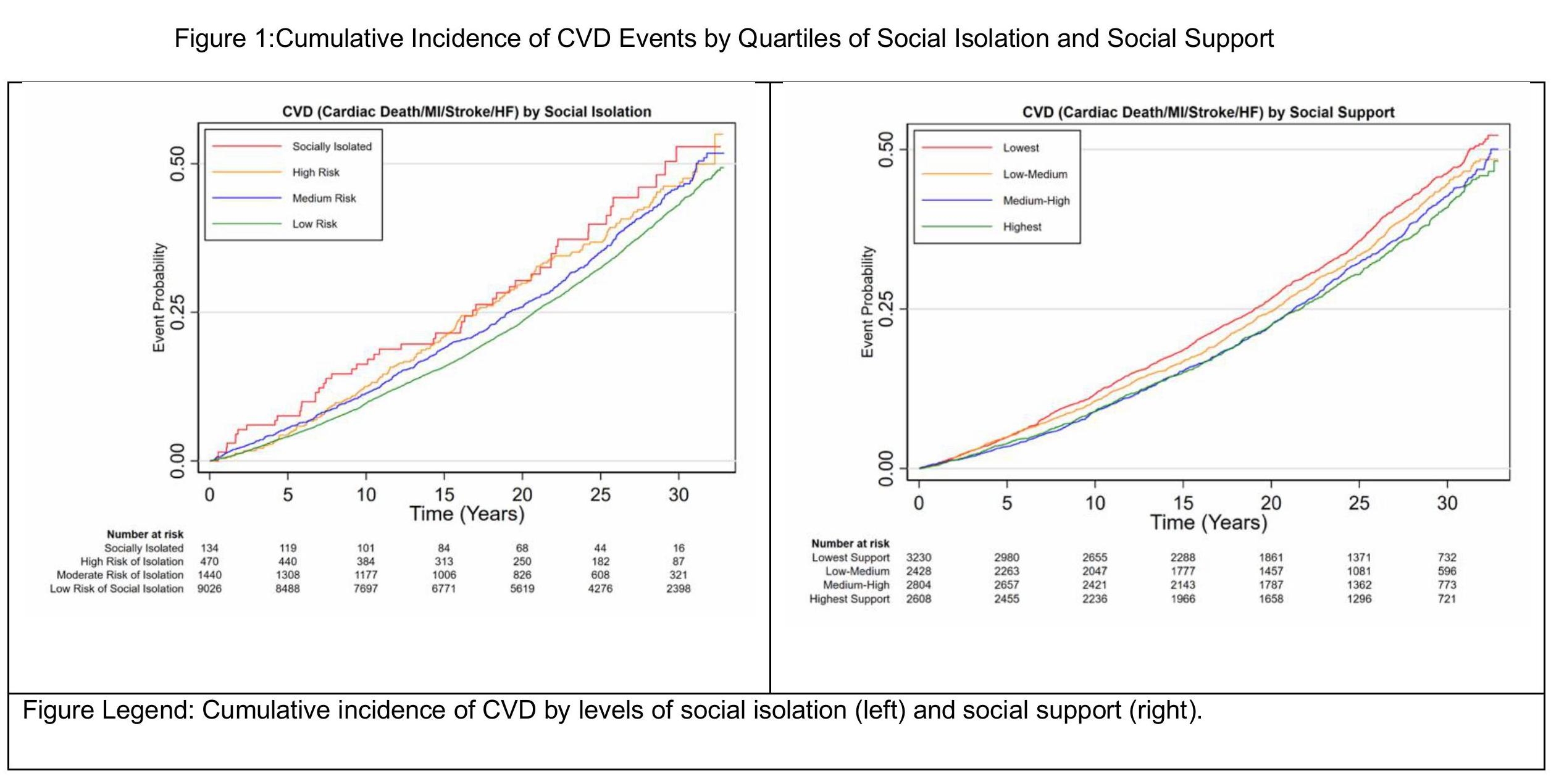
Results: Over a mean follow-up of 21.5 years (SD 9.2 years), 37% of participants developed CVD, and 60% died. The cumulative incidence of CVD was higher in those who were socially isolated and those with low social support (Figure 1). High, as compared to low, social isolation was statistically significantly associated with greater all-cause mortality (HR 1.77, 95% CI 1.46-2.15), but not with the risk of CVD (HR 1.13, 95% CI 0.86-1.49) (Table 1). The lowest, as compared to the highest, quartile of social support was associated with greater all-cause mortality (HR 1.28, 95% CI 1.20-1.37) but not with CVD risk (HR 1.05, 95% CI 0.96-1.14). The addition of social support and social isolation to the PREVENT score did not significantly improve risk discrimination or calibration (Table 2).
Conclusion: High social isolation and low social support were associated with greater all-cause mortality but not with incident CVD. The addition of social connection measures to the PREVENT score did not improve the risk prediction of CVD outcomes. These findings suggest that social connection may influence health through pathways already represented in current clinical models and underscore the difference between causal factors and predictive utility.
Ababulgu, Sitra Nuredin
(
Johns Hopkins Bloomberg School PH
, Baltimore , Maryland , United States )
Hu, Xiao
(
Johns Hopkins Bloomberg School of Public Health
, Baltimore , Maryland , United States )
Matsushita, Kunihiro
(
Johns Hopkins Bloomberg School of Public Health
, Baltimore , Maryland , United States )
Cudjoe, Thomas
(
JOHNS HOPKINS HOSPITAL
, Silver Spring , Maryland , United States )
Kucharska-newton, Anna
(
UNIVERSITY NORTH CAROLINA
, Chapel Hill , North Carolina , United States )
Peter-marske, Kennedy
(
UNC at Chapel Hill
, Chapel Hill , North Carolina , United States )
Aryee, Ebenezer
(
Johns Hopkins Bloomberg School of Public Health
, Baltimore , Maryland , United States )
Ndumele, Chiadi
(
JOHNS HOPKINS HOSPITAL
, Silver Spring , Maryland , United States )
Mathews, Lena
(
Johns Hopkins
, Baltimore , Maryland , United States )
Author Disclosures:
Sitra Nuredin Ababulgu:DO NOT have relevant financial relationships
| Xiao Hu:DO NOT have relevant financial relationships
| Kunihiro Matsushita:No Answer
| Thomas Cudjoe:No Answer
| Anna Kucharska-Newton:DO NOT have relevant financial relationships
| Kennedy Peter-Marske:DO NOT have relevant financial relationships
| Ebenezer Aryee:No Answer
| Chiadi Ndumele:DO NOT have relevant financial relationships
| Lena Mathews:DO NOT have relevant financial relationships
Mathews Lena, Okonkwo Miriam Chiamaka, Tolefree Tionna, Stewart Kerry, Benz Scott Lisa, Cooper Lisa, Ndumele Chiadi, Matsushita Kunihiro, Riekert Kristin