
Logo

American Heart Association

  13
  0


Final ID: 4364153

Cohort-scale automated patch clamp data improves variant classification and penetrance stratification for SCN5A-Brugada Syndrome

Abstract Body (Do not enter title and authors here): Introduction: Genetic data are transforming preventative cardiology by identifying individuals at risk of disease before sudden manifestations. Brugada Syndrome (BrS) is an inherited arrhythmia disorder that causes an elevated risk of sudden cardiac death. Approximately 20% of patients with BrS have rare variants in SCN5A, which encodes the cardiac sodium channel NaV1.5. Genetic workup of BrS, and analysis of secondary findings, is often complicated by SCN5A variants of uncertain significance (VUS) and/or incomplete penetrance.

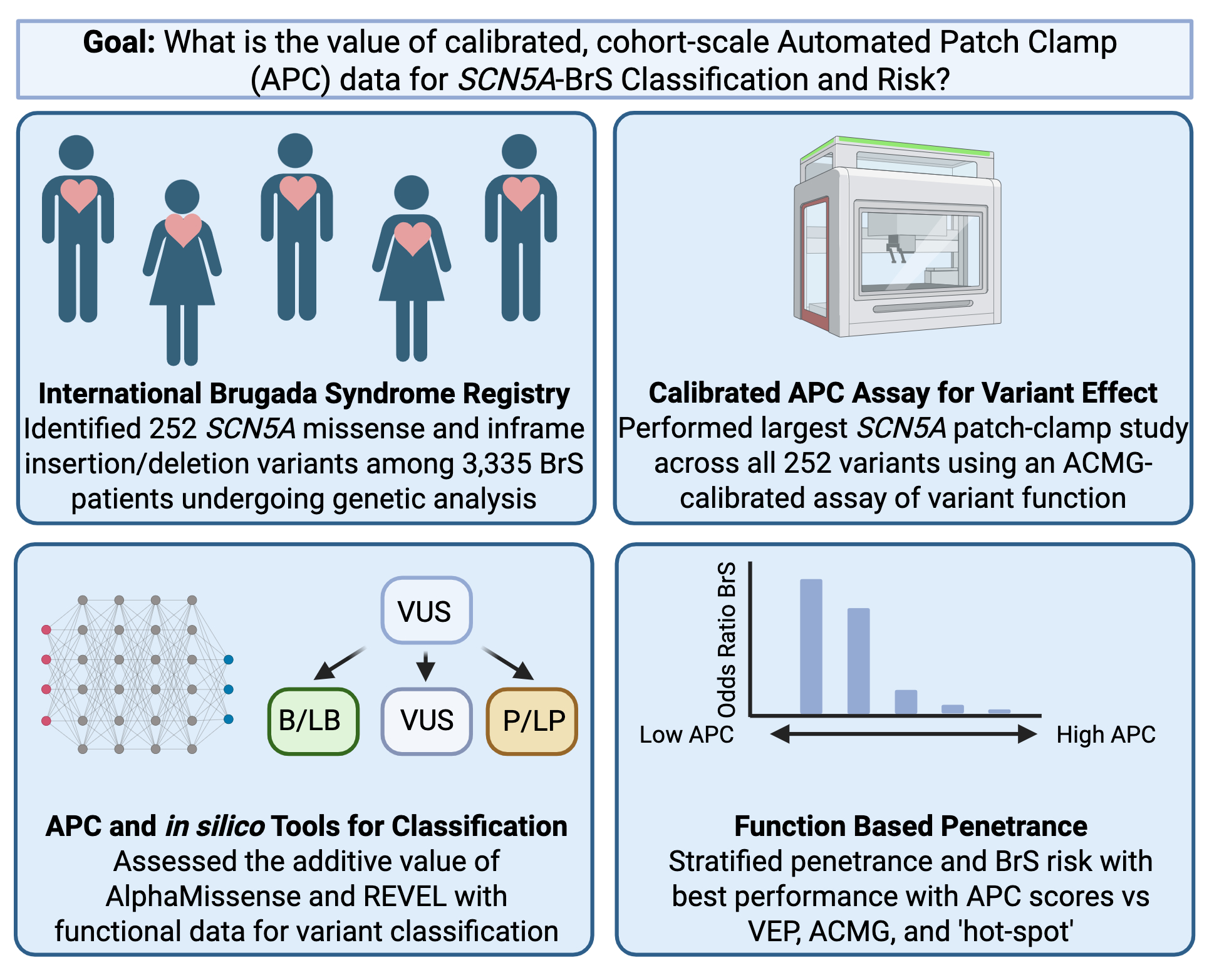
Research Question: What is the additive value of variant functional testing when applied across a cohort of patients undergoing evaluation of potential BrS?

Methods: We comprehensively studied 252 missense and in-frame insertion/deletion SCN5A variants from a previously published large cohort of BrS cases (n=3,335 patients) using a calibrated high-throughput automated patch clamp (APC) assay. Variant functional Z-scores were assigned evidence levels ranging from BS3_moderate (normal function) to PS3_strong (loss-of-function), as defined by American College of Medical Genetics and Genomics criteria. Functional evidence was combined with population frequency, hot-spot, case counts, protein length changes, and in silico predictions. Odds ratios of BrS case-control enrichment and penetrance for BrS were calculated from variant frequencies in the BrS cohort and in gnomAD.

Results: Most variants (146/252) were functionally abnormal (Z ≤ -2), with 100 having severe loss-of-function (Z ≤ -4). Functional evidence enabled the reclassification of 110 of 225 VUS; 104 to likely pathogenic and 6 to likely benign. SCN5A variants with loss-of-function were mainly localized to the transmembrane domains, especially the regions comprising the central pore. SCN5A variant penetrance was proportional to the severity of loss-of-function; variants with Z ≤ -6 had penetrance of 24.5% (15.9 – 37.7% CI) and an odds ratio of 501 for BrS.

Conclusions: This cohort-scale APC dataset stratifies SCN5A variants found in BrS patients into normal function “bystander” variants that have a low risk for BrS and loss-of-function variants that have a high risk for BrS. Functional data can be integrated with other criteria to reclassify a substantial fraction of VUS and identifies variants with higher penetrance among a secondary findings population. We anticipate this dataset will improve the diagnosis and clinical management of BrS probands and their families.
  • O'neill, Matthew  ( Brigham and Women's Hospital , Boston , Massachusetts , United States )
  • Walsh, Roddy  ( City St George's University of Lond , London , United Kingdom )
  • Vandenberg, Jamie  ( Victor Chang Cardiac Research Inst , Sydney , New South Wales , Australia )
  • Ng, Chai  ( VCCRI , Darlinghurst , New South Wales , Australia )
  • Glazer, Andrew  ( VANDERBILT UNIVERSITY MEDICAL CENT , Nashville , Tennessee , United States )
  • Ma, Joanne  ( Victor Chang Cardiac Research Inst , Sydney , New South Wales , Australia )
  • Aldridge, Jessa  ( VANDERBILT UNIVERSITY MEDICAL CENT , Nashville , Tennessee , United States )
  • Solus, Joseph  ( Vanderbilt University Medical Ctr , Nashville , Tennessee , United States )
  • Harvey, Genevieve  ( VANDERBILT UNIVERSITY MEDICAL CENT , Nashville , Tennessee , United States )
  • Roberson, Paige  ( VANDERBILT UNIVERSITY MEDICAL CENT , Nashville , Tennessee , United States )
  • Barc, Julien  ( Nantes Universite , Nantes , France )
  • Bezzina, Connie  ( UMC Amsterdam , Amsterdam , Netherlands )
  • Roden, Dan  ( Vanderbilt University Medical Ctr , Nashville , Tennessee , United States )
  • Author Disclosures:
    Matthew O'Neill: DO NOT have relevant financial relationships | Roddy Walsh: DO NOT have relevant financial relationships | Jamie Vandenberg: No Answer | Chai Ng: DO NOT have relevant financial relationships | Andrew Glazer: DO NOT have relevant financial relationships | Joanne Ma: DO NOT have relevant financial relationships | Jessa Aldridge: No Answer | Joseph Solus: No Answer | Genevieve Harvey: No Answer | Paige Roberson: No Answer | Julien Barc: DO NOT have relevant financial relationships | Connie Bezzina: No Answer | Dan Roden: DO NOT have relevant financial relationships
Meeting Info:

Scientific Sessions 2025

2025

New Orleans, Louisiana

Session Info:
More abstracts on this topic:
Adding a polygenic risk score to the PREVENT clinical risk tool significantly improves cardiovascular risk prediction

Euesden Jack, Absher Devin, Iribarren Carlos, Riveros-mckay Fernando, Rana Jamal, Rowell Sarah, Neogi Arpita, Harrison Seamus, Weale Michael, Donnelly Peter

A Nationwide Italian Network for the Clinical and Genetic Diagnosis of Familial Dyslipidemias: The LIPIGEN registry

Casula Manuela, Galimberti Federica, Olmastroni Elena, Arca Marcello, Averna Maurizio, Catapano Alberico

More abstracts from these authors:
Electrophysiological characterization of L1521I-Cav1.2 mutation reported in a cardiology patient provides insight into channel structure

Dyrda Agnieszka, Tan Chek-ying, Ng Chai, Vandenberg Jamie, Van Petegem Filip, Hool Livia

Ibrutinib Increases Phosphorylation of the Src-Erk1/2 Signaling Pathway in Human Atrial-Specific Cardiomyocytes Derived from Induced Pluripotent Stem Cells

Fleming Matthew, O'neill Matthew, Yang Tao, Solus Joseph, Kroncke Brett, Knollmann Bjorn, Moslehi Javid, Roden Dan

You have to be authorized to contact abstract author. Please, Login
Not Available