Social Risk Factors and Advanced Cardiovascular-Kidney-Metabolic (CKM) Syndrome in U.S. Adults: Evidence from NHANES 2005–2018
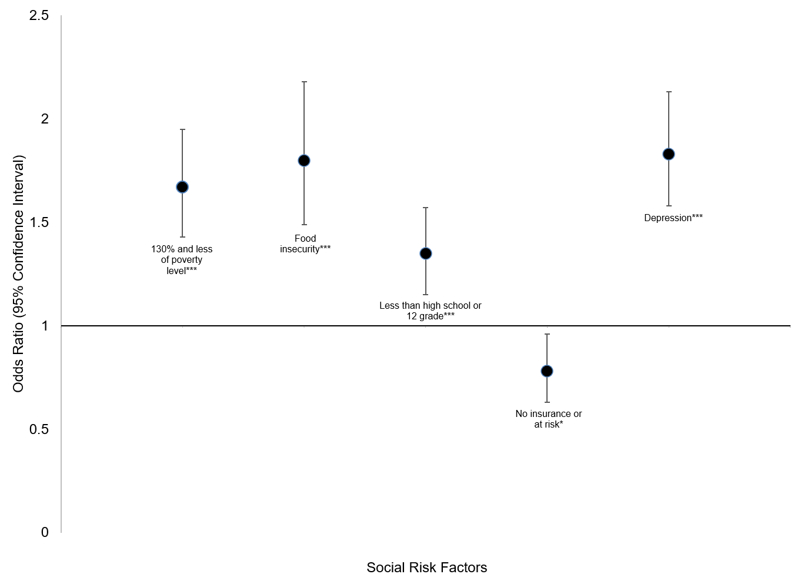
Abstract Body (Do not enter title and authors here): Introduction: Cardiovascular-Kidney-Metabolic (CKM) Syndrome is a growing public health concern linked to increased morbidity and mortality. The sociopolitical and economic environment, shaped by laws, policies, and institutional practice, profoundly influence daily life, particularly for marginalized populations. These structural forces give rise to social risk factors, leading to discrimination and stigma that, over time, contribute to poor health through stress-related factors like depressive symptoms. This study examines associations between social risk factors and advanced CKM Syndrome in a nationally representative sample of U.S. adults. Methods: We analyzed data from the National Health and Nutrition Examination Survey (NHANES) from 2005–2018 for U.S. adults aged 30 to 79 years with CKM Syndrome. Multivariable weighted logistic regression models were used to assess associations between social risk factors and CKM stage, defined as nonadvanced (stages 0–2) and advanced (stages 3–4). Social risk domains, based on the Kaiser framework, included: economic stability (>130% vs. ≤130% of the federal poverty line), neighborhood/built environment (food security vs. insecurity), education access (>high school vs. Results: Among 21,821 U.S. adults with CKM Syndrome, 15.1% (n=3,287) had advanced-stage disease. Of those with advanced CKM Syndrome, 59.8% were aged 65 or older, 43.7% were female, and 11.9% were Non-Hispanic Black. In fully adjusted models accounting for both social risk factors and demographic characteristics, economic instability (OR: 1.67; 95% CI: 1.43–1.95), the neighborhood/built environment (OR: 1.80; 95% CI: 1.49–2.18), limited education access (OR: 1.35; 95% CI: 1.15–1.57), and the social context (OR: 1.83; 95% CI: 1.58–2.13) were each associated with higher odds of advanced CKM Syndrome. Notably, limited healthcare access was associated with lower odds of advanced CKM Syndrome (OR: 0.78; 95% CI: 0.63–0.96) (Figure 1). Conclusions: Significant associations between advanced CKM Syndrome and disparities in income, food access, education, and depression emphasize the importance of implementing targeted, equity-focused prevention strategies.
Ekwunife, Obinna
(
University at Buffalo
, Buffalo , New York , United States )
Wang, Xuemeng
(
University at Buffalo
, Buffalo , New York , United States )
Fraser, Raphael
(
University at Buffalo
, Buffalo , New York , United States )
Campbell, Jennifer
(
University at Buffalo
, Buffalo , New York , United States )
Walker, Rebekah
(
University at Buffalo
, Buffalo , New York , United States )
Egede, Leonard
(
UBMD Internal Medicine
, Buffalo , New York , United States )
Author Disclosures:
Obinna Ekwunife:DO NOT have relevant financial relationships
| XUEMENG WANG:DO NOT have relevant financial relationships
| Raphael Fraser:DO NOT have relevant financial relationships
| Jennifer Campbell:DO NOT have relevant financial relationships
| Rebekah Walker:DO NOT have relevant financial relationships
| Leonard Egede:DO NOT have relevant financial relationships