Logo

American Heart Association

  25
  0


Final ID: 4363989

The Role and Mechanism of MKRN1 in Calcific Aortic Valve Disease

Abstract Body (Do not enter title and authors here): Calcific aortic valve disease (CAVD) is one of the most common valvular heart diseases worldwide. In recent years, the rise of minimally invasive treatment concepts, primarily Transcatheter aortic valve replacement (TAVR), and innovations in prosthetic valve development have led to substantial breakthroughs in CAVD treatment. However, effective pharmacotherapeutic targets to delay CAVD progression are still lacking. Therefore, uncovering novel molecular mechanisms underlying the initiation and progression of aortic valve calcification and improving CAVD management remain urgent clinical challenges.
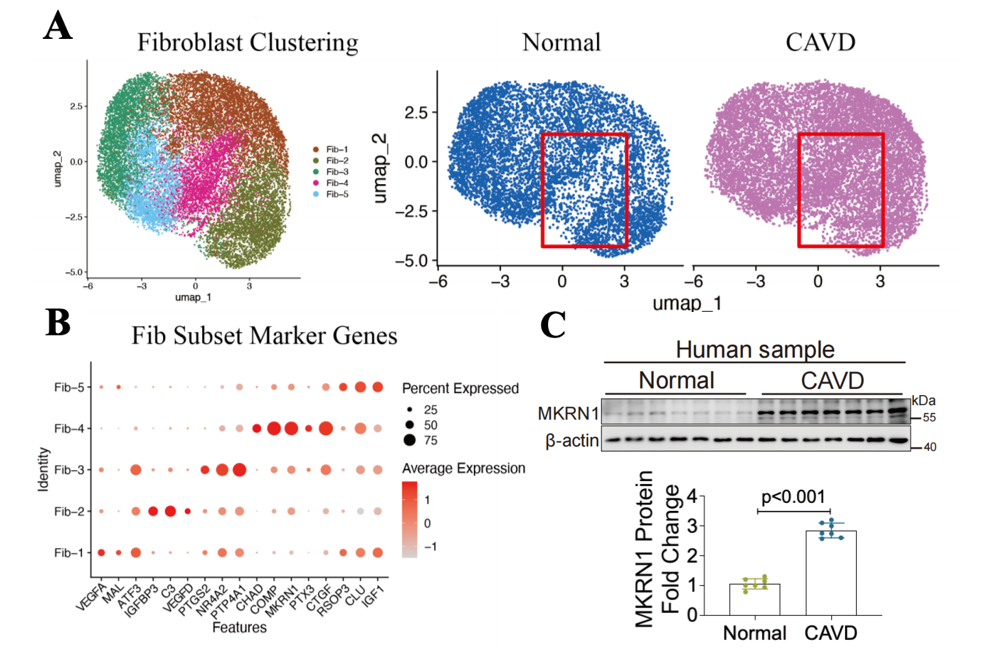
Single-cell RNA sequencing of human aortic valve tissues revealed a significantly increased proportion of a specific Valvular interstitial cell (VIC) subpopulation in calcified aortic valves (Figure 1A). Functional enrichment analysis of differentially expressed genes in this subpopulation showed high enrichment for pathways such as ubiquitination. Subsequently, bulk RNA sequencing was performed on human calcified aortic valves, revealing a set of significantly upregulated genes,which were cross-referenced with the marker genes of disease-specific VIC subpopulations identified through single-cell RNA sequencing, the MKRN1 gene—associated with protein ubiquitination—was identified as a key candidate gene. (Figure 1B). Validation by Western blot confirmed that MKRN1 protein levels were significantly higher in calcified human aortic valves compared to normal tissues (Figure 1C), consistent with the transcriptomic sequencing results. This finding was further corroborated by immunohistochemistry on human valve tissues (Figure 2C).
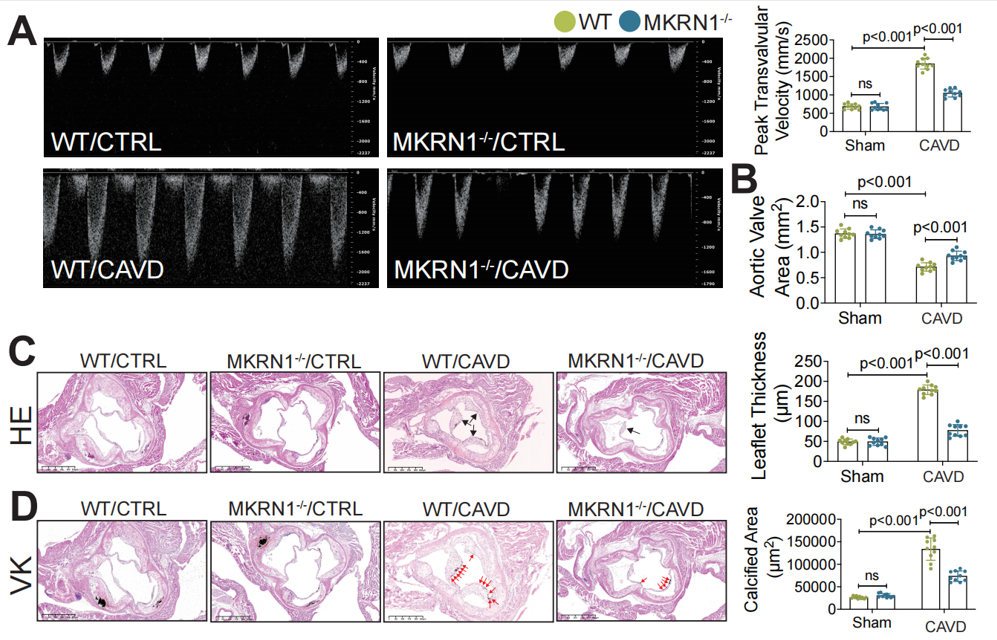
In vivo experiments, we generated MKRN1-/-/ApoE-/-mice. These 10-week-old mice were fed a high-fat diet for 6 months. Cardiac ultrasound examination at 24 weeks (Figure 2A/B), along with Hematoxylin and Eosin (H&E) staining (Figure 2C) and von Kossa (VK) staining (Figure 2D) of the aortic valves, demonstrated that MKRN1 knockout delayed the onset of calcific lesions in the mouse aortic valves.
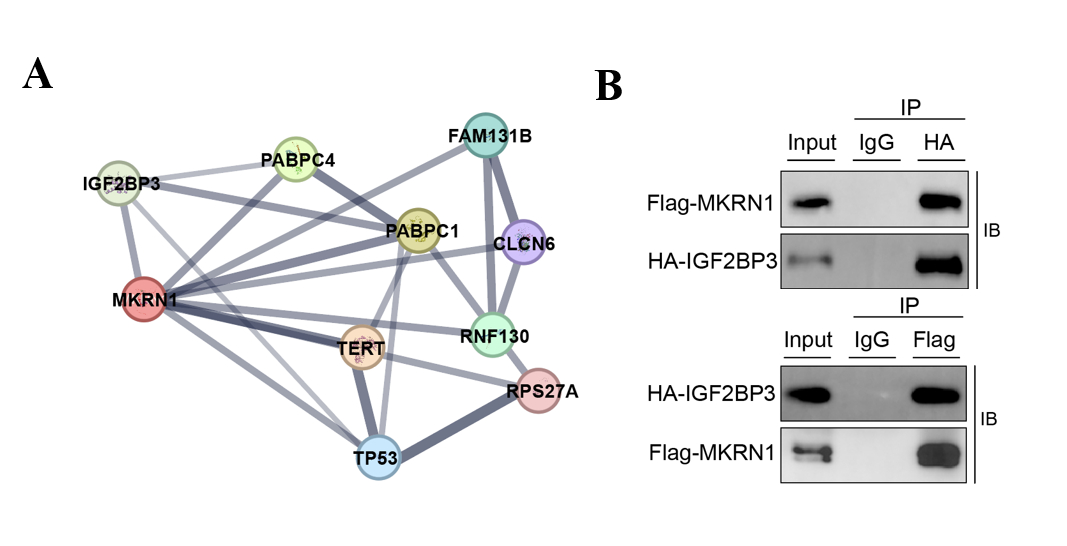
STRING protein-protein interaction (PPI) network analysis predicted proteins interacting with MKRN1, suggesting a direct interaction with IGF2BP3 (Figure 3A). This interaction was confirmed by co-immunoprecipitation(Co-IP) assays (Figure 3B).
This study reveals that MKRN1 exacerbates CAVD progression by regulating IGF2BP3 expression, providing a novel potential intervention target for CAVD treatment.
  • Miao, Jiaxin  ( Zhongshan Hospital , Shanghai , China )
  • Chen, Qixin  ( Zhongshan Hospital , Shanghai , China )
  • Fan, Jianing  ( Zhongshan Hospital , Shanghai , China )
  • Zhou, Daxin  ( Zhongshan Hospital , Shanghai , China )
  • Author Disclosures:
    Jiaxin Miao: DO NOT have relevant financial relationships | Qixin Chen: DO NOT have relevant financial relationships | Jianing Fan: DO NOT have relevant financial relationships | Daxin Zhou: No Answer
Meeting Info:

Scientific Sessions 2025

2025

New Orleans, Louisiana

Session Info:

Valve Science Spotlight: Top Research in Valve Disease

Friday, 11/07/2025 , 02:15PM - 03:30PM

Abstract Oral Session

More abstracts on this topic:
Automated IVUS Image Analysis for Cardiac Allograft Vasculopathy Surveillance in Heart Transplant Recipients

Birs Antoinette, Lyu Wenzhou, Ang Lawrence, Adler Eric, Mahmud Ehtisham, Contijoch Francisco

A Remedy for the Heart and the Hemoglobin: Improvement in Anemia Post Transcatheter Aortic Valve Replacement

Matta Raghav, Roy Aanya, Hammad Bayan, Draffen Arvind, Natsheh Zachary, Tiu Daniel, Tiu David, Salem Edward, Balami Jesse, Kalagara Swetha, Gupta Neil, Uraizee Omar, Sahgal Savina, Mishra Atreya, Ene Adriana, Hattab Aleyah, Arora Aarushi, Sufyaan Humam, Dau Trang, Silberstein Jonathan, Yu Julia, Torres Kayla, Seshadri Suhas, Navarro Laura, Singam Manisha, Ismail Mariam, Rana Riya, Habeel Samer, Liu Simon, Chaganti Srinidhi, Gurbuxani Vidur, Dwyer Kaluzna Stephanie, Groo Vicki, Carlson Andrew, Shroff Adhir, Bhayani Siddharth, Khan Azmer, Bhattaram Rohan, Zhang Runze, Shah Pal

More abstracts from these authors:
You have to be authorized to contact abstract author. Please, Login
Not Available