
The Andes Cardiac Magnetic Resonance Follow-up of a Fontan Cohort
Abstract Body (Do not enter title and authors here): Introduction/Background - Research Questions/Hypothesis: There is a notable lack of robust evidence regarding imaging follow-up in Fontan patients from resource-limited settings, where access to advanced imaging modalities remains scarce. This study aims to describe the prevalence of cardiac magnetic resonance (CMR) use, key findings, and associated clinical outcomes in a Latin American cohort of Fontan patients.
Methods/Approach: A retrospective, observational, single-center study included patients who underwent Fontan procedure completion and had an available postoperative cardiac magnetic resonance scan performed between 2006 and 2024. Data were analyzed descriptively using means ± SD, and frequencies (%).
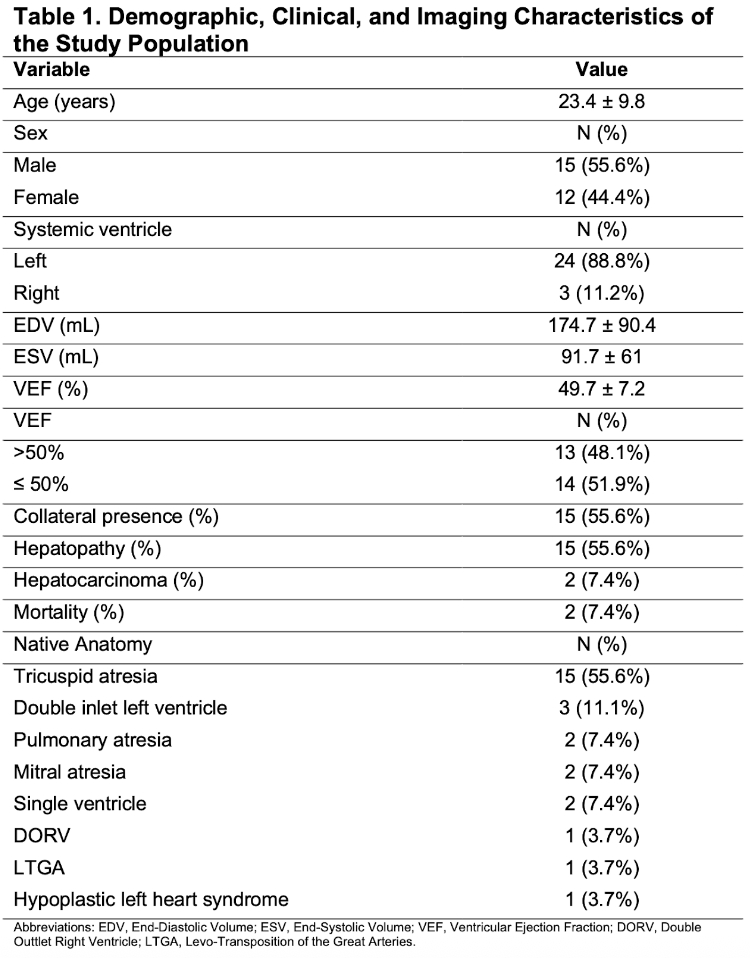
Results Of 174 Fontan surgeries performed in our center, we included 27 (12.7%) with a follow-up CMR, spanning all age groups. The cohort comprised 15 males (55.6%), with a mean age at the time of CMR of 23.4 years. The most prevalent congenital defect was tricuspid atresia (55.6%), and in 88.8% of patients, the left ventricle was the systemic ventricle. For the Fontan pathway the extracardiac conduit was the preferred surgical technique (92.5%) and fenestration was present in 48.1% of patients. CMR was performed 19 ± 7.4 years after Fontan completion, revealing a mean indexed systemic ventricular end-diastolic volume of 101.7 ± 44.9 mL/m2 and a mean indexed end-systolic volume of 52.8 ± 30.8 mL/m2. The mean ventricular ejection fraction was 49.7% ± 7.2%, and the mean cardiac index was 4.25 ± 1.78 L/min/m2. Among those with a documented fenestration, 7.4% remained patent at time of CMR. Venovenous collaterals were present in 55.5% of the cohort. With 29.6% having more than moderate atrioventricular valve regurgitation. Venovenous collaterals were identified in 55.5% of patients, and 29.6% had more than moderate atrioventricular valve regurgitation. Findings consistent with Fontan-associated liver disease were present in 55.6% of patients, and 7.4% were diagnosed with hepatocellular carcinoma all of whom died, yielding an overall mortality rate of 7.4%.
Conclusion(s): Despite limitations, our findings highlight that few Fontan patients undergo routine CMR follow-up. The high prevalence of complications suggests that CMR surveillance may be occurring too late to enable timely interventions. These results underscore the need for guideline-adherent imaging protocols to improve outcomes in this high-risk population.
Garcia-zambrano, Laura
( Fundacion Cardioinfantil-LaCardio
, Bogotá
, Colombia
)
Gutierrez-vargas, Roberto
( Liga Colombiana Contra el Infarto y la Hipertensión
, Bogotá
, Colombia
)
Casallas-gutierrez, Isabella
( Universidad del Rosario
, Bogotá
, Colombia
)
Patino, Andres
( Fundacion Cardioinfantil-LaCardio
, Bogotá
, Colombia
)
Fogel, Mark
( CHILDRENS HOSPITAL OF PHILADELPHIA
, Philadelphia
, Pennsylvania
, United States
)
Guerrero, Carlos
( Fundacion Cardioinfantil-LaCardio
, Bogotá
, Colombia
)
Author Disclosures:
Laura Garcia-Zambrano:DO NOT have relevant financial relationships
| Roberto Gutierrez-Vargas:No Answer
| Isabella Casallas-Gutierrez:DO NOT have relevant financial relationships
| Andres Patino:No Answer
| Ivonne Pineda:DO NOT have relevant financial relationships
| Mark Fogel:DO have relevant financial relationships
;
Research Funding (PI or named investigator):NIH:Active (exists now)
; Research Funding (PI or named investigator):Friedrich's Ataxia Foundation:Past (completed)
; Consultant:Law firm:Past (completed)
; Research Funding (PI or named investigator):Additional Ventures:Active (exists now)
; Research Funding (PI or named investigator):CMP Pharma:Active (exists now)
| Carlos Guerrero:DO NOT have relevant financial relationships