Logo

American Heart Association

  21
  0


Final ID: MP1239

Higher fibroblast activation protein identifies improved myocardial plasticity and positive response to cardiac resynchronization therapy

Abstract Body (Do not enter title and authors here): Background. Fibroblast activation protein (FAP) has been shown to be elevated in patients post-MI and may be associated with the development of HFrEF. However, whether and to what degree FAP levels may hold prognostic relevance with HFrEF remains unclear. One large, prospectively designed trials in terms of blood sample collection prior to CRT and subsequent follow-up after CRT was the AV delay Methods Used in CRT (SMART-AV) trial. A positive CRT response in HFrEF patients was a reduction in LV end-systolic volume (LVESV) of >.15 mL at 6 months and yielded a binary result of 52% with a positive response (Responder) and 48% without a positive response (Non-Responder). The present study tested the hypothesis that differences in baseline (pre-CRT) FAP plasma levels would be associated with CRT response at 6 months.
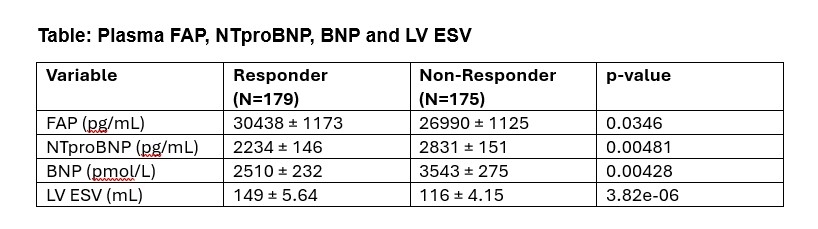
Methods and Results. Plasma samples from the SMART-AV trial were randomly selected (n=354) and plasma samples subjected to immunoassay for the soluble fragment of FAP, which represents the extracellular domain which is shed upon FAP activation. Baseline BNP and NTpro-BNP levels were also measured by immunoassay. These results as a function of CRT response are shown in Table. Using multivariable modeling, higher FAP levels were associated with a positive CTR response (p=0.007). In addition, higher FAP levels were associated with a lower LV ESV (p=0.009). Interestingly, there was an inverse relationship between plasma FAP and BNP levels (p=0.003). Using in-silco mapping a peptide sequence contained within BNP was identified as a putative substrate for BNP..
Conclusions. The unique findings from this study are 2-fold. First, higher FAP levels were associated with a positive CRT response and “reverse remodeling” indicative of greater myocardial plasticity in these HFrEF patients. Second, BNP may be a substrate for FAP and could confound diagnostic utility in HFrEF.
  • Ervin, Charlie  ( USC SCHOOL MEDICINE , Columbia , South Carolina , United States )
  • Churillo, Amelia  ( University of South Carolina SOM and Columbia VA Health System , Columbia , South Carolina , United States )
  • Freeburg, Lisa  ( University of South Carolina SOM and Columbia VA Health System , Columbia , South Carolina , United States )
  • Chalise, Sweta  ( USC SCHOOL MEDICINE , Columbia , South Carolina , United States )
  • Barringhaus, Kurt  ( University of South Carolina SOM and Columbia VA Health System , Columbia , South Carolina , United States )
  • Spinale, Francis  ( University of South Carolina SOM and Columbia VA Health System , Columbia , South Carolina , United States )
  • Author Disclosures:
    Charlie Ervin: No Answer | Amelia Churillo: DO NOT have relevant financial relationships | Lisa Freeburg: DO NOT have relevant financial relationships | Sweta Chalise: DO NOT have relevant financial relationships | Kurt Barringhaus: DO NOT have relevant financial relationships | Francis Spinale: DO NOT have relevant financial relationships
Meeting Info:

Scientific Sessions 2025

2025

New Orleans, Louisiana

Session Info:

HF Unfiltered: Basic and Clinical Insights in a Potpourri of Topics

Sunday, 11/09/2025 , 11:50AM - 01:05PM

Moderated Digital Poster Session

More abstracts on this topic:
More abstracts from these authors:
Systemic Heparin Administration Does Not Inhibit microRNA Amplification in Patients with Myocardial Infarction

Barringhaus Kurt, Slone Sarah, Prousi George, Samani Stephanie, Freeburg Lisa, Churillo Amelia, Spinale Francis

The role of fibroblast activation protein on left ventricular growth and matrix signaling as a function of age

Churillo Amelia, Freeburg Lisa, Catherwood Grayson, Maclaren Janna, Al-soudi Jumanah, Cavalli Eliana, Spinale Francis

You have to be authorized to contact abstract author. Please, Login
Not Available