
Logo

American Heart Association

  123
  0


Final ID: Mo4006

Systemic Heparin Administration Does Not Inhibit microRNA Amplification in Patients with Myocardial Infarction

Abstract Body (Do not enter title and authors here): Purpose: MicroRNAs (miRs) have been proposed as biomarkers of myocardial infarction (MI), but prior evidence has demonstrated that heparin, commonly administered to patients presenting with MI, inhibits amplification during quantitative PCR (qPCR). The purpose of this study was to determine whether qPCR amplification of miRs is reduced in plasma of patients receiving heparin and if heparinase reverses this effect.
Methods: Blood samples were collected and plasma recovered from patients with normal coronary arteries who had undergone CT coronary angiography (N=5) or who had received intravenous heparin at the time of invasive coronary angiography(N=8). Blood was also collected at the time of invasive coronary angiography from patients presenting with ST elevation MI (N=9). RT-qPCR was performed to quantify levels of 84 cardiac miRs, and Cel-miR-39-3p was utilized as a spike-in control. MiR qPCR was also performed following the addition of heparinase to plasma from 2 patients without MI treated with heparin and 2 patients presenting with MI who had received heparin.
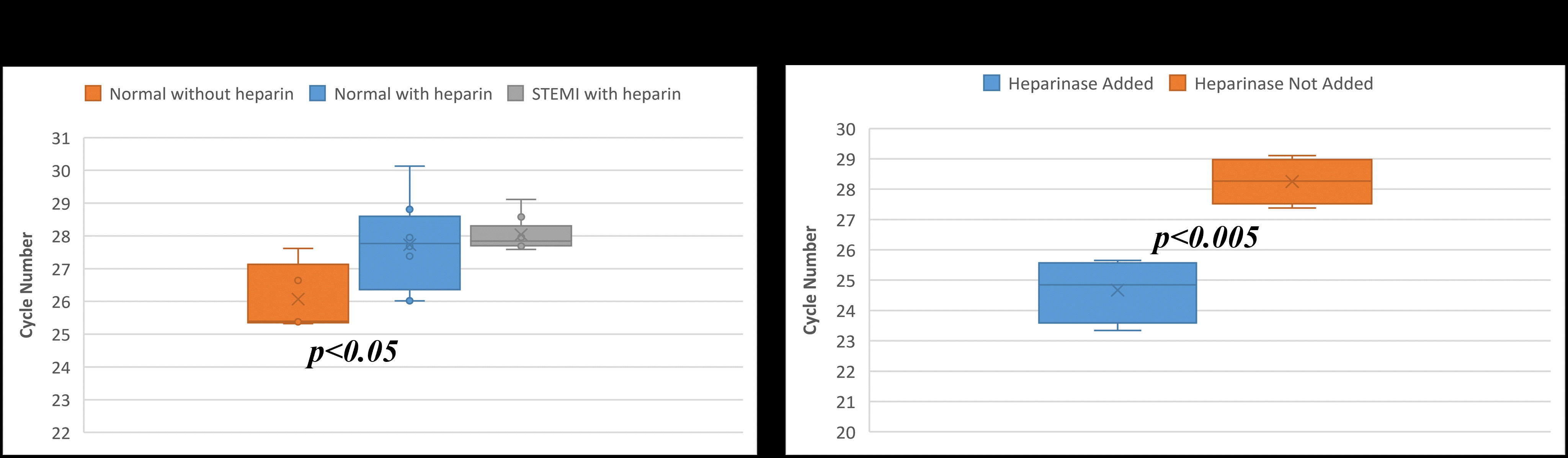
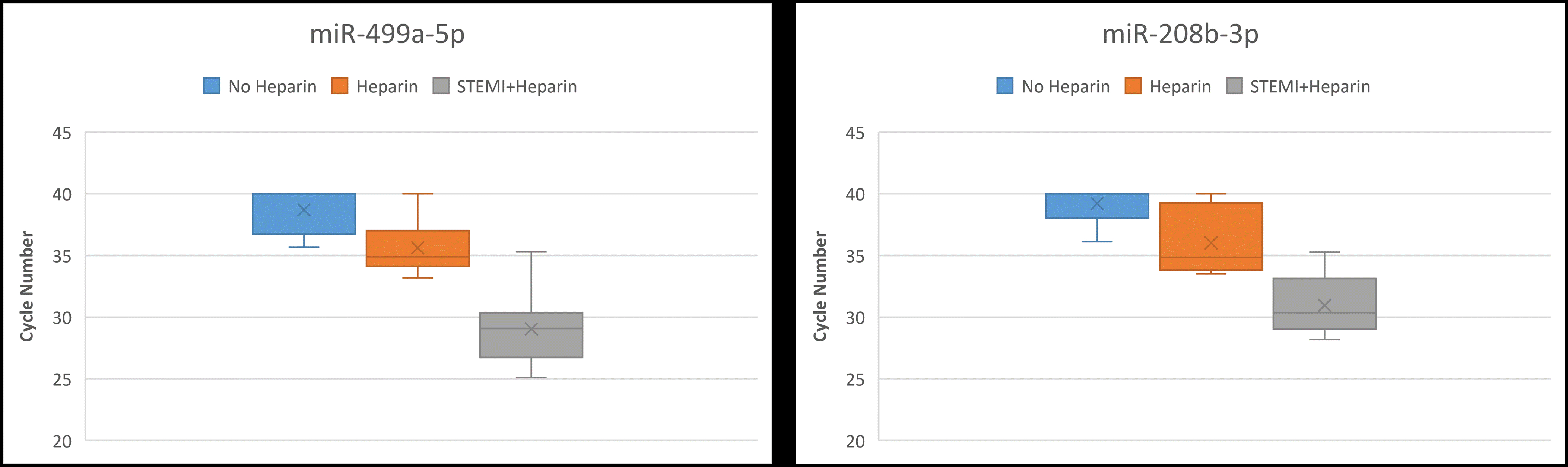
Results: Mean age of patients was 57 years, and 55% of patients were male. As compared with control patients, the cycle number for cel-miR-39-3p was significantly increased for patients receiving heparin (Figure 1a). No difference was seen in levels of cel-39-3p in heparin-treated patients with respect to the presence or absence of MI. Cel-miR-39-3p cycle times decreased when heparinase was added to samples from heparin-treated patients (Figure 1b). In contrast, heparin did not increase cycle times in any of the cardiac miRs tested, and cycle times decreased even further for miRs 499a-5p and 208b-3p in patients with MI (Figure 2).
Conclusions: Systemic heparin treatment inhibits qPCR amplification of cel-mir-39-3p but does not inhibit endogenous miR amplification under these conditions. MiRs 499a-5p and 208b-3p are potentially important candidates for MI detection and quantification.
  • Barringhaus, Kurt  ( USC SCHOOL MEDICINE , Columbia , South Carolina , United States )
  • Slone, Sarah  ( Johns Hopkins School of Nursing , Irmo , South Carolina , United States )
  • Prousi, George  ( USC SCHOOL MEDICINE , Columbia , South Carolina , United States )
  • Samani, Stephanie  ( USC SCHOOL MEDICINE , Columbia , South Carolina , United States )
  • Freeburg, Lisa  ( USC SCHOOL MEDICINE , Columbia , South Carolina , United States )
  • Churillo, Amelia  ( USC SCHOOL MEDICINE , Columbia , South Carolina , United States )
  • Spinale, Francis  ( USC SCHOOL MEDICINE , Columbia , South Carolina , United States )
  • Author Disclosures:
    Kurt Barringhaus: DO NOT have relevant financial relationships | Sarah Slone: DO NOT have relevant financial relationships | George Prousi: DO NOT have relevant financial relationships | Stephanie Samani: No Answer | Lisa Freeburg: DO NOT have relevant financial relationships | Amelia Churillo: DO NOT have relevant financial relationships | Francis Spinale: No Answer
Meeting Info:

Scientific Sessions 2024

2024

Chicago, Illinois

Session Info:

Antiplatelet and Anticoagulant Management in ACS

Monday, 11/18/2024 , 10:30AM - 11:30AM

Abstract Poster Session

More abstracts on this topic:
Circulating miRNAs are Differentially Expressed in Pediatric Dilated Cardiomyopathy Patients with Favorable vs. Poor Outcomes

Stuart Scott, Miyamoto Shelley, Lipshultz Steven, Hernandez Ana Laura, Hamza Taye, Wilkinson James, Karimpour-fard Anis, Colan Steven, Sucharov Carmen

Blood Metabolomic Atlas for One-Hour Post-Load Glucose Predicts Long-Term Glycemic Dynamics and Cardiometabolic Disease Incidence

Heianza Yoriko, Sacks Frank, Qi Lu, Kou Minghao, Wang Xuan, Sun Qi, Rood Jennifer, Bray George, Appel Lawrence, Hu Frank, Manson Joann

More abstracts from these authors:
Higher fibroblast activation protein identifies improved myocardial plasticity and positive response to cardiac resynchronization therapy

Ervin Charlie, Churillo Amelia, Freeburg Lisa, Chalise Sweta, Barringhaus Kurt, Spinale Francis

30-Day Outcomes of Dual vs Triple Antithrombotic Therapy After PCI

Meeks William, Slone Sarah, Barringhaus Kurt

You have to be authorized to contact abstract author. Please, Login
Not Available