From Donation Data to Disease Prevention: Sending 135,000 Letters as a National Outreach by the American Red Cross Improves Hypertension Control
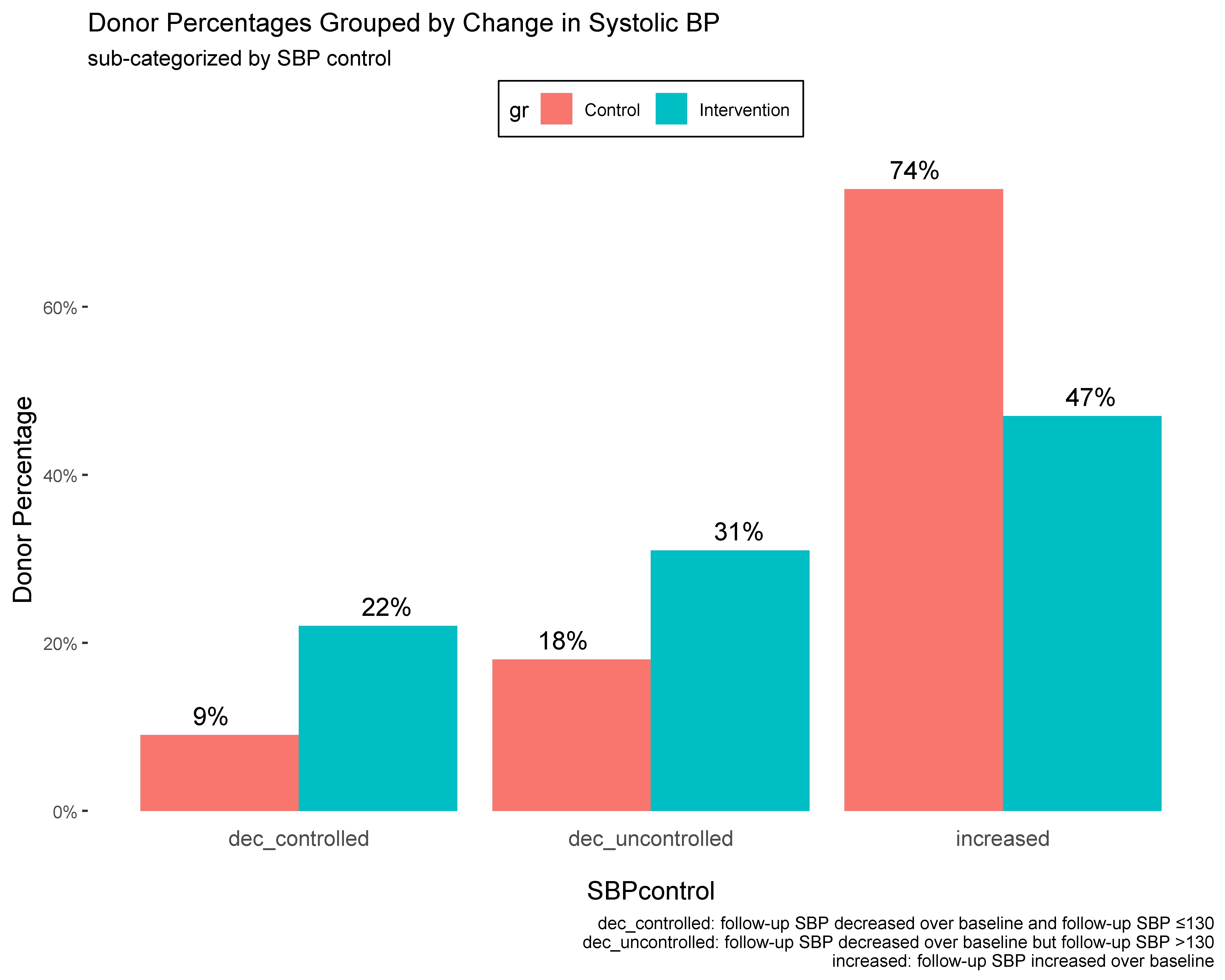
Abstract Body (Do not enter title and authors here): Background: Mandatory blood pressure (BP) screening at blood donor events generates millions of data points, yet this information is seldom used for chronic disease prevention. In June 2023, the American Red Cross (ARC) launched a nationwide mitigation effort for donors who recorded ≥ 2 consecutive BP readings ≥ 140/90 mm Hg, sending a personalized letter explaining the risks of chronic hypertension, offering evidence-based lifestyle guidance, and urging follow-up with a clinician. Herein, we provide a first look at the impact of this campaign. Methods: To date, 135,000 letters have been mailed. From this group, we identified an intervention cohort of 7,129 donors who received a notification letter and had follow-up BP data. We used 1:1 propensity score matching based on age, sex, and race to derive a control cohort of donors who also had ≥ 2 elevated systolic BP readings ( ≥ 140 mm Hg) but a diastolic BP < 90 mm Hg, did not receive a letter, and had follow-up BP data (n = 7,025 after exclusions). The change in systolic BP (ΔSBP) between baseline and the next donation (median interval = 4 months) was analyzed with chi squared tests for categorical outcomes, and multivariable linear regression and regression tree modeling for continuous ΔSBP. Results: At follow-up, SBP was lower in 53 % of letter recipients versus 27 % of controls (Figure, p < 0.001). Guideline level control (SBP < 130 mm Hg) was achieved in 22 % of the intervention group compared with 9 % of controls (p < 0.001). The intervention effect remained the strongest independent predictor of ΔSBP after adjustment for baseline BP, body mass index, and antihypertensive medication use. Among the latter, greater incremental SBP reduction at follow-up was also seen among intervention (–2.8 mm Hg; p < 0.0001) but not control donors (–1.2 mm Hg; p=0.15). Conclusions: Letters sent by the ARC to ensure awareness and education about hypertension among blood donors was associated with a clinically meaningful improvement in BP and a three-fold increase in the rate of hypertension control at follow-up. The success of this initiative focused on targeted, low-cost outreach demonstrates the untapped potential of blood donation centers to serve as scalable partners in public health by converting routine BP screening data into actionable engagement to reduce cardiovascular disease risk.
Young, Pampee
(
American Red Cross
, Brentwood , Tennessee , United States )
Singh, Umesh
(
American Red Cross
, Brentwood , Tennessee , United States )
Levy, Phillip
(
WAYNE STATE UNIVERSITY
, Detroit , Michigan , United States )
Author Disclosures:
Pampee Young:DO NOT have relevant financial relationships
| Umesh Singh:DO NOT have relevant financial relationships
| Phillip Levy:DO NOT have relevant financial relationships