
Genetic And Pharmacological Autophagy Inhibition Protects Against Autoimmune Myocarditis And Post-inflammatory Fibrosis In Mice
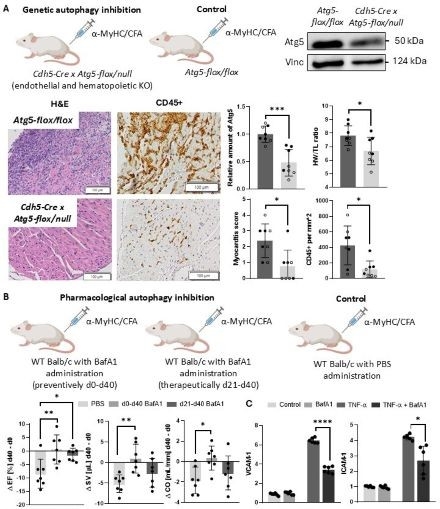
Abstract Body (Do not enter title and authors here): Background Myocarditis is a serious inflammatory heart condition that can progress to post-inflammatory dilated cardiomyopathy. Autophagy is known to regulate immune cell function and cell survival, but its role in autoimmune myocarditis remains unclear. Hypothesis We hypothesized that elevated autophagic activity contributes to disease progression in experimental autoimmune myocarditis (EAM), and that inhibition of autophagy may attenuate inflammation and preserve cardiac function. Methods To induce EAM, 6-8-week-old mice on Balb/c background were immunized with alpha myosin heavy chain (α-MyHC) emulsified in complete Freund’s adjuvant at d0 and d7. In genetic approach, three cell type-specific autophagy-haploinsufficient strains were used: hematopoietic- and endothelial-specific Cdh5-CrexAtg5-flox/null, endothelial-specific Cdh5-CreERT2xAtg5-flox/flox, and myeloid-specific LysM-CrexAtg5-flox/null, along with respective controls. In pharmacological approach, Balb/c mice were treated intraperitoneally with bafilomycin A1 (2.5 µg/injection, BafA1) every other day, either preventively (d0-40) or therapeutically (d21–40). Inflammation and fibrosis were assessed histologically on days 21 and 40. Cardiac function was measured by echocardiography on day 40 of EAM. Additionally, in vitro studies were conducted on α-MyHC-specific T cells and cardiac microvascular endothelial cells (CMVECs). T-tests and ANOVA were used for statistical comparisons, with significance set at p<0.05. Results On acute inflammatory phase (d21), Balb/c exhibited extensive CD3+ and CD45+ cell infiltration and elevated Beclin-1 and Lc3b expression in myocardial tissue. All three autophagy haploinsufficient strains showed reduced inflammation, with the strongest effect in the Cdh5-Cre x Atg5-flox/null group, which also showed reduced heart weight to tibia length ratio and cardiac CD45+ cells (Fig. 1A). Echocardiographic assessment demonstrated that preventive administration of the BafA1 mitigated left ventricular dysfunction, indicating a cardioprotective effect during the post-inflammatory phase of EAM (Fig. 1B). Complementary in vitro assays revealed that BafA1 suppressed T cell proliferation and downregulated the expression of endothelial adhesion molecules ICAM-1 and VCAM-1 in CMVECs (Fig. 1C). Conclusions These findings indicate that autophagy contributes to the pathogenesis of EAM, and its genetic and pharmacological inhibition can prevent disease onset and progression in this model.
Czepiec, Magdalena
( Jagiellonian Univeristy Collegium Medicum
, Kraków
, Poland
)
Rolski, Filip
( Jagiellonian Univeristy Collegium Medicum
, Kraków
, Poland
)
Jazwa-kusior, Agnieszka
( Jagiellonian University
, Kraków
, Poland
)
Galuszka-bulaga, Adrianna
( Jagiellonian Univeristy Collegium Medicum
, Kraków
, Poland
)
Tyszka-czochara, Malgorzata
( Jagiellonian University Medical College
, Kraków
, Poland
)
Siedlar, Maciej
( Jagiellonian Univeristy Collegium Medicum
, Kraków
, Poland
)