
Logo

American Heart Association

  22
  0


Final ID: Su3025

Demographic Patterns and Temporal Trends in Arrhythmia-Related Mortality Among U.S. Young Adults: A 22-Year CDC WONDER Analysis

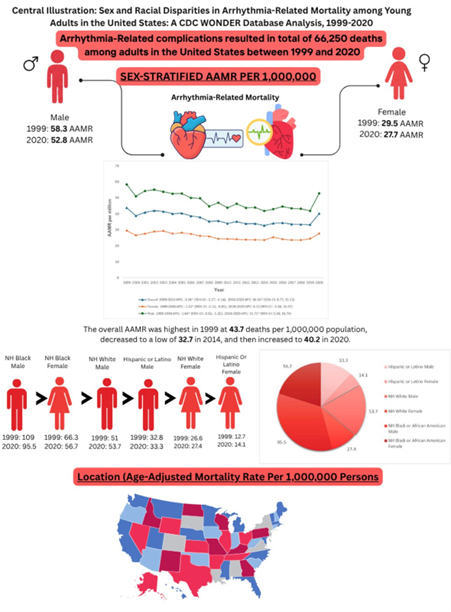
Abstract Body (Do not enter title and authors here): Background: Arrhythmias represent a broad spectrum of abnormal heart rhythms that can range from benign to life-threatening. While often associated with older populations, arrhythmia-related morbidity and mortality in younger adults (aged 25-44) remain an important public health concern due to the potential for sudden cardiac death and chronic complications. Understanding how these mortality trends have evolved over time and whether disparities exist by sex and race is critical for developing targeted prevention and intervention efforts. Prior studies have highlighted differences in cardiovascular outcomes across demographic groups, but limited data exist specifically for arrhythmia-related deaths in young adults. This study aims to identify trends and demographic disparities in arrhythmia-related deaths among U.S. young adults.

Methods: Mortality data were obtained from the CDC WONDER database. Arrhythmia-related deaths were identified using ICD-10 codes I47-I49. We calculated age-adjusted mortality rates (AAMRs) per 1,000,000 individuals and evaluated trends over time using Joinpoint regression to estimate annual percent changes (APCs) and corresponding 95% confidence intervals.

Results: A total of 66,250 arrhythmia-related deaths were recorded among young adults during the study period, with 43,033 deaths among men and 23,217 among women. The overall mean AAMR was considerably higher in men (48.2 per million) than in women (26.0 per million). From 1999 to 2018, both sexes experienced a gradual decline in AAMRs (APC for men: -1.64%; women: -1.22%). However, this downward trend reversed between 2018 and 2020, with a notable increase in mortality. Marked disparities were observed across racial and ethnic groups. Non-Hispanic Black men had the highest mean AAMR (87.3), followed by non-Hispanic White men (49.5) and Hispanic men (24.3). Among women, the highest mean AAMR was also seen in non-Hispanic Black individuals (51.4), compared to non-Hispanic White women (26.2) and Hispanic women (10.6). These differences remained consistent over time and were most pronounced in recent years.

Conclusion: Despite earlier improvements, arrhythmia-related mortality among young adults has increased in recent years, particularly after 2018. Men and non-Hispanic Black individuals are disproportionately affected, underscoring the urgent need for targeted public health strategies to reduce these persistent disparities and improve outcomes for at-risk populations.
  • Meer, Komail Khalid  ( Dow University of Health Sciences , Karachi , Pakistan )
  • Khan, Abdul Wali  ( University of Missouri Kansas City , Kansas City , Missouri , United States )
  • Ullah, Irfan  ( Khyber Teaching Hospital , Peshawar , Pakistan )
  • Khan, Umar  ( Dow University of Health Sciences , Karachi , Pakistan )
  • Abdelkhalek, Ahmad  ( RFU- Northwestern McHenry Hospital , McHenry , Illinois , United States )
  • Hasan, Minal  ( Dow University of Health Sciences , Karachi , Pakistan )
  • Latif, Fakhar  ( Dow University of Health Sciences , Karachi , Pakistan )
  • Khan, Saifullah  ( Dow Medical College , Karachi , Pakistan )
  • Shuja, Muhammad Hamza  ( dow university of health sciences, , Karachi , Pakistan )
  • Shahid, Ahmad  ( DOW University of Health Sciences , Karachi , Pakistan )
  • Usmani, Taimur Faheem  ( Dow University of Health Sciences , Karachi , Pakistan )
  • Author Disclosures:
    Komail Khalid Meer: DO NOT have relevant financial relationships | Abdul Wali Khan: DO NOT have relevant financial relationships | Irfan Ullah: DO NOT have relevant financial relationships | Umar Khan: DO NOT have relevant financial relationships | Ahmad Abdelkhalek: DO NOT have relevant financial relationships | Minal Hasan: No Answer | Fakhar Latif: No Answer | Saifullah Khan: DO NOT have relevant financial relationships | Muhammad Hamza Shuja: DO NOT have relevant financial relationships | Ahmad Shahid: DO NOT have relevant financial relationships | Taimur Faheem Usmani: No Answer
Meeting Info:

Scientific Sessions 2025

2025

New Orleans, Louisiana

Session Info:

Population Science and Arrhythmia Trends

Sunday, 11/09/2025 , 03:15PM - 04:15PM

Abstract Poster Board Session

More abstracts on this topic:
A Simple One-Item Nursing Falls Assessment Predicts Outcomes For Patients With Stage D Heart Failure Undergoing Surgical Advanced Therapies

Salvador Vincent, Perez Jaime Abraham, Hudec Paige, Gorodeski Eiran, Oneill Thomas

A Contemporary Machine Learning-Based Risk Stratification for Mortality and Hospitalization in Heart Failure with Preserved Ejection Fraction Using Multimodal Real-World Data

Fudim Marat, Weerts Jerremy, Patel Manesh, Balu Suresh, Hintze Bradley, Torres Francisco, Micsinai Balan Mariann, Rigolli Marzia, Kessler Paul, Touzot Maxime, Lund Lars, Van Empel Vanessa, Pradhan Aruna, Butler Javed, Zehnder Tobias, Sauty Benoit, Esposito Christian, Balazard Félix, Mayer Imke, Hallal Mohammad, Loiseau Nicolas

More abstracts from these authors:
Global Trends in Congenital Heart Disease Mortality: A 31-Year Analysis from the Global Burden of Disease Study (1990–2021)

Khan Wajeeh, Siddiqui Saim, Chigurupati Himaja Dutt, Shahid Ahmad, Khan Wajeeha, Hameed Arooba, Khan Umar, Naveed Muhammad Abdullah, Neppala Sivaram

Trends In Stroke Mortality due to Hypertension Among Older Adults In The United States From 1999-2020

Shahid Ahmad, Kumar Mukesh, Latif Fakhar, Meer Komail, Shaikh Abdul Wassay, Mubbashir Ayesha, Usmani Taimur Faheem, Ahmed Huda, Nasir Muhammad Moiz, Shaikh Naeemuddin

You have to be authorized to contact abstract author. Please, Login
Not Available