
Logo

American Heart Association

  24
  0


Final ID: Su2097

Neighborhood-Level Gentrification and Rates of ST-Elevation Myocardial Infarction

Abstract Body (Do not enter title and authors here): Background: Despite advances in preventive cardiology, there remain differences in ST Elevation Myocardial Infarction (STEMI) rates among certain populations and across neighborhoods. While gentrification is an important neighborhood-level factor that may contribute to disparities, no studies have examined the relationship between gentrification and STEMI. We sought to analyze the change in STEMI rates over time for gentrifying neighborhoods compared to non-gentrifying, stably low-SES neighborhoods.

Methods: This retrospective cohort study included all emergency medical service STEMI activations occurring within low-SES census tracts (i.e. tracts susceptible to gentrification) in Los Angeles County from 2011-2019. Low-SES tracts that did or did not gentrify in 2015-2019 were defined using American Community Survey data following methods from the Urban Displacement Project. The outcome was rate of STEMI activations per 1000 tract residents. Multivariable Poisson regression was performed to assess the association of gentrification with change in STEMI rates between baseline (2011-2014) and follow-up (2015-2019), adjusted for demographics. As displacement is an inherent characteristic of gentrification, we performed subgroup analyses comparing tracts with the lowest and highest quartiles of geographic mobility, a characteristic sourced from the American Community Survey.

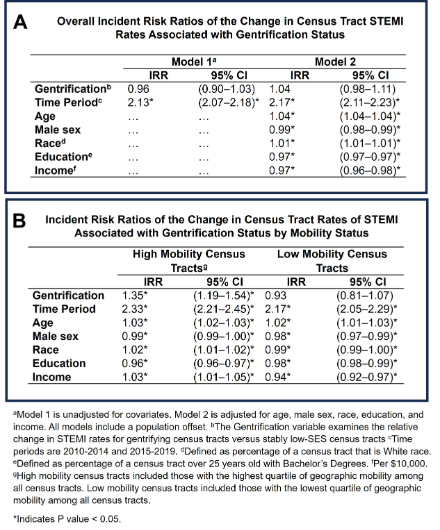
Results: A total of 868 low-SES census tracts in Los Angeles County were included, of which 128 gentrified in the 2015-2019 time period while 740 remained low-SES. Multivariable analysis found no significant change in STEMI rates in gentrifying versus stably low-SES tracts. Subgroup analysis found that among tracts in the highest quartile of mobility (213 tracts), STEMI rates were 35% higher in gentrifying versus stably low-SES tracts (95% CI 19%-54%), with no differences in low-mobility tracts.

Conclusion: There was no significant association between gentrification and neighborhood STEMI rates. However, among neighborhoods with high levels of displacement, STEMI rates were higher among gentrifying tracts. Changing group composition due to displacement may result in declining social cohesion among remaining residents, which is a known protective factor against myocardial infarction. Future work is needed to clarify this relationship, understand subgroups that differentially experience gentrification, and determine mechanisms through which gentrification affects cardiovascular health.
  • Zhang, Neil  ( CEDARS-SINAI MEDICAL CENTER , West Hollywood , California , United States )
  • Chen, Katherine  ( UCLA , Los Angeles , California , United States )
  • Zimmerman, Frederick  ( UCLA , Los Angeles , California , United States )
  • Huang, Tzu Yu  ( CEDARS-SINAI MEDICAL CENTER , West Hollywood , California , United States )
  • Botting, Patrick  ( CEDARS-SINAI MEDICAL CENTER , West Hollywood , California , United States )
  • Ebinger, Joseph  ( Cedars-Sinai Smidt Heart Institute , Los Angeles , California , United States )
  • Author Disclosures:
    Neil Zhang: DO NOT have relevant financial relationships | Katherine Chen: DO NOT have relevant financial relationships | Frederick Zimmerman: No Answer | Tzu Yu Huang: DO NOT have relevant financial relationships | Patrick Botting: DO NOT have relevant financial relationships | Joseph Ebinger: DO have relevant financial relationships ; Consultant:Edwards LifeSciences:Past (completed)
Meeting Info:

Scientific Sessions 2025

2025

New Orleans, Louisiana

Session Info:

Signals in the Noise: Uncovering Hidden Gaps in Cardiovascular Risk and Care

Sunday, 11/09/2025 , 03:15PM - 04:15PM

Abstract Poster Board Session

More abstracts on this topic:
A Perfect Storm: Simultaneous Pulmonary Embolism, STEMI, and Stroke via Paradoxical Embolism in a Hospitalized Patient on DVT Prophylaxis

Khan Abdul Allam, Thukral Jatin, Elgabry Ibrahim, Lamp Garron

Absence of standard modifiable risk factors (SMuRF-less) among 5002 Middle Eastern patients with atherosclerotic cardiovascular disease: (Interim analysis from the Jo-SMuRF Study)

Aldalal'ah Mo'men, Hammoudeh Ayman, Hamza Ibrahem, Alqudah Mohammad, Khasawneh Hasan, Alomari Sawsan, Alomari Ahmad, H. Assaf Sarah, Zaqqa Ayah, Khatatbeh Moawiah

More abstracts from these authors:
Correlates of Nocturnal Hypertension in a Real-World Cohort

Zhang Neil, Huang Tzu Yu, Dhruva Sanket, Cheng Susan, Ebinger Joseph

Adherence to First Line Antihypertensive Medication Prescription Recommendations by Race

Nguyen Andrew, Le Jonathan, Huang Tzu Yu, Botting Patrick, Cheng Susan, Ebinger Joseph

You have to be authorized to contact abstract author. Please, Login
Not Available