Risk Stratification After Myocardial Infarction: Functional Recovery is More Important Than Tissue Recovery
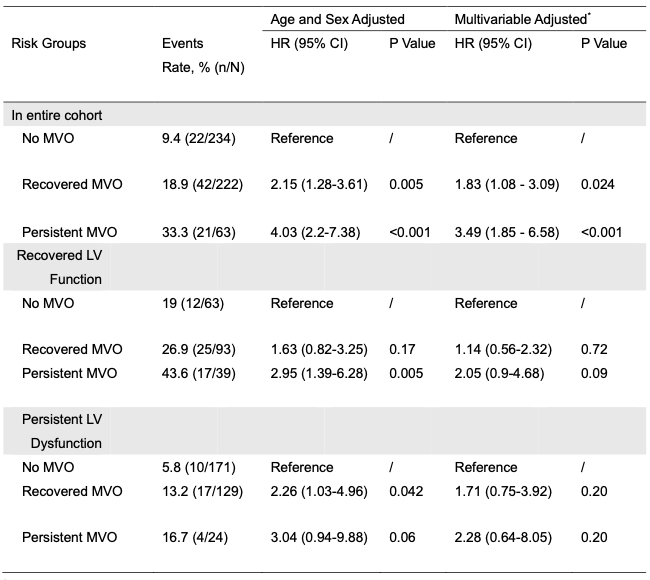
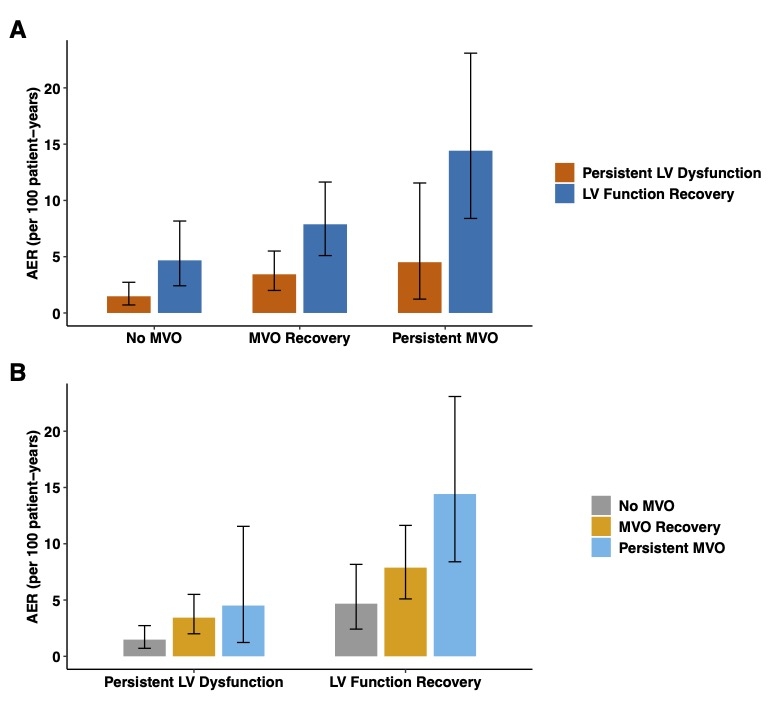
Abstract Body (Do not enter title and authors here): Background: Microvascular obstruction (MVO) and LVEF are key prognostic factors post-STEMI. Although persistent MVO often correlates with poorer LVEF, MVO resolution (tissue recovery) frequently mismatches LVEF improvement (functional recovery). This discordance raises a critical question: should the tissue level recovery or the functional level recovery be the primary focus in the long-term management? Aims: This study aimed to determine whether follow-up MVO status or LVEF recovery holds greater prognostic value for major adverse cardiovascular events (MACE) after STEMI. Methods: This is a post-hoc analysis from the prospective EARLY-MYO-CMR registry (NCT03768453). 519 consecutive reperfused STEMI patients were enrolled who underwent cardiac magnetic resonance at a median 5 days (acute) and 175 days (follow-up). Based on baseline and follow-up scans, patients were classified by MVO status (No MVO, MVO Recovery, or Persistent MVO) and LV functional recovery (LVEF 50%, functional recovery; <50%, persistent dysfunction). The primary endpoint was major adverse cardiovascular events (MACE: all-cause death, non-fatal MI, or heart failure hospitalization). Results: Among 519 patients (87% male, mean age 59±11-year-old), 85 patients (16%) experienced MACE over a median 3.8 years. After adjusting for known cardiovascular risk factors, persistent LV dysfunction (HR: 2.40, 95% confidence interval [CI]:1.10 - 3.68, P=0.022) remained strongly associated with MACE after adjusting for MVO status and other risk factors. Persistent LV dysfunction persistently predicts worse outcome across all MVO strata (P for interaction=0.83). The prognostic significance of MVO Recovery observed in simpler models was attenuated and became non-significant after adjusting for LV functional recovery (HR 1.42, 95% CI 0.83-2.43, P=0.20). While Persistent MVO remained an independent risk factor (HR 2.24, 95% CI 1.14-4.39, P=0.019), mediation analysis revealed that the beneficial effect of MVO recovery on MACE was largely mediated through LVEF improvement (proportion of mediation 24%, 95%CI: 10%-51%, P<0.001). Conclusions: LV function in follow-up is a more robust and potentially more critical determinant of long-term prognosis than MVO status after STEMI. These data support focusing surveillance and treatment on optimizing LV function, especially when serial CMR for tissue recovery is impractical.
Xiang, Jin-yi
(
Shanghai Jiao Tong University School of Medicine Affiliated Renji Hospital
, Shanghai , China )
Wu, Lian-ming
(
Shanghai Jiao Tong University School of Medicine Affiliated Renji Hospital
, Shanghai , China )
Author Disclosures:
Jin-Yi Xiang:DO NOT have relevant financial relationships
| Lian-Ming Wu:No Answer