
Logo

American Heart Association

  23
  0


Final ID: MP1217

Mechanical Chest Compressions are Associated with Worse Outcomes When Compared to Manual Chest Compressions during In-Hospital Cardiac Arrests

Abstract Body (Do not enter title and authors here): Background:
Early high-quality chest compressions in cardiopulmonary resuscitation (CPR) are critical to in-hospital cardiac arrests (IHCA). Studies report suboptimal CPR during IHCA due to inadequate compression depth, interruption, and rescuer fatigue. Mechanical chest compression devices, such as the Lund University Cardiopulmonary Assist System (LUCAS), are designed to deliver consistent compressions and proposed to improve perfusion. Trials evaluating these devices focus on out-of-hospital cardiac arrests and show no survival benefit. Data on use of these devices during IHCA is limited and their role remains unclear.

Research Question:
Do mechanical chest compressions impact outcomes of IHCA compared to manual chest compressions?

Methods:
We conducted a retrospective review of 61 IHCA between April 1, 2024 and April 1, 2025. Cardiac arrests in the Emergency Department prior to admission were excluded. Comorbidities, type of arrest, and the Good Outcome Following Attempted Resuscitation (GO-FAR) score were collected. The primary outcome was return of spontaneous circulation (ROSC). Secondary outcomes included survival and Cerebral Performance Category (CPC) score on discharge. Statistical analysis included exploratory logistic regression for primary outcomes and T-tests, Mann-Whitney U tests, or one-way ANOVA for continuous variables. Two-tailed p-value <0.05 was statistically significant.

Results:
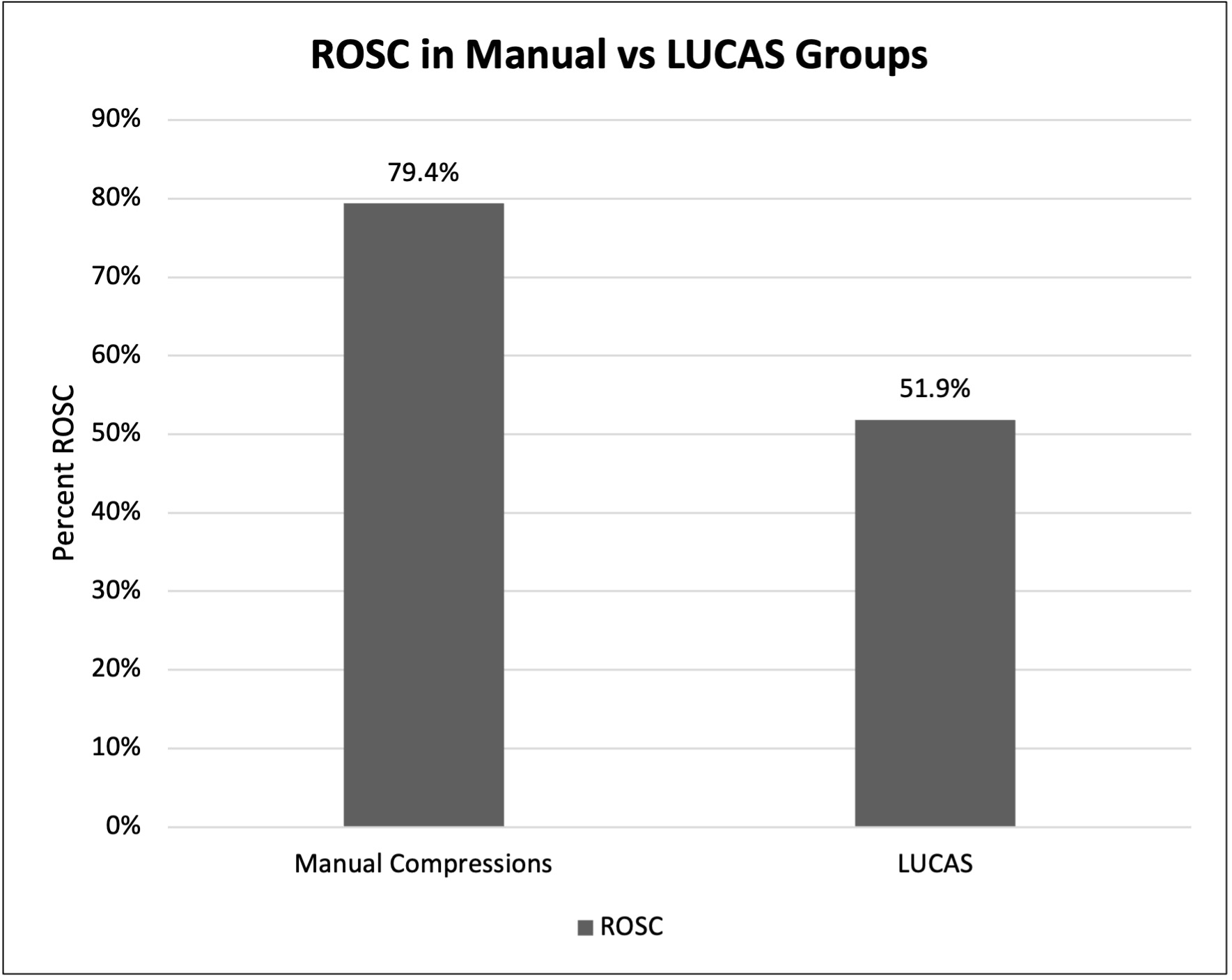
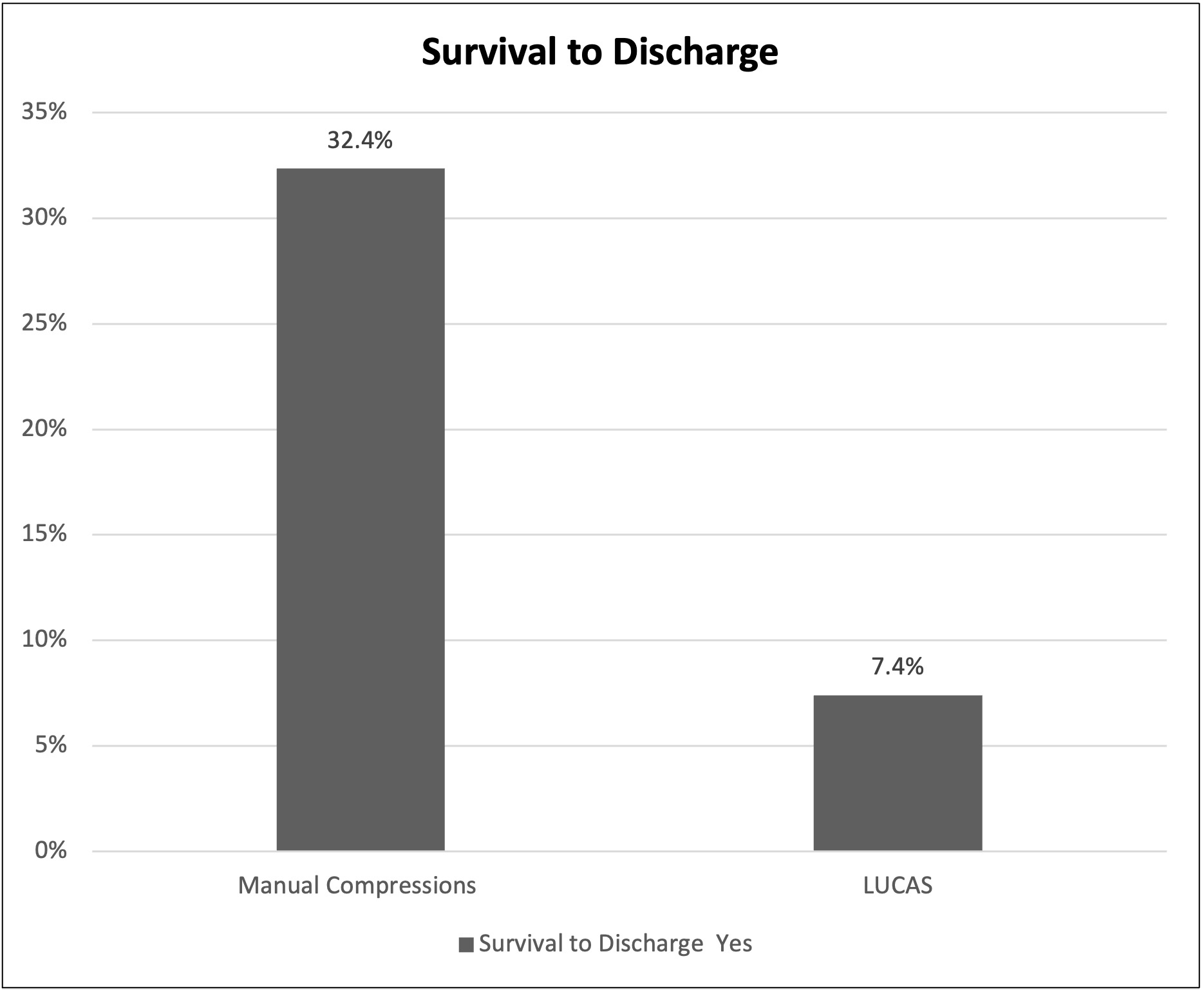
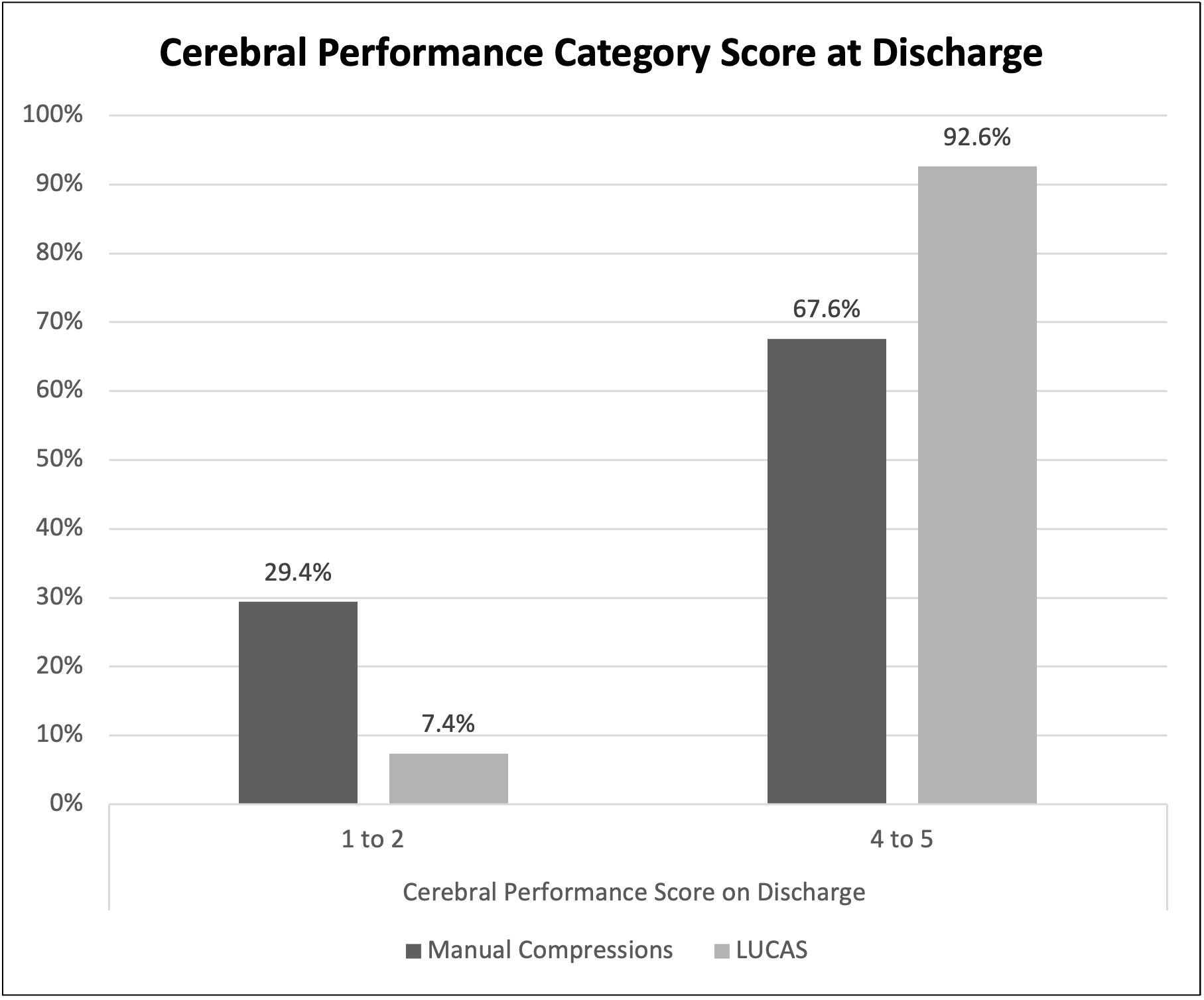
Of 61 IHCA, 56%(n=34) received manual compressions and 44%(n=27) received mechanical compressions via LUCAS. GO-FAR scores did not differ between groups, indicating similar predicted survival and neurologic outcome. ROSC was significantly higher in the manual group(79.4% vs. 51.9%, p=0.03). The LUCAS group had lower survival to discharge(7.4% vs. 32.4%, p=0.027) and worse neurologic outcomes(p=0.011). Mean CPR duration was longer in the LUCAS group(28 vs. 17 minutes, p=0.004). Lower odds of survival remained in the LUCAS group when adjusting for CPR time, though not significant(p=0.088).

Conclusion:
Mechanical compressions were associated with lower rates of ROSC and survival to discharge compared to manual compressions. CPR duration was longer with LUCAS, though the underlying cause for this remains unclear. These findings suggest mechanical compressions do not provide benefit during IHCA. Further investigation with larger cohorts and standardized documentation of device use and deployment are needed to guide the use of mechanical compressions during IHCA.
  • Seward, Katelyn  ( Scripps Mercy Hospital San Diego , San Diego , California , United States )
  • Akcam, Annaelle  ( Scripps Mercy Hospital San Diego , San Diego , California , United States )
  • Puglisi, Leah  ( Scripps Mercy Hospital San Diego , San Diego , California , United States )
  • Wong, Steven  ( Scripps Mercy Hospital San Diego , San Diego , California , United States )
  • Author Disclosures:
    Katelyn Seward: DO NOT have relevant financial relationships | Annaelle Akcam: DO NOT have relevant financial relationships | Leah Puglisi: DO NOT have relevant financial relationships | Steven Wong: No Answer
Meeting Info:

Scientific Sessions 2025

2025

New Orleans, Louisiana

Session Info:

From Collapse to Comeback: Cutting Edge Advances in Cardiac Arrest

Sunday, 11/09/2025 , 03:15PM - 04:25PM

Moderated Digital Poster Session

More abstracts on this topic:
Adapting Chest Compressions to Variable Chest Dynamics in Out-of-Hospital CPR

Uriguen Jose Antonio, Leturiondo Mikel, Daya Mohamud, Russell James

A Case of Successful Resuscitation After Out-of-hospital Cardiac Arrest Caused by Undiagnosed Pheochromocytoma-induced Cardiomyopathy

Hatakeyama Toshihiro, Suetsugu Yusuke, Watanabe Kaoru, Matsushima Hisao

You have to be authorized to contact abstract author. Please, Login
Not Available