
Logo

American Heart Association

  16
  0


Final ID: Mo3028

Cardiopulmonary Resuscitation Coach Training with Modified Resuscitation Cart Improves Provider Knowledge and Perception of Pediatric Resuscitation Efficiency

Abstract Body (Do not enter title and authors here):
Background: High-quality cardiopulmonary resuscitation (CPR) is critical for survival after pediatric cardiac arrest, yet adherence to guideline metrics and timely utilization of equipment remain inconsistent. CPR coaches have been described to improve CPR quality; however, a standardized training approach has not been defined. We sought to develop and implement a streamlined CPR coach training program using multimedia education and rapid cycle deliberate practice simulations to enhance adherence to resuscitation guidelines and CPR quality. Concurrently, a dedicated bedside CPR Cart was introduced to improve resuscitation ergonomics and efficiency.

Objectives: To evaluate the impact of CPR coach training on provider knowledge and perceptions of pediatric resuscitation efficiency using the CPR Cart compared to a traditional pediatric crash cart.

Methods: A cross-sectional survey was distributed to frontline physicians, advanced practice providers, nurses, and respiratory therapists at a large, tertiary pediatric hospital. The survey assessed demographics, CPR knowledge, and perceptions of the CPR coach and CPR Cart. Respondents were categorized as CPR coach-trained or non-trained. Mann-Whitney U and McNemar tests were applied where appropriate to compare knowledge scores, preparedness as the role of CPR coach, and perceptions of the CPR Cart versus a traditional pediatric crash cart.

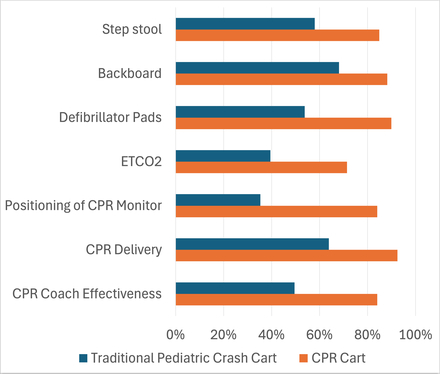
Results: Among 226 responses, 56 (25%) had participated in dedicated CPR coach training. CPR coach-trained individuals scored higher on knowledge of key CPR principles compared to non-trained individuals (median 93% vs 64%, p < 0.001). Trained staff reported higher preparedness (range 0-100) to assume the role of CPR coach than those who had not been trained (median 87 vs 25, p <0.001). Among those who had experience with both the CPR Cart and the traditional pediatric crash cart (n = 119), the CPR Cart was preferred over the traditional pediatric crash cart (p < 0.001), with respondents rating it higher for rapid equipment access, positioning, and workflow efficiency during CPR (Figure 1).

Conclusions: A structured CPR Coach training program improves provider CPR knowledge and enhances perceptions of resuscitation effectiveness. The streamlined bedside CPR Cart further optimizes the reported efficiency of pediatric resuscitations. Future research should explore the longitudinal impact of these interventions on real-time clinical performance and survival outcomes.
  • Daigle, Hunter  ( University of Texas at Austin , Austin , Texas , United States )
  • Earp, Ada  ( University of Texas at Austin , Austin , Texas , United States )
  • Puro, Amanda  ( University of Texas at Austin , Austin , Texas , United States )
  • Stanford, Holli  ( Dell Children's Medical Center , Austin , Texas , United States )
  • Truty, Erin  ( Dell Children's Medical Center , Austin , Texas , United States )
  • Yuan, Yingchao  ( University of Texas at Austin , Austin , Texas , United States )
  • Author Disclosures:
    Hunter Daigle: DO NOT have relevant financial relationships | Ada Earp: No Answer | Amanda Puro: DO NOT have relevant financial relationships | Holli Stanford: No Answer | Erin Truty: No Answer | Yingchao Yuan: No Answer
Meeting Info:

Scientific Sessions 2025

2025

New Orleans, Louisiana

Session Info:

Potpourri 3: Pediatric and Congenital Cardiology

Monday, 11/10/2025 , 10:30AM - 11:30AM

Abstract Poster Board Session

More abstracts on this topic:
Airway Opening Index is Associated with Return of Spontaneous Circulation in Swine and Humans with Cardiac Arrest

Bhandari Shiv, Coult Jason, Sharpe Zachary, Rea Thomas, Neumar Robert, Hsu Cindy, Counts Catherine, Sayre Michael, Johnson Nicholas

Accounting for the First, First Responder: Dispatch Audio Analysis Reveals Higher Bystander CPR Rates Than EMS Records

Palatinus Helen, Felker Ashlynn, Colton Tate, Youngquist Scott

You have to be authorized to contact abstract author. Please, Login
Not Available