Prognostic value of Markis classification in patients with coronary ectasia after an acute coronary syndrome: a single-center retrospective cohort study
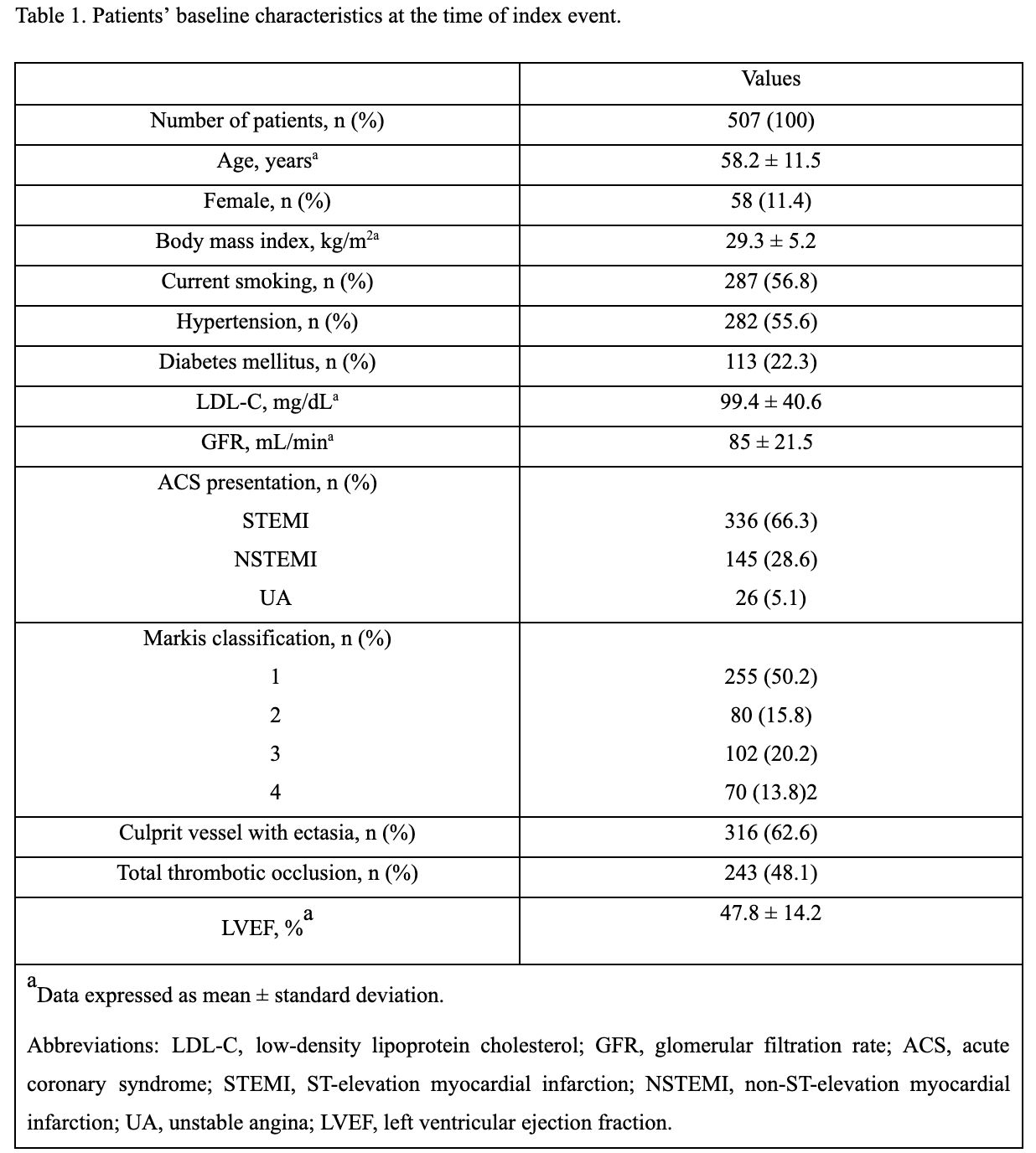
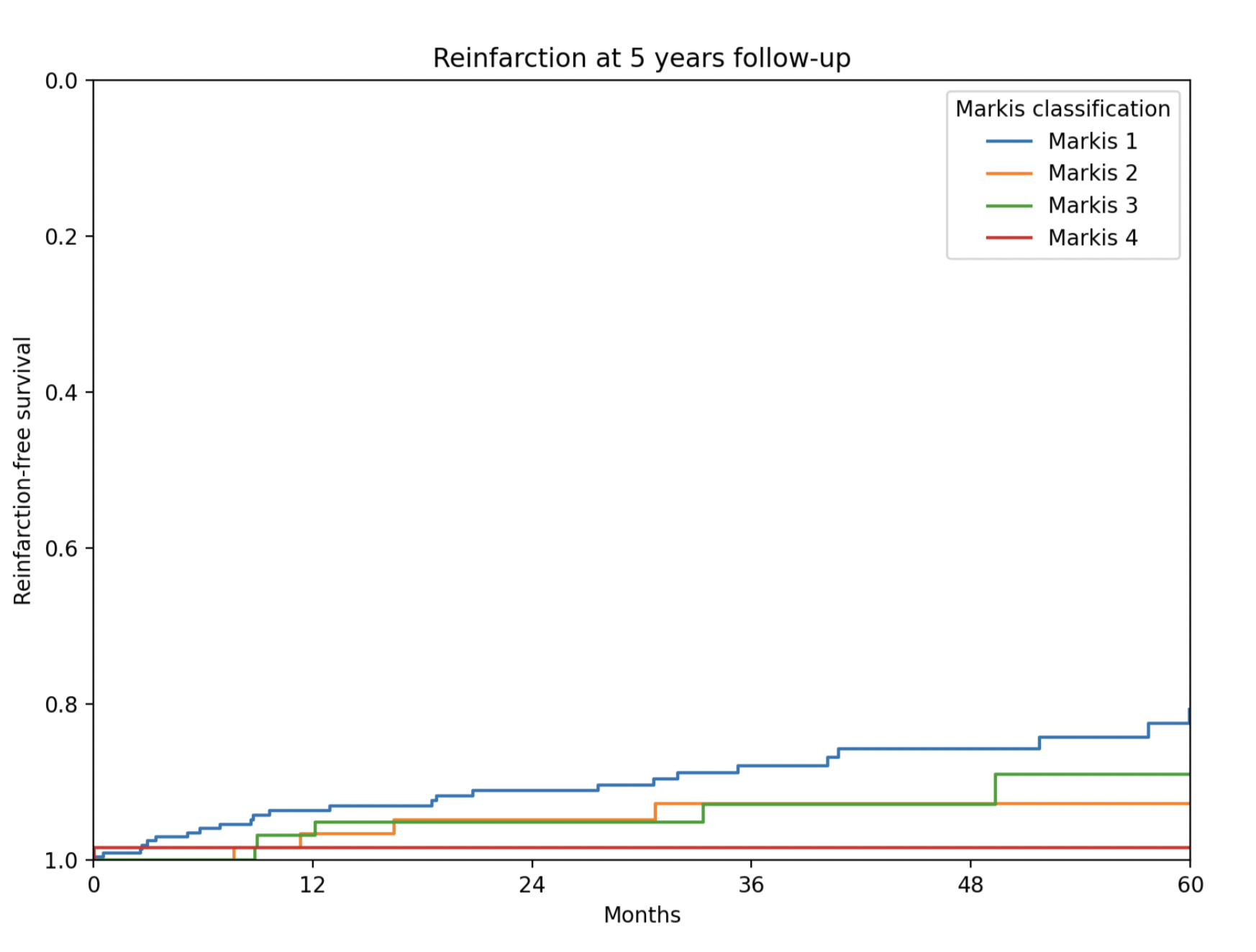
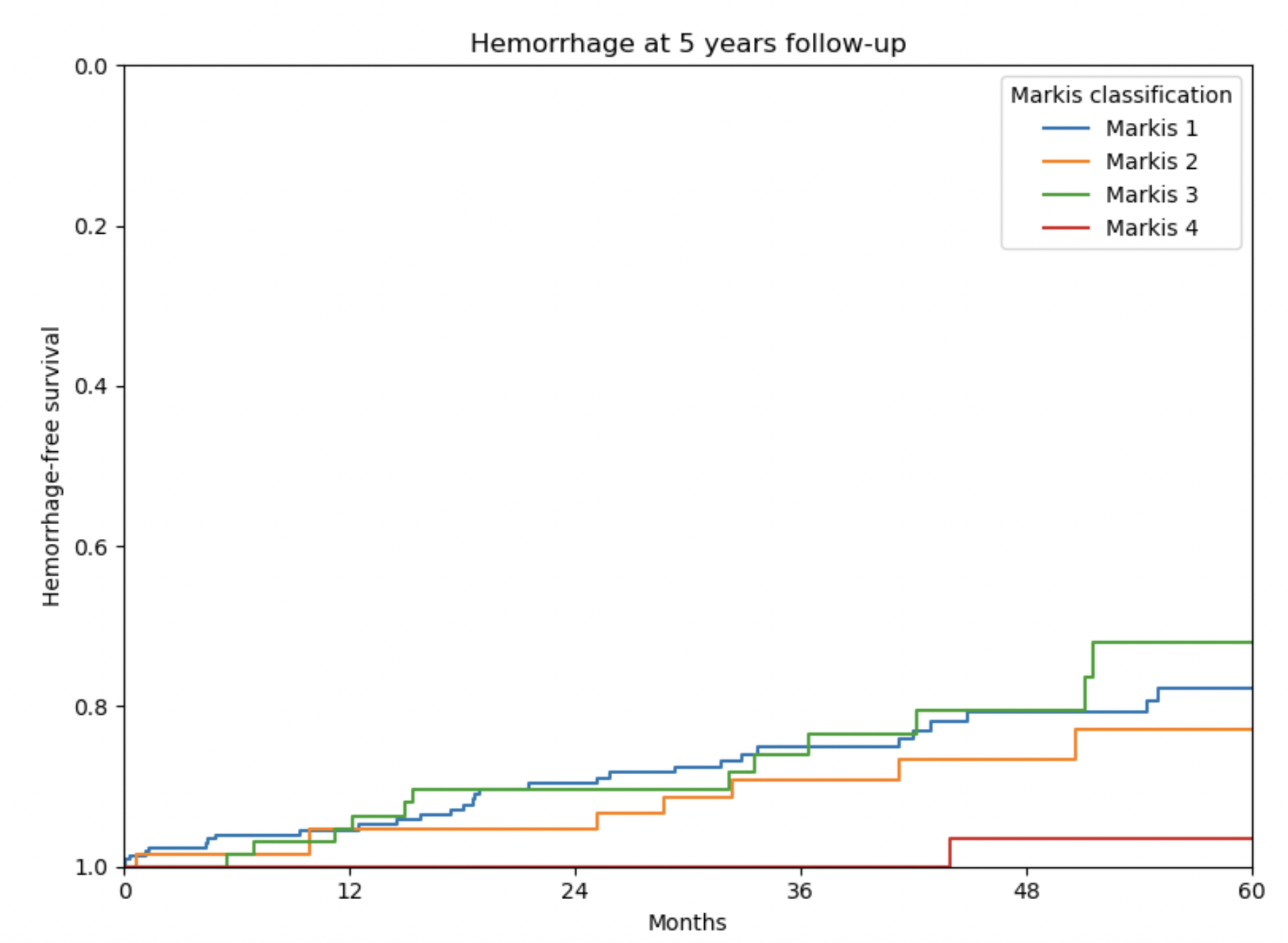
Abstract Body (Do not enter title and authors here): Introduction Coronary ectasia (CE) is defined as a diffuse dilatation of the coronary arteries, in which the diameter is ≥50% greater than that of the adjacent segment. In a consecutive series of patients with ST-elevation myocardial infarction (STEMI) at our center, the prevalence of CE was 10.3%. The extent of CE is commonly described using the Markis classification. However, the association between CE extent and long-term clinical outcomes following an acute coronary syndrome (ACS) has not been clearly established. Hypothesis The extent of CE, as assessed by the Markis classification, is associated with recurrent infarction and bleeding events after an ACS. Methods We conducted a retrospective cohort study of patients diagnosed with ACS and angiographic evidence of CE between January 2001 and December 2021. Re-infarction and bleeding events were assessed through the last follow-up (defined as the last documented visit to the outpatient clinic or emergency department). Event-free survival was estimated using the Kaplan–Meier method, and differences between groups were evaluated with the log-rank test. Results A total of 507 patients were included. The mean follow-up was 31.4 months (4.3–53.8). During the 5-year follow-up, 46 patients (9%) experienced re-infarction. In 34 of these cases (75.6%), the culprit vessel was ectatic. Overall, the most frequently involved vessel was the right coronary artery. Event distribution by Markis classification was as follows: 31 (67.4%) patients with Markis type 1, 5 (10.9%) with type 2, 6 (13%) with type 3, and 4 (8.7%) with type 4. Compared to Markis type 1, the hazard ratio (HR) for re-infarction was 0.43 (p = 0.12) for type 2, and 0.12 (p = 0.04) for type 4. Hemorrhagic events occurred in 51 patients (10%), with 27 (5%) classified as moderate to severe bleeding. Distribution by Markis type was: 30 (11.8) patients with type 1, 8 (10) with type 2, 12 (11.8) with type 3, and 1 (1.5) with type 4. Compared to Markis type 1, the HR for hemorrhage was 0.33 (p = 0.40) for type 2, 1.09 (p = 0.80) for type 3, and 0.10 (p = 0.025) for type 4. Conclusion Patients with Markis type 4 CE had a significantly lower risk of both re-infarction and hemorrhage compared to those with type 1. These findings suggest that the extent of CE, as classified by Markis, may help predict the recurrence of ischemic and bleeding events in patients with a history of ACS.
Ruiz-beltran, Arturo
(
Instituto Nacional de Cardiologia
, Mexico City , Mexico )
Hur, Seojin
(
Insituto Nacional de Cardiologia
, Mexico City , Mexico )
Solis, Fabio
(
Insituto Nacional de Cardiologia
, Mexico City , Mexico )
Gomez De La Cortina-martinez, Laura
(
Insituto Nacional de Cardiologia
, Mexico City , Mexico )
Serrano Wong, Vicktor Jhavier
(
Insituto Nacional de Cardiologia
, Mexico City , Mexico )
Vargas Valencia, Cristian Ivan
(
Insituto Nacional de Cardiologia
, Mexico City , Mexico )
Arredondo Aragon, Federico
(
Insituto Nacional de Cardiologia
, Mexico City , Mexico )
Arellano Juvera, Fernando
(
Insituto Nacional de Cardiologia
, Mexico City , Mexico )
Araiza, Diego
(
Instituto Nacional de Cardiologia
, Ciudad de Mexico , Mexico )
Author Disclosures:
Arturo Ruiz-Beltran:DO NOT have relevant financial relationships
| Seojin Hur:DO NOT have relevant financial relationships
| Fabio Solis:DO NOT have relevant financial relationships
| Laura Gomez de la Cortina-Martinez:DO NOT have relevant financial relationships
| Vicktor Jhavier Serrano Wong:No Answer
| Cristian Ivan Vargas Valencia:No Answer
| Federico Arredondo Aragon:No Answer
| Fernando Arellano Juvera:DO NOT have relevant financial relationships
| Diego Araiza:No Answer