Logo

American Heart Association

  21
  0


Final ID: MP675

Stereotactic Body Radiotherapy for Refractory Ventricular Tachycardia in Patients with Left Ventricular Assist Devices

Abstract Body (Do not enter title and authors here): Background: Patients with left ventricular assist devices (LVADs) may develop ventricular tachycardia (VT) refractory to conventional antiarrhythmic strategies. Catheter ablation is associated with increased procedural risks in this population and may be less effective, especially when critical substrate is epicardial or near the LVAD cannula. Cardiac stereotactic body radiotherapy (SBRT) has emerged as a promising therapy for patients with VT refractory to antiarrhythmic drugs (AADs) and catheter ablation. However, clinical data on SBRT in patients with LVADs remain limited.

Objective: To evaluate the safety and efficacy of cardiac SBRT in managing refractory VT in patients with durable LVAD support.

Methods: We conducted a retrospective review of all patients with existing LVADs who underwent SBRT (25 Gy) for drug- and ablation-refractory VT at our institution. All patients had previously failed conventional therapies. Clinical outcomes, including VT recurrence, implantable cardioverter defibrillator (ICD) therapies, ventricular function, complications, and survival, were assessed over a follow-up period ranging from 3 to 28 months.

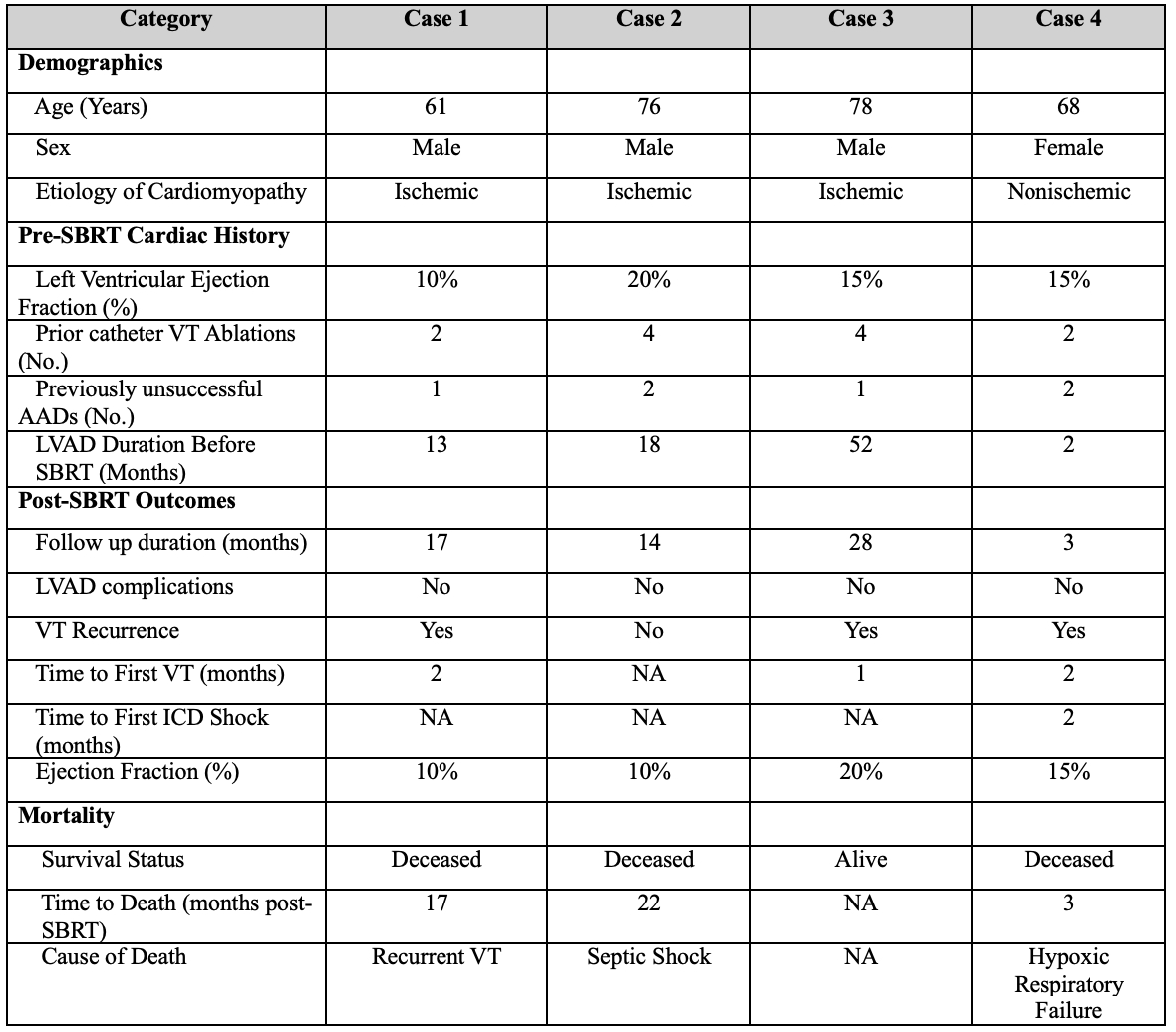
Results: Four patients met inclusion criteria (see Table). Three experienced VT recurrence: one within the first month and two within two months post-SBRT. One of these recurrences resulted in an ICD shock. One patient has remained arrhythmia-free for 14 months post-treatment. Importantly, no patients experienced LVAD-related complications attributable to SBRT. Post-treatment echocardiographic assessment revealed no significant changes in left or right ventricular function. Three patients died during follow-up at 3, 17, and 22 months. Only one death was directly attributed to refractory VT; the remaining two were due to hypoxic respiratory failure and septic shock.

Conclusion:
In this small series, cardiac SBRT appeared safe and potentially beneficial for patients with LVADs and refractory VT. Although most patients experienced recurrent VT, SBRT may delay recurrence in selected high-risk individuals. One patient achieved sustained arrhythmia suppression. These findings support further investigation of SBRT as a non-invasive adjunctive therapy in this challenging population.
  • Bhuiya, Tanzim  ( Penn , Philadelphia , Pennsylvania , United States )
  • Marchlinski, Francis  ( University of Pennsylvania , Philadelphia , Pennsylvania , United States )
  • Cengel, Keith  ( University of Pennsylvania , Philadelphia , Pennsylvania , United States )
  • Markman, Timothy  ( University of Pennsylvania , Philadelphia , Pennsylvania , United States )
  • Litt, Michael  ( University of Pennsylvania , Philadelphia , Pennsylvania , United States )
  • Chelius, Monica  ( University of Pennsylvania , Philadelphia , Pennsylvania , United States )
  • Raad, Mohamad  ( University of Pennsylvania , Philadelphia , Pennsylvania , United States )
  • Keane, Stephen  ( University of Pennsylvania , Philadelphia , Pennsylvania , United States )
  • Tan, Jian Liang  ( University of Pennsylvania , Philadelphia , Pennsylvania , United States )
  • Arkles, Jeffrey  ( University of Pennsylvania , Philadelphia , Pennsylvania , United States )
  • Tschabrunn, Cory  ( University of Pennsylvania , Philadelphia , Pennsylvania , United States )
  • Frankel, David  ( University of Pennsylvania , Philadelphia , Pennsylvania , United States )
  • Author Disclosures:
    Tanzim Bhuiya: DO NOT have relevant financial relationships | Francis Marchlinski: No Answer | Keith Cengel: No Answer | Timothy Markman: DO have relevant financial relationships ; Consultant:Medtronic:Active (exists now) ; Consultant:Johnson and Johnson:Active (exists now) ; Consultant:Abbott:Active (exists now) ; Consultant:Boston Scientific:Active (exists now) | Michael Litt: No Answer | Monica Chelius: No Answer | Mohamad Raad: No Answer | Stephen Keane: No Answer | Jian Liang Tan: DO NOT have relevant financial relationships | Jeffrey Arkles: No Answer | Cory Tschabrunn: No Answer | David Frankel: No Answer
Meeting Info:

Scientific Sessions 2025

2025

New Orleans, Louisiana

Session Info:

The ECG and Beyond: The Expanding Role of Imaging in Electrophysiology

Saturday, 11/08/2025 , 12:15PM - 01:30PM

Moderated Digital Poster Session

More abstracts from these authors:
Prognostic Value of Unipolar and Bipolar Low Voltage Areas in Predicting Outcomes After Ventricular Tachycardia Ablation in Patients with Non-Ischemic Cardiomyopathy and Heart Failure

Afzalian Arian, Tschabrunn Cory, Guandalini Gustavo, Enriquez Andres, Garcia Fermin, Riley Michael, Lin David, Schaller Robert, Nazarian Saman, Callans David, Supple Gregory, Oraii Alireza, Kumareswaran Ramanan, Dixit Sanjay, Frankel David, Marchlinski Francis, Rodriguez-queralto Oriol, Hanumanthu Balaram Krishna, Zado Erica, Shivamurthy Poojita, Markman Timothy, Hyman Matthew, Peters Carli

Comparative Outcomes of Stereotactic Body Radiotherapy for Ventricular Tachycardia in Ischemic vs. Non-Ischemic Cardiomyopathy

Bhuiya Tanzim, Marchlinski Francis, Cengel Keith, Markman Timothy, Litt Michael, Chelius Monica, Raad Mohamad, Keane Stephen, Tan Jian Liang, Arkles Jeffrey, Tschabrunn Cory, Frankel David

You have to be authorized to contact abstract author. Please, Login
Not Available