Logo

American Heart Association

  23
  0


Final ID: Mo3029

Integrated Risk Modeling of Donor and Recipient Predictors of One-Year Graft Loss in Pediatric Heart Transplantation

Abstract Body (Do not enter title and authors here): Background: Pediatric heart transplant outcomes have improved in recent decades due to advancements in donor and recipient selection. Despite this, early graft loss—defined as graft dysfunction resulting in death or need for re-transplantation in the first year—remains a significant adverse outcome. Prior studies have focused primarily on recipient or donor factors in isolation and have emphasized mortality rather than graft loss. A comprehensive understanding of contemporary and combined risk factors could improve patient selection, prognostication, and post-transplant management.
Methods: A multivariable risk prediction model was developed using data from the Scientific Registry of Transplant Recipients (SRTR) for all first-time heart transplant recipients under 18 years of age between 2014-2022. Multi-organ transplants were excluded. Graft loss within one year was the primary outcome. A multivariable logistic regression model was developed using AIC-based variable selection, optimized through 20 iterations of 5-fold cross-validation to maximize predictive performance. Missing data were handled using multiple imputation.
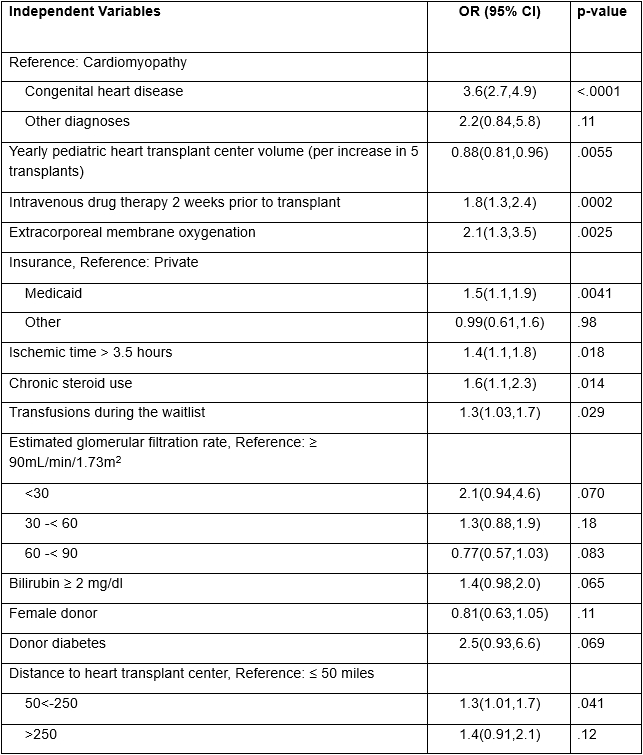
Results: Among 4,066 patients (52% congenital heart disease; 47% cardiomyopathy), 302 (7.43%) experienced graft loss within one year; 70% occurred during the index hospitalization. The variables selected for the final predictive model along with their estimated effect sizes are shown in Table. Higher pediatric transplant center volume was associated with reduced predicted risk of graft loss, with the odds of graft loss decreased by 12% for every 5 additional transplants per year (OR=0.88, 95% CI: 0.81–0.96). The model demonstrated good calibration (intercept: 0.002, 95% CI -0.009 –0.014; slope: 0.951, 95% CI 0.820–1.115) and moderate discriminative performance (AUC: 0.719, 95% CI 0.660–0.773). Donor-only variable selection yielded a weakly predictive model (AUC: 0.573; 95% CI: 0.520–0.645), which may explain why only two donor features were retained in the final model (Table).
Conclusions: A predictive model for one-year graft loss in pediatric heart transplant recipients was developed using both recipient and donor variables. Donor variables contributed minimally to model performance. The final model may serve as a valuable clinical decision-support tool for transplant candidacy evaluation and post-operative risk stratification.
  • Christmas, Ashlee  ( Cleveland Clinic Children's , Cleveland , Ohio , United States )
  • Liu, Wei  ( Cleveland Clinic Children's , Cleveland , Ohio , United States )
  • Amdani, Shahnawaz  ( Cleveland Clinic Children's , Cleveland , Ohio , United States )
  • Author Disclosures:
    Ashlee Christmas: DO NOT have relevant financial relationships | Wei Liu: DO NOT have relevant financial relationships | Shahnawaz Amdani: DO have relevant financial relationships ; Research Funding (PI or named investigator):Site PI for multi-center study led by the University of Michigan, report no salary support:Active (exists now) ; Research Funding (PI or named investigator):Site PI for the Fontan Udenafil Exercise Longitudinal Assessment Trial (the FUEL-2 Study) (IQVIA Biotech), report no salary support:Active (exists now)
Meeting Info:

Scientific Sessions 2025

2025

New Orleans, Louisiana

Session Info:

Potpourri 3: Pediatric and Congenital Cardiology

Monday, 11/10/2025 , 10:30AM - 11:30AM

Abstract Poster Board Session

More abstracts on this topic:
Adherence to Pediatric Screening Guidelines for Cardiovascular Risk Factors in a Diverse Cohort of Children in Chicago

Gauen Abigail, Wang Yaojie, Perak Amanda, Davis Matthew, Rosenman Marc, Lloyd-jones Donald, Zmora Rachel, Allen Norrina, Petito Lucia

Angiotensin Converting Enzyme Gene Polymorphisms (ACE-I/D) Do Not Predict Exercise-Induced Cardiac Remodeling or Performance in Adolescent Male Athletes

Becker Kristian, Hardie William, Gubanich Paul, Hill Garick, Logan Kelsey, Martin Lisa, Powell Adam

You have to be authorized to contact abstract author. Please, Login
Not Available