
Logo

American Heart Association

  24
  0


Final ID: MP2059

Longitudinal Assessment of Myocardial Work Indices in Pediatric Heart Transplantation: A Novel Noninvasive Marker of Graft Function and Rejection Risk

Abstract Body (Do not enter title and authors here): Background:
Routine surveillance of graft dysfunction in pediatric heart transplant recipients relies on invasive assessments by catheterization and biopsy. Noninvasive imaging techniques, including ejection fraction and strain, lack sensitivity to detect early rejection-related dysfunction. Myocardial work indices (MWI) are a novel echocardiographic tool that generates pressure-strain loops and may offer a more integrative marker of graft performance. The utility of MWI in pediatric heart transplant patients remains largely uncharacterized.
Methods:
We conducted a single-center, longitudinal retrospective study of pediatric heart transplant recipients (0-21 years) transplanted between 2010 and 2021. Echocardiograms from protocol-driven surveillance biopsies were analyzed using EchoPAC to derive global longitudinal strain (GLS), ejection fraction (EF), and myocardial work indices (GWI, global work index; GCW, constructive work; GWE, work efficiency). Their trends over the first two years post-transplant were modeled using splines. One-year measures were compared to age- and sex-matched controls. Associations with concurrent invasive hemodynamics were also assessed.
Results:
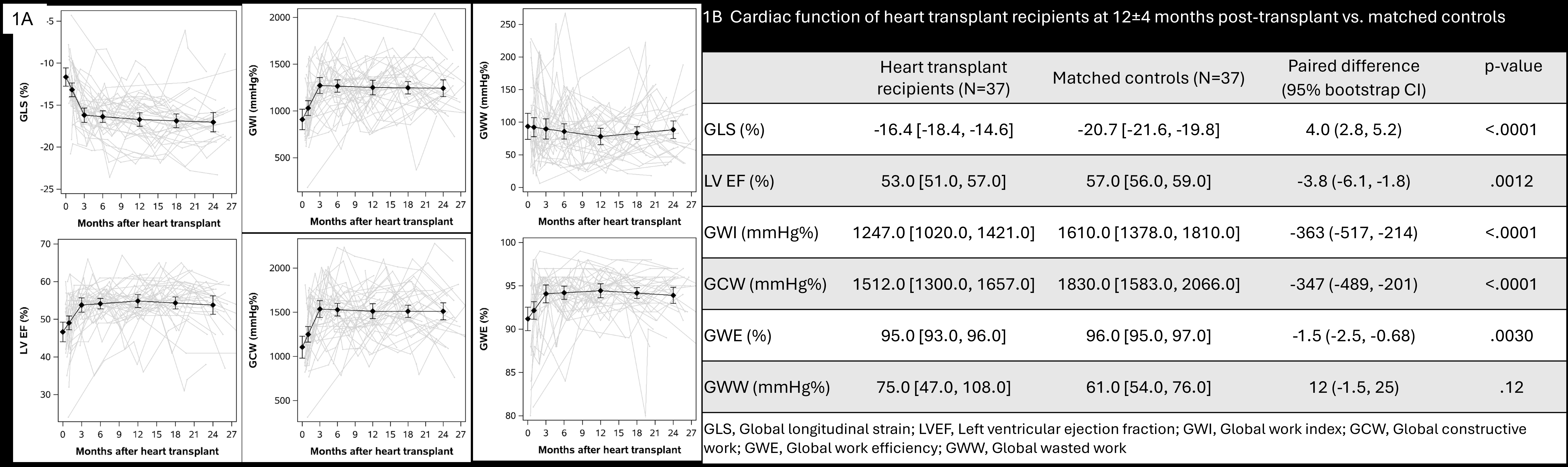
Forty-two recipients met inclusion criteria (median age 4 years; 6.5 echocardiograms/patient). Functional recovery was most notable within the first 3 months, with no significant changes from 3 to 24 months post-transplant (Figure 1A). At 1 year post-transplant, transplant recipients demonstrated impaired myocardial performance relative to the matched controls (all p<.05), with lower EF (53 vs 57%), less negative GLS (-16.4 vs -20.7%), and decreased myocardial work indices (GWE: 95.0 vs 96.0%; GCW: 1512.0 vs 1830.0 mmHg%, and GWI: 1247 vs 1610.0 mmHg%) (Figure 1B). Correlations between noninvasive imaging and invasive hemodynamics were weak; no parameter had a correlation coefficient >0.4.
Conclusion:
This is the first study to longitudinally evaluate MWI in pediatric heart transplant recipients. Findings demonstrate persistent myocardial impairment 24 months post-transplant despite stable clinical status and conventional imaging, suggesting ongoing subclinical dysfunction. MWI represent a promising, physiologically integrative, noninvasive marker that may enhance detection of subclinical graft dysfunction and reduce reliance on invasive testing. Prospective studies are warranted to validate their use in routine transplant surveillance.
  • Schwab, Daniel  ( Cleveland Clinic , Beachwood , Ohio , United States )
  • Tretter, Justin  ( Cleveland Clinic , Ohio , Ohio , United States )
  • Liu, Wei  ( Cleveland Clinic , Beachwood , Ohio , United States )
  • Amdani, Shahnawaz  ( Cleveland Clinic Childrens Hospital , Solon , Ohio , United States )
  • Author Disclosures:
    Daniel Schwab: DO NOT have relevant financial relationships | Justin Tretter: DO have relevant financial relationships ; Consultant:Cara Medical, Ltd.:Active (exists now) | Wei Liu: DO NOT have relevant financial relationships | Shahnawaz Amdani: DO have relevant financial relationships ; Research Funding (PI or named investigator):Site PI for multi-center study led by the University of Michigan, report no salary support:Active (exists now) ; Research Funding (PI or named investigator):Site PI for the Fontan Udenafil Exercise Longitudinal Assessment Trial (the FUEL-2 Study) (IQVIA Biotech), report no salary support:Active (exists now)
Meeting Info:

Scientific Sessions 2025

2025

New Orleans, Louisiana

Session Info:
More abstracts on this topic:
A Bridge from Sweet to Sour: A Case of Recurrent Myocardial Stunning in Diabetic Ketoacidosis

Satish Vikyath, Pargaonkar Sumant, Slipczuk Leandro, Schenone Aldo, Maliha Maisha, Chi Kuan Yu, Sunil Kumar Sriram, Borkowski Pawel, Vyas Rhea, Rodriguez Szaszdi David Jose Javier, Kharawala Amrin, Seo Jiyoung

A novel Notch and WNT signaling mechanism contribute to pediatric DCM: a pathway to new therapeutics

Nyarko Obed, Miyamoto Shelley, Stauffer Brian, Sucharov Carmen

You have to be authorized to contact abstract author. Please, Login
Not Available