The Effect of Tirzepatide versus Semaglutide on Post-Operative Outcomes in Type 2 Diabetics Following Coronary Artery Bypass Grafting
Abstract Body (Do not enter title and authors here): Background: Post-operative cardiovascular outcomes after Coronary Artery Bypass Grafting (CABG) in patients with type 2 diabetes pose unique and significant clinical challenges. Although both tirzepatide, a dual GLP-1/GIP receptor agonist, and semaglutide, a GLP-1 receptor agonist, have demonstrated cardiovascular benefits in diabetic patients, their comparative effectiveness in this population post-CABG remains unclear- a gap this study aims to address.
Hypothesis: We hypothesized that tirzepatide provides superior protection against post-operative complications compared to semaglutide in diabetic patients post-CABG based on the premise that dual agonism may offer enhanced metabolic benefits beyond GLP-1 receptor activation alone.
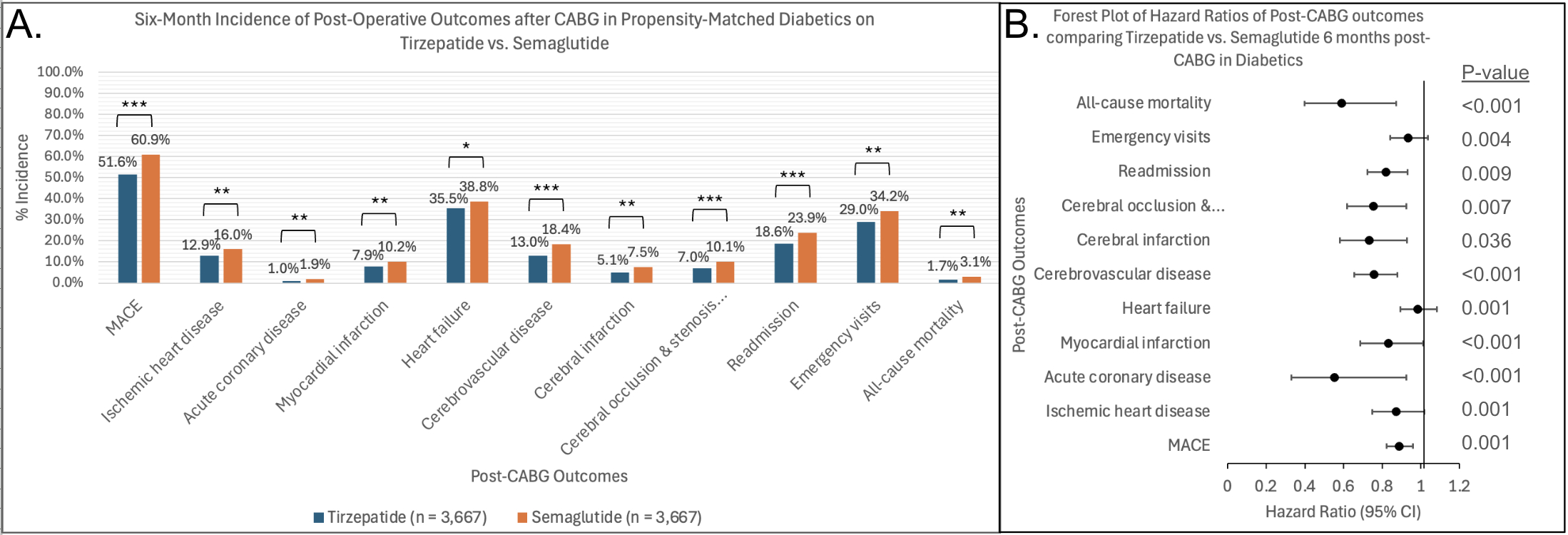
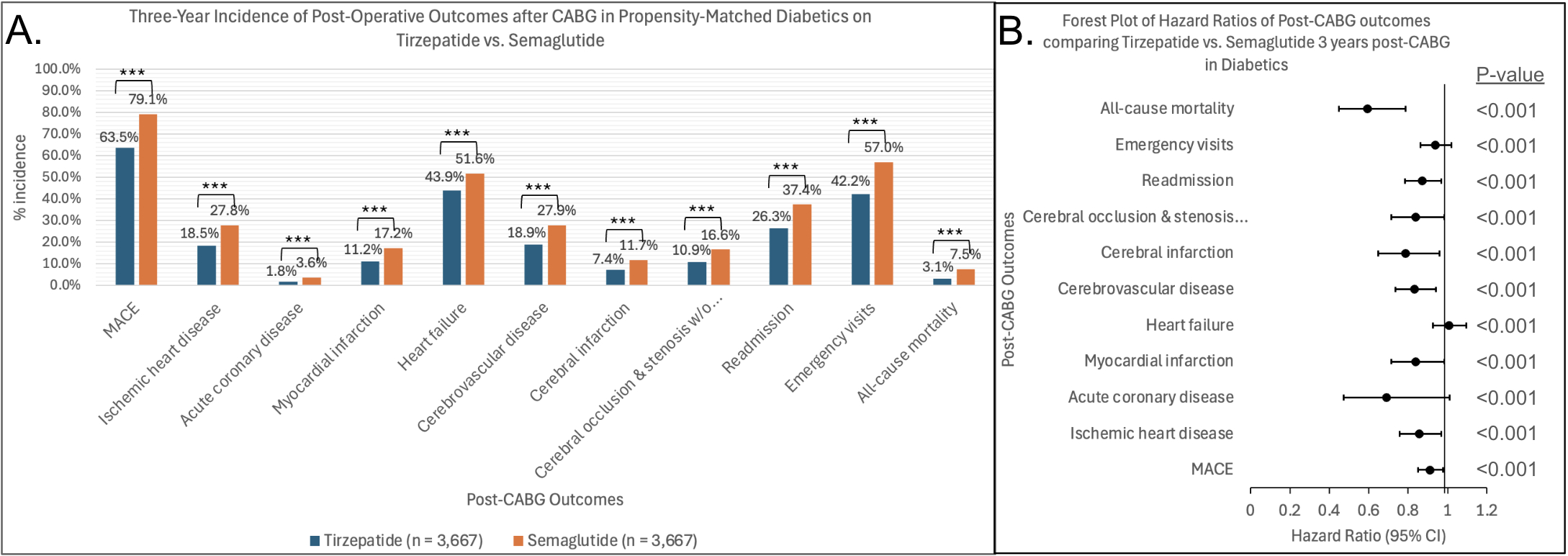
Methods: In this retrospective cohort study utilizing the TriNetX global federated health research network (2022-2024), we analyzed 3,667 propensity score-matched pairs of type 2 diabetic adults (≥18 years old) on either tirzepatide or semaglutide after undergoing CABG. Outcomes measured at 6 months and 3 years included post-operative complications, cardiovascular outcomes, cerebrovascular outcomes, and healthcare utilization.
Results: At 6 months following CABG, tirzepatide use decreased adverse cardiovascular outcomes such as myocardial infarction (7.9% vs. 10.2%, HR=0.833, 95%CI=0.686-1.012, p=0.007) and MACE (51.6% vs. 60.9%, HR=0.889, 95%CI=0.822-0.960, p<0.001) compared to semaglutide. Statistical significance was maintained at 3 years post-CABG in MACE outcomes (63.7% vs. 79.1%, HR=0.911, 95%CI=0.850-0.976, p<0.001). Superior cerebrovascular protection with tirzepatide was also seen at 6 months following CABG with lower rates of cerebral infarction (5.1% vs. 7.5%, HR=0.733, 95%CI=0.580-0.927, p=0.001) and cerebrovascular disease (13.0% vs. 18.4%, HR=0.758, 95%CI=0.645-0.879, p<0.001) compared to semaglutide and sustained at 3 years. Both time points also showed tirzeptide use to have decreased readmissions, emergency visits, and all-cause mortality (3.1% vs. 7.5% at 3 years, HR=0.595, 95%CI=0.449-0.787, p<0.001).
Conclusions: Tirzepatide demonstrates superior cardiovascular and cerebrovascular protection, reduced healthcare utilization, and lower mortality compared to semaglutide in diabetic patients after CABG. These findings highlight the postoperative potential of GLP-1/GIP receptor agonism in this high-risk population.
Chunduri, Shriya
(
Tulane School of Medicine
, Prosper , Texas , United States )
Bidaoui, Ghassan
(
Tulane University School of Medicine
, New Orleans , Louisiana , United States )
Hussein, Mohammad
(
Ochsner Clinic Foundation
, New Orleans , Louisiana , United States )
Patel, Milee
(
Tulane School of Medicine
, Prosper , Texas , United States )
Abdelmaksoud, Ahmed
(
University of California, Riverside
, Riverside , California , United States )
Hussein, Mohammad
(
University of California, Riverside
, Riverside , California , United States )
Attia, Abdallah
(
Tulane University School of Medicine
, New Orleans , Louisiana , United States )
Tatum, Danielle
(
Tulane University School of Medicine
, New Orleans , Louisiana , United States )
Borgi, Jamil
(
Tulane University School of Medicine
, New Orleans , Louisiana , United States )
Toraih, Eman
(
Tulane University School of Medicine
, New Orleans , Louisiana , United States )
Author Disclosures:
Shriya Chunduri:DO NOT have relevant financial relationships
| Eman Toraih:No Answer
| ghassan bidaoui:DO NOT have relevant financial relationships
| Mohammad Hussein:No Answer
| Milee Patel:DO NOT have relevant financial relationships
| Ahmed Abdelmaksoud:No Answer
| Mohammad Hussein:No Answer
| Abdallah Attia:No Answer
| Danielle Tatum:DO NOT have relevant financial relationships
| Jamil Borgi:No Answer