Porcine Model of Biventricular Pressure-Volume Loop Assessment during Impella 5.5 Support
Abstract Body (Do not enter title and authors here): Introduction The Impella 5.5 is frequently employed to provide temporary mechanical circulatory support as bridge to recovery or durable therapy. Optimization of device management relies on understanding ventricular pressure-volume (PV) relationships.
Aim The aim of this study was to evaluate the biventricular (BiV) relationship with PV loop assessment during Impella 5.5 support in non-myopathic ventricles.
Methods Six domestic Yorkshire Pigs were used for this study. The Impella 5.5 (J&J MedTech, NJ) was inserted percutaneously under ultrasound and fluoroscopic guidance through either the carotid artery or aortic arch, using a 26Fr DrySeal Sheath (Gore, AZ). BiV PV loop conductance catheters (Sigma-M, CD Leycom, Hengelo, The Netherlands) were inserted via femoral venous access. The LV PV loop catheter is positioned via transeptal puncture and with intracardiac echocardiogram guidance. BiV PV loops are generated for each level of Impella 5.5 support.
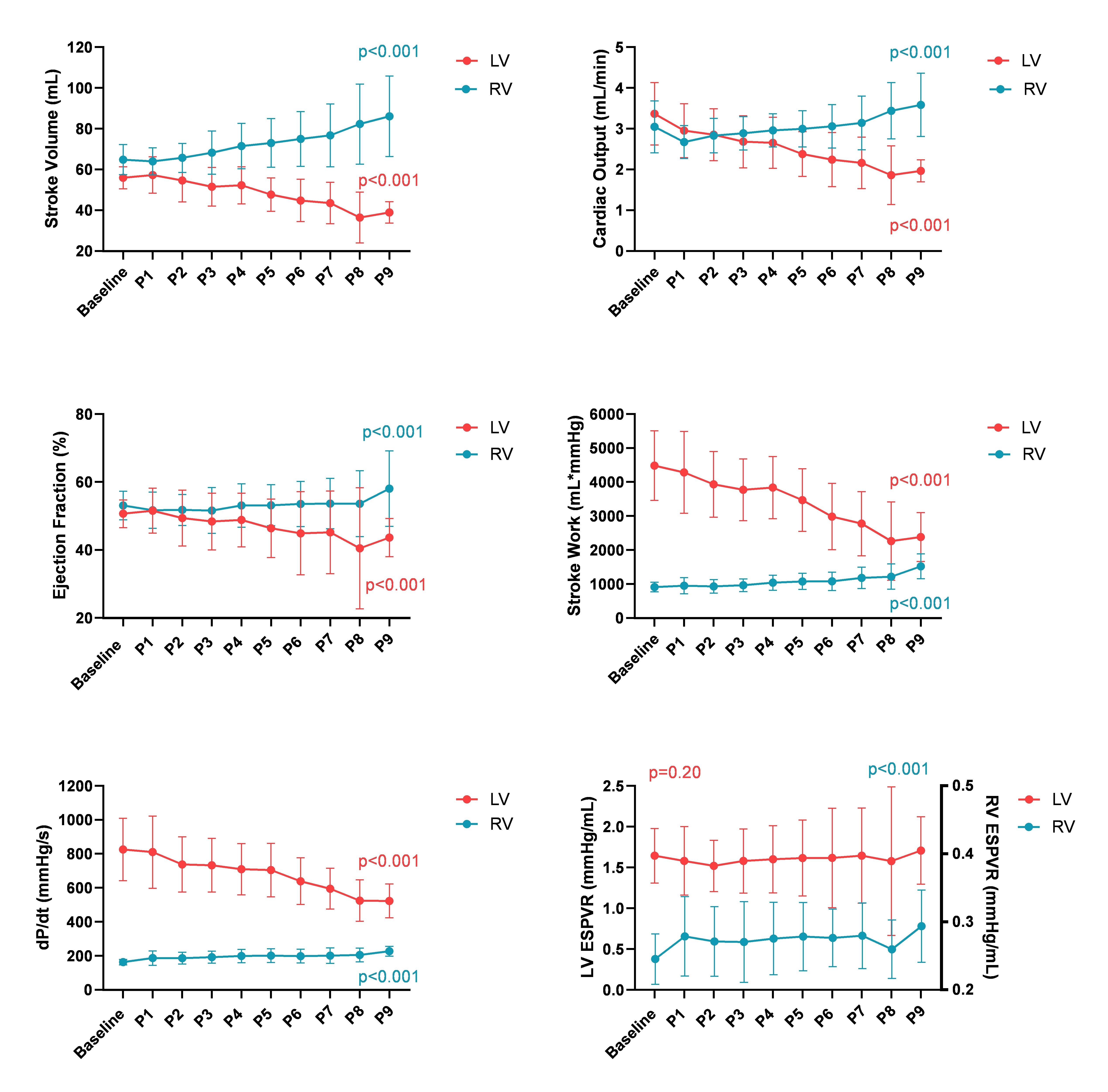
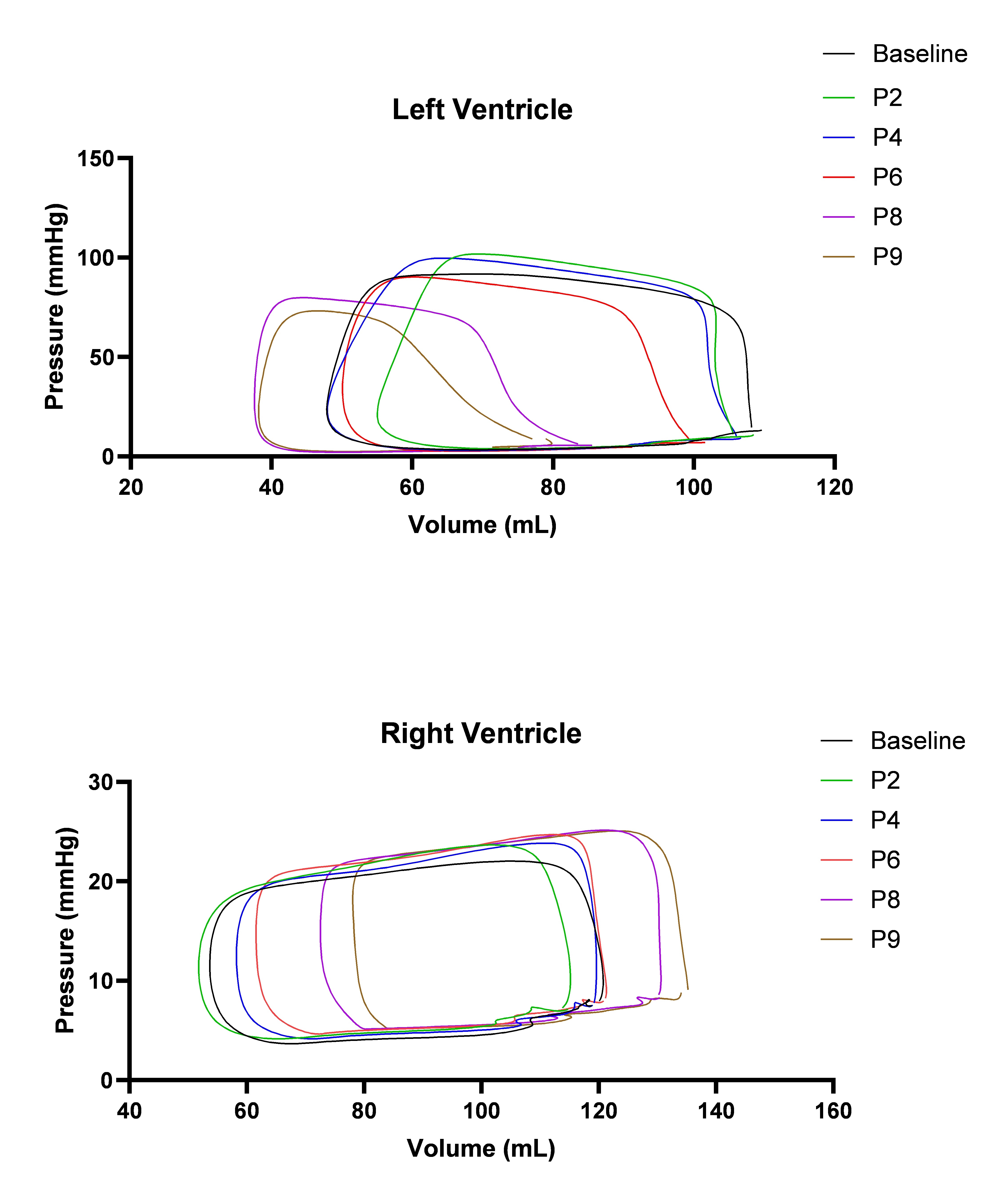
Results With increasing levels of Impella 5.5 support, left ventricular (LV) PV loops shifted increasingly to the left and right ventricular (RV) loops to the right. Accordingly, LV end-diastolic volume (EDV) decreased (110±4 ml to 90±8 ml; p<0.001) and RV EDV increased (121±7 ml to 147±13 ml; p<0.001), from baseline to P9. Native LV systolic function decreased with increasing Impella 5.5 support, as demonstrated by a reduction in stroke volume (SV) (56±5 ml to 49±5 ml; p<0.001), cardiac output (CO) (3.4±0.8 ml/min to 2.0±0.3 ml/min; p<0.001), ejection fraction (EF) (51±4% to 44±6%; p<0.001), stroke work (SW) (4483±1023 ml*mmHg to 2383±719 ml*mmHg; p<0.001), and LV peak positive dP/dt (825 ± 184 mmHg/s to 523 ± 99 mmHg/s; p<0.001). Conversely, the native RV experienced preload-mediated increase in SV (65±7 ml to 86±20 ml; p<0.001), CO (3.7±0.8 ml/min to 4.3±0.9 ml/min; p<0.001), EF (53±4% to 58±11%; p<0.001), SW (918±143 ml*mmHg to 1529±365 ml*mmHg; p<0.001), and RV dP/dt (164±16 mmHg/s to 228±29 mmHg/s, p<0.001). Load independent contractility was assessed in the LV (1.64±0.33 mmHg/ml to 1.71±0.41 mmHg/ml; p=0.2) and RV (0.25±0.04 mmHg/ml to 0.29±0.05 mmHg/ml; p<0.001).
Conclusions This study highlights ventricular interdependence with Impella 5.5 support with opposing BiV trends. In a healthy heart, the RV can adequately compensate for increased preload offered by the device.
Inglis, Sara
( Mayo Clinic
, Rochester
, Minnesota
, United States
)
Rahme, Serena
( Mayo Clinic
, Rochester
, Minnesota
, United States
)
Witt, Tyra
( Mayo Clinic
, Rochester
, Minnesota
, United States
)
Nagel, Mary
( Mayo Clinic
, Rochester
, Minnesota
, United States
)
Tiffany, Sarrafian
( Mayo Clinic
, Rochester
, Minnesota
, United States
)
Tollefsrud, Katrina
( Mayo Clinic
, Rochester
, Minnesota
, United States
)
Yalamuri, Suraj
( Mayo Clinic
, Rochester
, Minnesota
, United States
)
Rosenbaum, Andrew
( Mayo Clinic
, Rochester
, Minnesota
, United States
)
Behfar, Atta
( Mayo Clinic
, Rochester
, Minnesota
, United States
)
Author Disclosures:
Sara Inglis:DO NOT have relevant financial relationships
| Serena Rahme:No Answer
| Tyra Witt:DO NOT have relevant financial relationships
| Mary Nagel:DO NOT have relevant financial relationships
| Sarrafian Tiffany:No Answer
| Katrina Tollefsrud:DO NOT have relevant financial relationships
| suraj yalamuri:No Answer
| Andrew Rosenbaum:DO NOT have relevant financial relationships
| Atta Behfar:No Answer