Logo

American Heart Association

  18
  0


Final ID: MP2277

Characteristics of Blue Zones and Their Association with Longevity: Analysis in the Women’s Health Initiative

Abstract Body (Do not enter title and authors here): Background
Nine lifestyle characteristics have been identified across Blue Zones - 5 regions of the world noted for their longevity - but these factors have yet to be empirically tested. This study aimed to do so by analyzing data from the Women’s Health Initiative (WHI), a 30+ year prospective study of post-menopausal women.

Research Question
Is higher adherence to Blue Zone characteristics associated with a lower mortality risk in women?


Methods
This analytic sample was comprised of 31,099 participants from the WHI Observational Study. Eligible women had no missing values for the nine factors, assessed via questionnaires: 1) moving via physical activity (PA); 2) having purpose via purpose in life constructs; 3) reducing stress via perceived stress; 4) eating less via body mass index (BMI); 5) eating plant-based protein diet via Mediterranean diet intake; 6) consuming light alcohol via weekly alcohol patterns; 7) having faith-based community via frequency of church attendance; 8) putting family first via frequency meeting with family and friends; and 9) having a social circle via MOS social support. Death was determined by medical record review with adjudication and linkage to the National Death Index. Multivariable Cox models estimated hazard ratios (HR) for all-cause and CVD-specific mortality with time beginning at Blue Zones characteristics assessment (2011) through 2024.

Results
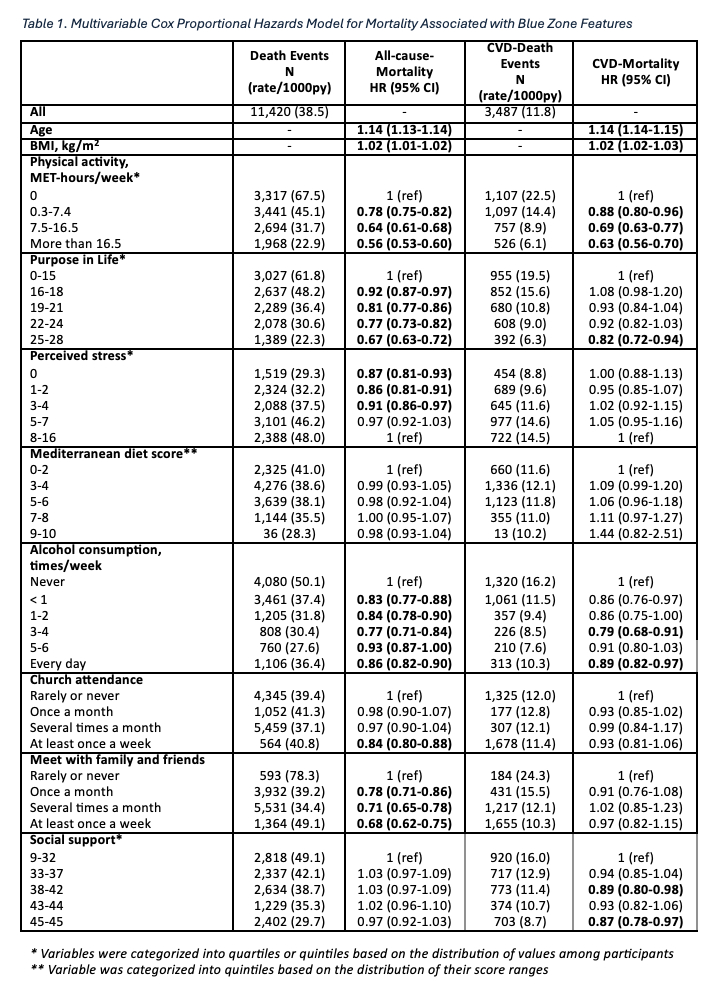
During the observational period, 11,420 (38.5/1000 person-years) women died. Factors associated with reduced mortality included lower BMI, higher PA, higher purpose in life, lower perceived stress, light alcohol consumption, higher church attendance, and regularly meeting with family and friends (Table 1). A dose-response relationship was seen for PA and all-cause mortality (P<0.001), with a 44% reduction in mortality for high PA and still a reduction of 22% for light activity. Reporting a strong life purpose and meeting frequently with friends and family were associated with a 33% and 32% lower mortality, respectively. For CVD mortality, factors associated with reduced risk were largely the same, with the exception of higher social support showing a reduced risk of CVD mortality but not all-cause mortality.

Conclusion
In addition to robust findings linking higher physical activity to reduced mortality, psychological components, such as having a purpose and social interactions, were also associated with lower mortality risk. Promoting longevity requires attention to multiple factors.
  • Reding, Kerryn  ( University of Washington , Seattle , Washington , United States )
  • Malek, Angela  ( MED UNIV OF SOUTH CAROLINA , Charleston , South Carolina , United States )
  • Hale, Lauren  ( Stony Brook University , Stony Brook , New York , United States )
  • Lane, Dorothy  ( Stony Brook University , Stony Brook , New York , United States )
  • Haring, Bernhard  ( Saarland University Hospital , Homburg , Germany )
  • Nudy, Matthew  ( Penn State Health , Hummelstown , Pennsylvania , United States )
  • Johnson, Karen  ( UNIVERSITY TENNESSEE , Memphis , Tennessee , United States )
  • Garcia, Lorena  ( University of California, Davis , Davis , California , United States )
  • Manson, Joann  ( Brigham and Women's Hospital , Boston , Massachusetts , United States )
  • Lamonte, Michael  ( University at Buffalo - SUNY , Buffalo , New York , United States )
  • Lee, Hyunhae  ( University of Washington , Seattle , Washington , United States )
  • Hovey, Kathleen  ( University of Buffalo , Buffalo , New York , United States )
  • Andrews, Chris  ( University of Buffalo , Buffalo , New York , United States )
  • Vasbinder, Alexi  ( University of Washington , Seattle , Washington , United States )
  • Szewczyk, Warren  ( University of Washington , Seattle , Washington , United States )
  • Tsai, Chi-shan  ( University of Washington , Seattle , Washington , United States )
  • Kroenke, Candyce  ( Kaiser Permanente Northern Calif , Oakland , California , United States )
  • Mozhui, Khyobeni  ( University of Tennessee , Memphis , Tennessee , United States )
  • Author Disclosures:
    Kerryn Reding: DO NOT have relevant financial relationships | Angela Malek: DO NOT have relevant financial relationships | Lauren Hale: No Answer | Dorothy Lane: No Answer | Bernhard Haring: DO have relevant financial relationships ; Speaker:Bristol Myers Squibb:Past (completed) ; Speaker:Boehringer Ingelheim:Past (completed) ; Speaker:Daiichi Sankyo:Past (completed) ; Speaker:Inari:Past (completed) ; Speaker:Pfizer:Active (exists now) | Matthew Nudy: DO NOT have relevant financial relationships | Karen Johnson: DO NOT have relevant financial relationships | Lorena Garcia: No Answer | JoAnn Manson: DO have relevant financial relationships ; Research Funding (PI or named investigator):Mars Edge:Past (completed) | Michael LaMonte: DO NOT have relevant financial relationships | Hyunhae Lee: DO NOT have relevant financial relationships | Kathleen Hovey: No Answer | Chris Andrews: No Answer | Alexi Vasbinder: DO NOT have relevant financial relationships | Warren Szewczyk: DO NOT have relevant financial relationships | Chi-shan Tsai: No Answer | Candyce Kroenke: DO NOT have relevant financial relationships | Khyobeni Mozhui: No Answer
Meeting Info:

Scientific Sessions 2025

2025

New Orleans, Louisiana

Session Info:

Beyond Biology: Exploring Social and Environmental Pathways in Cardiovascular Health

Monday, 11/10/2025 , 09:15AM - 10:30AM

Moderated Digital Poster Session

More abstracts from these authors:
Adverse Pregnancy Outcomes Are Associated with Incident Peripheral Artery Disease, Results from the Women’s Health Initiative.

Jackson Elizabeth, Leblanc Erin, Haring Bernhard, Harrington Laura, Allison Matthew, Eaton Charles, Lamonte Michael, Hovey Kathleen, Andrews Chris, Wells Gretchen, Manson Joann, Levitan Emily, Spracklen Cassandra, Wild Robert

Calibration and Discrimination of Cardiovascular Risk Scores in Women with Breast Cancer in the Women’s Health Initiative

Wadden Elena, Barac Ana, Simon Michael, Vasbinder Alexi, Cheng Richard, Larson Joseph, Jung Su Yon, Nudy Matthew, Sun Yangbo, Manson Joann, Levy Wayne, Stefanick Marcia, Reding Kerryn

You have to be authorized to contact abstract author. Please, Login
Not Available