Development and Validation of a Prediction Model for Recurrent Atherosclerotic Cardiovascular Disease
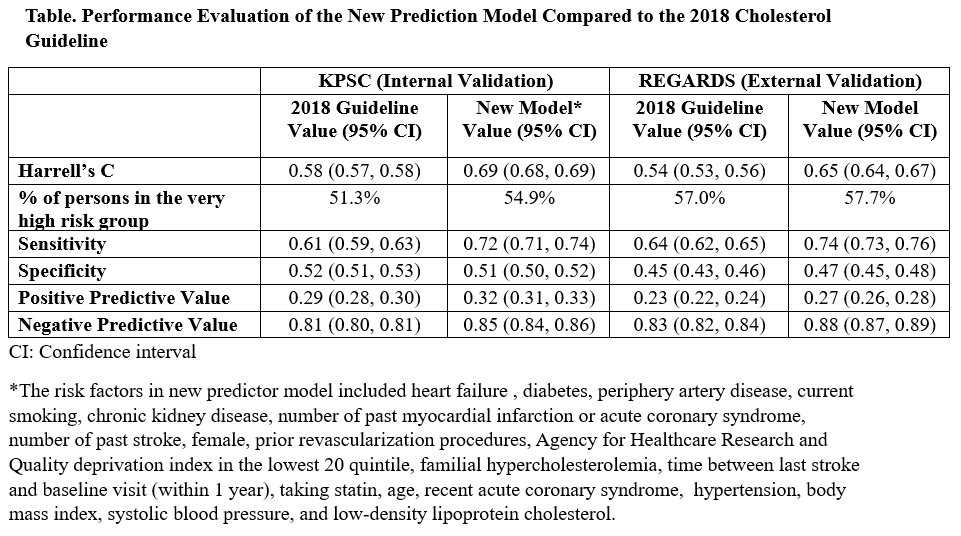
Abstract Body (Do not enter title and authors here): Background: The 2018 AHA/ACC cholesterol guideline classifies a subgroup of individuals with established atherosclerotic cardiovascular disease (ASCVD) as being at “very high risk” for recurrent ASCVD to guide lipid-lowering therapy. The classification is based on a history of multiple major ASCVD events or one major event accompanied by high-risk conditions such as age ≥65 years or prior coronary procedures. However, this dichotomous classification may oversimplify the continuous nature of cardiovascular recurrence risk. Research Question: Does a new prediction model for recurrent ASCVD among individuals with established ASCVD perform better than the 2018 guideline definition of very high risk? Methods: Data from Kaiser Permanente Southern California (KPSC) was used for model development and internal validation, and the Reasons for Geographic and Racial Differences in Stroke (REGARDS) cohort was used for external validation. Adults with a history of ASCVD were followed for 10 years. The outcome was recurrent ASCVD, defined as myocardial infarction, fatal coronary heart disease, and fatal and nonfatal ischemic stroke. Elastic net regularization was used to develop the prediction model. Model discrimination was assessed using Harrell’s C index; sensitivity, specificity, and positive predictive value were evaluated based on very high vs. no very high risk classification. Results: We included 70,310 adults from KPSC and 5,190 adults from REGARDS, with 17,344 and 1,060 recurrent ASCVD events, respectively. The most influential predictors were history of heart failure, diabetes, peripheral artery disease, smoking, and chronic kidney disease. Compared to the 2018 guideline, the new model improved Harrell’s C from 0.58 (95% CI: 0.57, 0.58) to 0.69 (95% CI: 0.68, 0.69) in the internal validation, and from 0.54 (95% CI: 0.53, 0.56) to 0.65 (95% CI: 0.64, 0.67) in the external validation (Table). Using a 30% risk threshold, the new model classified a similar proportion of individuals as very high risk compared to the 2018 guideline definition, but improved sensitivity from 0.61 (95% CI: 0.59, 0.63) to 0.72 (95% CI: 0.71, 0.74) in internal validation, and from 0.63 (95% CI: 0.62, 0.65) to 0.74 (95% CI: 0.73, 0.76) in external validation, with similar specificity. Conclusion: Compared with the 2018 cholesterol guideline, the newly developed prediction model more accurately estimated 10-year recurrent ASCVD risk in two large contemporary US adult population cohorts.
Zhou, Hui
(
Kaiser Permanente Southern California
, Pasadena , California , United States )
Zhang, Yiyi
(
COLUMBIA UNIVERSITY
, New York , New York , United States )
Zhou, Mengnan
(
Kaiser Permanente Southern California
, Pasadena , California , United States )
Choi, Soonie
(
Kaiser Permanente Southern California
, Pasadena , California , United States )
Morrissette, Kerresa
(
Kaiser Permanente Southern California
, Pasadena , California , United States )
Reynolds, Kristi
(
Kaiser Permanente Southern California
, Pasadena , California , United States )
Bellows, Brandon
(
COLUMBIA UNIVERSITY
, New York , New York , United States )
Moran, Andrew
(
COLUMBIA UNIVERSITY
, New York , New York , United States )
Colantonio, Lisandro
(
UNIVERSITY OF ALABAMA AT BIRMINGHAM
, Birmingham , Alabama , United States )
Safford, Monika
(
WEILL CORNELL MEDICINE
, New York , New York , United States )
An, Jaejin
(
Kaiser Permanente Southern California
, Pasadena , California , United States )
Author Disclosures:
Hui Zhou:DO NOT have relevant financial relationships
| Monika Safford:DO have relevant financial relationships
;
Advisor:MedExplain Inc:Active (exists now)
| Jaejin An:DO have relevant financial relationships
;
Research Funding (PI or named investigator):Bayer:Active (exists now)
; Research Funding (PI or named investigator):Merck:Past (completed)
; Research Funding (PI or named investigator):AstraZeneca:Active (exists now)
| Yiyi Zhang:DO have relevant financial relationships
;
Research Funding (PI or named investigator):NIH/NHLBI:Active (exists now)
| Mengnan Zhou:No Answer
| Soonie Choi:DO have relevant financial relationships
;
Other (please indicate in the box next to the company name):Bayer AG:Active (exists now)
| Kerresa Morrissette:DO NOT have relevant financial relationships
| Kristi Reynolds:DO have relevant financial relationships
;
Research Funding (PI or named investigator):Merck:Past (completed)
| Brandon Bellows:DO NOT have relevant financial relationships
| Andrew Moran:No Answer
| Lisandro Colantonio:DO NOT have relevant financial relationships