Effect of Medical-Grade Mask Use on Exercise Physiology in Healthy Adults: A Randomized Crossover Study
Abstract Body (Do not enter title and authors here): Background Respirator masks are widely used in East Asia for air pollution and, since COVID-19, in public health. However, their physiological impact during exercise remains poorly understood. We evaluates cardiopulmonary responses to exercise under three conditions: no mask, KF80 (Korean Filter; ≥80% filtration of 0.6 μm particles), and KF94 (≥94% filtration of 0.4 μm particles; functionally equivalent to N95).
Methods Forty healthy adults (mean age 33.3 ± 7.2 years, 50% female) underwent a randomized crossover trial, performing cardiopulmonary exercise testing (CPET) using a modified Bruce protocol under no mask, KF80, and KF94. Each session was separated by ≥48 hours. Gas exchange and physiological variables were measured in real time. Outcomes included peak oxygen uptake (VO2max), metabolic equivalents (METs), heart rate (HR), tidal volume (VT), minute ventilation (VE), respiratory rate (RR), respiratory exchange ratio (RER), oxygen saturation (SpO2), and systolic blood pressure (SBP). Repeated-measures ANOVA with Bonferroni correction was applied.
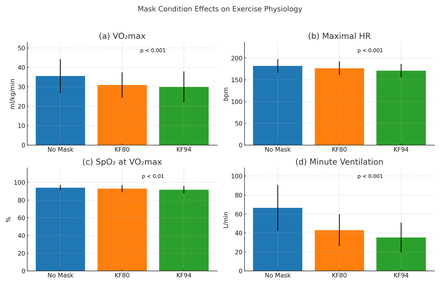
Results VO2max and METs both declined with greater filtration: VO2max was 35.6 ± 8.7 ml/kg/min (No Mask), 31.0 ± 6.5 (KF80), and 29.9 ± 8.0 (KF94; p < 0.001); METs were 7.8 ± 1.3, 6.8 ± 1.2, and 6.2 ± 1.4, respectively (p < 0.001). Maximal HR decreased from 181.9 ± 15.7 bpm (No Mask) to 176.6 ± 15.9 (KF80) and 171.0 ± 15.3 (KF94; p < 0.001). At 3-min post-exercise, HR remained lower under KF94 (104.2 ± 20.8 bpm) than No Mask (112.6 ± 21.5; p = 0.026), suggesting delayed autonomic recovery. SpO2 at VO2max declined under KF94 (91.8 ± 4.3%) relative to No Mask (94.1 ± 3.0%) and KF80 (93.0 ± 4.2%; p = 0.012); 9 of 40 subjects experienced SpO2 < 80%. All ventilatory measures declined with increased mask filtration: VE was 66.4 ± 24.3 (No Mask), 43.0 ± 16.8 (KF80), 35.2 ± 15.6 L/min (KF94; p < 0.001); VT was 1.9 ± 0.6, 1.4 ± 0.6, and 1.2 ± 0.4 L (p < 0.001); and RR was 35.6 ± 8.7, 31.0 ± 6.5, and 29.9 ± 8.0 bpm (p < 0.01). RER remained unchanged across conditions (p = 0.24), suggesting consistent metabolic substrate utilization and comparable anaerobic thresholds.
Conclusion KF94 respirators reduce aerobic capacity, maximal HR, and ventilatory efficiency in healthy adults without causing hemodynamic instability. Reduced VO2max, blunted HR response, and episodes of desaturation underscore performance trade-offs. These findings support cautious mask use during exertion within evolving post-pandemic health policy.
Lee, Ju-hee
(
Chungbuk National University College of Medicine
, Cheongju , Korea (the Republic of) )
Lee, Goo Joo
(
Seoul National University Hospital
, Seoul , Korea (the Republic of) )
Kang, Mingyu
(
Chungbuk National University College of Mediciine
, Cheongju , Korea (the Republic of) )
Eom, Sang Yong
(
Chungbuk National University College of Medicine
, Cheongju , Korea (the Republic of) )
Author Disclosures:
Ju-Hee Lee:DO NOT have relevant financial relationships
| Goo Joo Lee:No Answer
| Mingyu Kang:No Answer
| Sang yong Eom:No Answer