Aspirin for Primary Prevention of Cardiovascular Events in Patients with Diabetes Mellitus: An Updated Systematic Review, Meta-Analysis & Trial Sequential Analysis of Randomized Controlled Trials post-ASCEND Trial
Abstract Body (Do not enter title and authors here): Introduction: Patients with diabetes mellitus are at increased risk of cardiovascular events such as myocardial infarction, stroke, and cardiovascular death. While aspirin’s role in secondary prevention is well established, its use in primary prevention for diabetic patients without existing cardiovascular disease remains unclear. The objective of this meta-analysis is to evaluate the efficacy and safety of aspirin in diabetic patients without pre-existing cardiovascular diseases.
Materials & Methods: A comprehensive literature search was performed across PubMed MEDLINE, Cochrane Library, ScienceDirect, Google Scholar, and ClinicalTrials.gov using keywords including “aspirin,” “diabetes mellitus,” “cardiovascular disease,” and “bleeding.” Out of 1,293 identified articles, 22 articles underwent full-text review, and 11 randomized controlled trials (RCTs) were included. A trial sequential analysis (TSA) was conducted to assess the sufficiency of evidence and control for random errors.
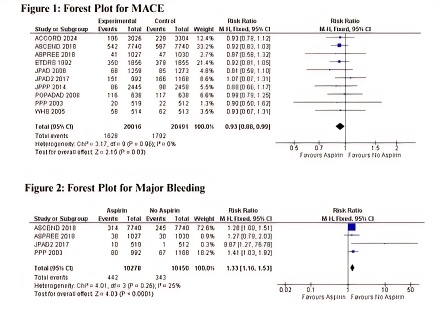
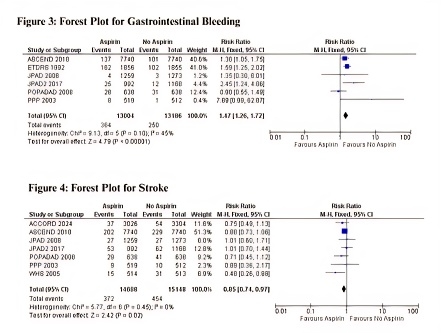
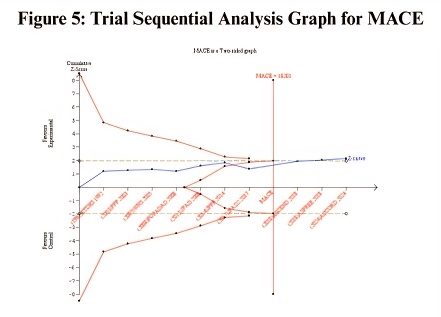
Results: Eleven RCTs (N=41,040; aspirin: 20,291, control: 20,749) were included. Major adverse cardiovascular events (MACE) occurred in 1,628 of 20,016 patients in the aspirin group versus 1,792 of 20,491 in controls (pooled RR: 0.93 [95% CI: 0.88–0.99], p=0.03). Risk of major bleeding (pooled RR: 1.33 [95% CI: 1.16–1.53], p<0.0001) and gastrointestinal bleeding (pooled RR: 1.47 [95% CI: 1.26–1.72], p<0.00001) were significantly higher with aspirin. A reduced risk of all-cause stroke was observed in the aspirin group (pooled RR: 0.85 [95% CI: 0.74–0.97], p=0.02). No significant difference was found in all-cause mortality, cardiovascular death, non-fatal MI, non-fatal stroke, or intracranial bleeding. TSA for MACE showed the cumulative Z-curve crossed both the conventional and trial sequential monitoring boundaries, and the required information size (RIS) of 18,201 participants was met. However, TSA for bleeding and stroke outcomes did not reach the RIS.
Conclusion: The results of this meta-analysis and trial sequential analysis suggest that aspirin use led to significant reduction in rates of major adverse cardiovascular events in diabetic patients. However, more RCTs are required to adequately assess the safety profile of aspirin use for primary prevention of cardiovascular disease on account of increased risk of major bleeding, particularly gastrointestinal bleeding. Hence, a cautious use of aspirin on diabetic patients based on individual risk profile is advised.
Puthia Valappil, Omer Mohammed
(
Government Medical College Calicut
, Calicut , India )
John, M Rose
(
Sree Narayana Institute of Medical Sciences
, Kochi , India )
Mallikarjun, Samanth
(
Karnataka Medical College & Research Institute
, Hubli , India )
D Souza, Leroy
(
Bangalore Medical College
, Bengaluru , India )
Rongala, Sai Anurag
(
Bangalore Medical College
, Bengaluru , India )
Chakraborty, Diya
(
Dr Vithilrao Vikhe Patil Medical College
, Maharashtra , India )
Balarishnan, Rojith
(
Government Medical College Calicut
, Calicut , India )
Kutty, Shelby
(
BayCare Health System
, Clearwater , Florida , United States )
Author Disclosures:
Omer Mohammed Puthia Valappil:DO NOT have relevant financial relationships
| M Rose John:DO NOT have relevant financial relationships
| Samanth Mallikarjun:No Answer
| Leroy D Souza:DO NOT have relevant financial relationships
| Sai Anurag Rongala:No Answer
| Diya Chakraborty:No Answer
| Rojith Balarishnan:No Answer
| SHELBY KUTTY:No Answer