Uncontrolled hypertension is associated with high healthcare resource utilization: Observations from the EnligHTN study
Abstract Body (Do not enter title and authors here): Background: Despite the availability of various treatment options, uncontrolled hypertension (HTN) remains prevalent, significantly increasing risks of cardiorenal disease and mortality, and underscores the urgency of greater engagement from healthcare providers and burden for healthcare systems. We aimed to characterize healthcare resource utilization (HCRU) among patients with uncontrolled HTN across several countries.
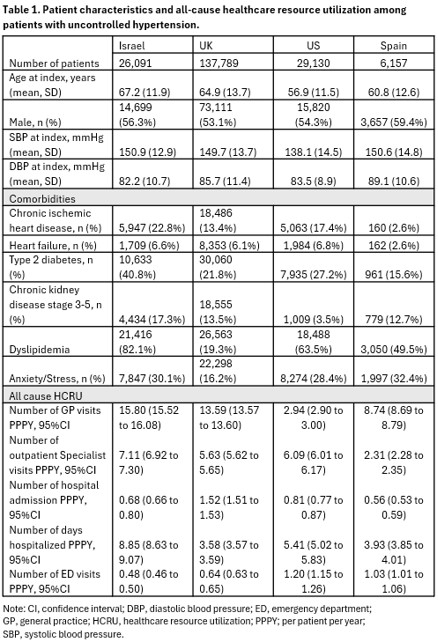
Methods: In this multi-country database cohort study, data from Telotròn (Spain (ESP)), IQVIA Ambulatory EMR linked with IQVIA PharMetrics® Plus claims (US), Clinical Practice Research Datalink (UK) and Meuhedet (Israel (ISR)) from 2018 to 2023 were used, with data anticipated from additional countries. Patients were included if they had a diagnosis of HTN and their first blood pressure (BP) measurement; were being treated with ≥2 antihypertensive medications for ≥30 days (index date) and were above the BP target (US: ≥130/80 mmHg; UK, ESP, and ISR: ≥140/90 mmHg), indicating uncontrolled HTN. Patient characteristics and all-cause HCRU were analyzed descriptively. Results: A total of 199,167 patients with uncontrolled HTN were included (Table 1). The mean age ranged from 56.9 – 67.2 years and 40.6% – 46.9% were female. Mean age was the highest in ISR (67.2 years; standard deviation (SD) 11.9) and lowest in the US (56.9 years; SD 11.5). General practice visit rates were highest in ISR, followed by the UK, ESP and the US. The number of outpatient specialist visits ranged from 2.31 (95%CI 2.28, 2.35) in ESP to 7.11 (6.92, 7.30) per person per year (PPPY) in ISR. The number of hospital admissions ranged between 0.56 (95%CI; 0.53, 0.59) in ESP and 1.52 in the UK (95%CI; 1.51, 1.53) PPPY with mean number of days hospitalized between 3.58 (95%CI; 3.57, 3.59) and 8.85 (95%CI; 8.63, 9.07) PPPY. Lastly, the number of emergency department visits varied the most between the US (1.20 (95%CI; 1.15, 1.26)) and ISR (0.48 (95%CI; 0.46, 0.50)).
Conclusions: Uncontrolled HTN is associated with a substantial burden on healthcare resources. Patterns of HCRU varied across countries, likely reflecting differences in healthcare systems, clinical practice, definitions of uncontrolled HTN and patient demographics.
Ben Dor, Naomi
(
Meuhedet Health Service
, Petah Tikva , Israel )
Bech, Jesper
(
Godstrup Hospital and Aarhus University
, Herning , Denmark )
Suarez Fernandez, Carmen
(
Hospital Universitario de La Princesa Diego de Leon
, Madrid , Spain )
Mccormack, Terry
(
Hull York Medical School
, Hull , United Kingdom )
Bhalla, Vivek
(
Stanford University School of Medicine
, Palo Alto , California , United States )
Weil, Joachim
(
Sana Kliniken Lübeck GmbH
, Luebeck , Germany )
Giannuola, Alexia
(
AstraZeneca
, Barcelona , Spain )
Chen, Jieling
(
AstraZeneca
, Gaithersburg , Maryland , United States )
Coto, Esteban
(
AstraZeneca
, Gaithersburg , Maryland , United States )
Chin, Ken Lee
(
AstraZeneca
, Molndal , Sweden )
Author Disclosures:
Naomi Ben Dor:No Answer
| Ken Lee Chin:DO have relevant financial relationships
;
Employee:AstraZeneca:Active (exists now)
| Jesper Bech:No Answer
| Carmen Suarez Fernandez:No Answer
| Terry McCormack:No Answer
| Vivek Bhalla:DO have relevant financial relationships
;
Advisor:Astra Zeneca:Active (exists now)
; Ownership Interest:Pyrames:Active (exists now)
; Advisor:Bayer:Past (completed)
; Ownership Interest:Nephrogen:Active (exists now)
; Consultant:Nephrogen:Active (exists now)
; Advisor:Medtronic:Active (exists now)
; Advisor:Idorsia:Active (exists now)
| Joachim Weil:DO have relevant financial relationships
;
Speaker:Astra Zeneca:Active (exists now)
| Alexia Giannuola:No Answer
| Jieling Chen:DO have relevant financial relationships
;
Employee:Astrazeneca:Active (exists now)
| Esteban Coto:No Answer