
Logo

American Heart Association

  32
  0


Final ID: MP1019

Association of Gillmore score with presence and development of atrial fibrillation at 1 year in a large, real-world cohort of patients with transthyretin amyloid cardiomyopathy

Abstract Body (Do not enter title and authors here):
Introduction:
Transthyretin amyloid cardiomyopathy (ATTR-CM) is a disease of misfolded transthyretin deposition into cardiac structures, very commonly causing arrythmias. Reports from older amyloid populations have shown that atrial fibrillation (AF) prevalence is higher at higher Gilmore stages. Given that, nowadays, ATTR-CM is being diagnosed at an earlier stage, we sought to reevaluate the association between Gillmore score and prevalence of AF at time of diagnosis and development of AF at one year.
Research Question:
In a large, real-world and recent cohort of patients with ATTR-CM, what is the interaction between a higher Gillmore stage of ATTR-CM and AF?
Methods:
Patient data was obtained from a prospective registry of ATTR-CM patients at our institution from 2015-2024. Patients were excluded from the cohort if they did not have NT-proBNP or eGFR data available within 6 months of ATTR-CM diagnosis. Primary analysis was 1 year outcome of AF or death.
Results:
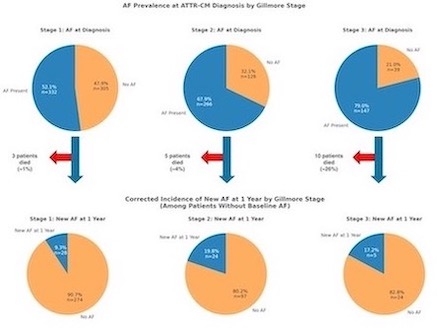
Of the 1380 patients with ATTR-CM, only 1215 patients had NT-ProBNP and eGFR data to be included in the analysis. Of the 1215, 745 (61.3%) had a prior diagnosis of AF at the time of ATTR-CM diagnosis. Most patients (637, 52%) were in Gillmore Stage 1 at ATTR diagnosis. The prevalence of AF at the time of ATTR diagnosis was increasingly higher at higher Gillmore stages (Stage 1: 332/637, 52%; Stage 2: 266/392, 68%; Stage 3: 147/186, 79%). Of the patients alive at 1-year, new AF was present in 9% (28/302) of patients in Gilmore Stage 1, 19% (24/121) in Stage 2, and 17% (5/29) in Stage 3 (Figure 1). The combined outcome of AF and death at 1 year of those who did not have AF at baseline was highest with Gilmore stage 3 (38%) compared to Gilmore Stage 1 (10%) or Stage 2 (23%).
Conclusion:
In our recent cohort of patients, a progressively higher Gillmore score was associated with both a higher prevalence of AF at the time of ATTR-CM diagnosis and development of AF at 1 year after ATTR-CM diagnosis. Death at 1 year following ATTR-CM diagnosis increases exponentially for those at Gilmore stage 3. This study highlights that despite diagnosing ATTR-CM earlier, AF is still highly prevalent even in early stages of the disease and highlights the importance of continued surveillance for the development of AF in ATTR-CM.
  • Zeis, Tessa  ( Cleveland Clinic Foundation , Cleveland , Ohio , United States )
  • Abadie, Bryan  ( Cleveland Clinic Foundation , Cleveland , Ohio , United States )
  • Motairek, Issam  ( Cleveland Clinic Foundation , Cleveland , Ohio , United States )
  • Hanna, Mazen  ( Cleveland Clinic Foundation , Cleveland , Ohio , United States )
  • Jaber, Wael  ( Cleveland Clinic Foundation , Cleveland , Ohio , United States )
  • Author Disclosures:
    Tessa Zeis: DO NOT have relevant financial relationships | Bryan Abadie: DO NOT have relevant financial relationships | Issam Motairek: No Answer | Mazen Hanna: DO have relevant financial relationships ; Advisor:Pfizer:Active (exists now) ; Advisor:Alnylam:Active (exists now) ; Advisor:ATTRALUS:Active (exists now) ; Advisor:Alexion:Active (exists now) ; Advisor:Ionis:Active (exists now) ; Advisor:Bridge Bio:Active (exists now) | Wael Jaber: DO have relevant financial relationships ; Consultant:Boston Scientific:Active (exists now) ; Consultant:Pfizer:Active (exists now)
Meeting Info:

Scientific Sessions 2025

2025

New Orleans, Louisiana

Session Info:

Arrhythmic Risks in Infiltrative Cardiomyopathy: Pathophysiology and Management

Saturday, 11/08/2025 , 03:15PM - 04:30PM

Moderated Digital Poster Session

More abstracts on this topic:
A diagnostic challenge overcome with persistent clinical suspicion in a case of cardiac AL amyloidosis

Zimmerman Allison, Kuriakose Philip, Godfrey Amanda, Ananthasubramaniam Karthikeyan, Cowger Jennifer, Al-darzi Waleed

A DHX38 Spliceosomal Mutation Impairs MYC Signaling, Cardiac Transcriptome Splicing, and Leads to Diastolic Dysfunction

Iwanski Jessika, Sarvagalla Sailu, Methawasin Mei, Van Den Berg Marloes, Churko Jared

More abstracts from these authors:
Association Between PET-Defined Ischemia Severity and LVEF Improvement After PCI

Hajj Joseph, Harb Serge, Menon Venu, Jaber Wael, Abadie Bryan

High Prevalence of Abnormal Baseline PET Imaging for Screening of CAV in Early Post-Heart Transplant Patients

Safdar Ahmad, Prakash Sakthi Surya, Elghoul Yasmine, Bhattacharya Sanjeeb, Tang Wai Hong, Starling Randall, Jaber Wael, Abadie Bryan

You have to be authorized to contact abstract author. Please, Login
Not Available