International Differences in Hemodynamic Response to Balloon Pulmonary Angioplasty in Chronic Thromboembolic Pulmonary Hypertension: A Multicenter Study from Japan and the Netherlands
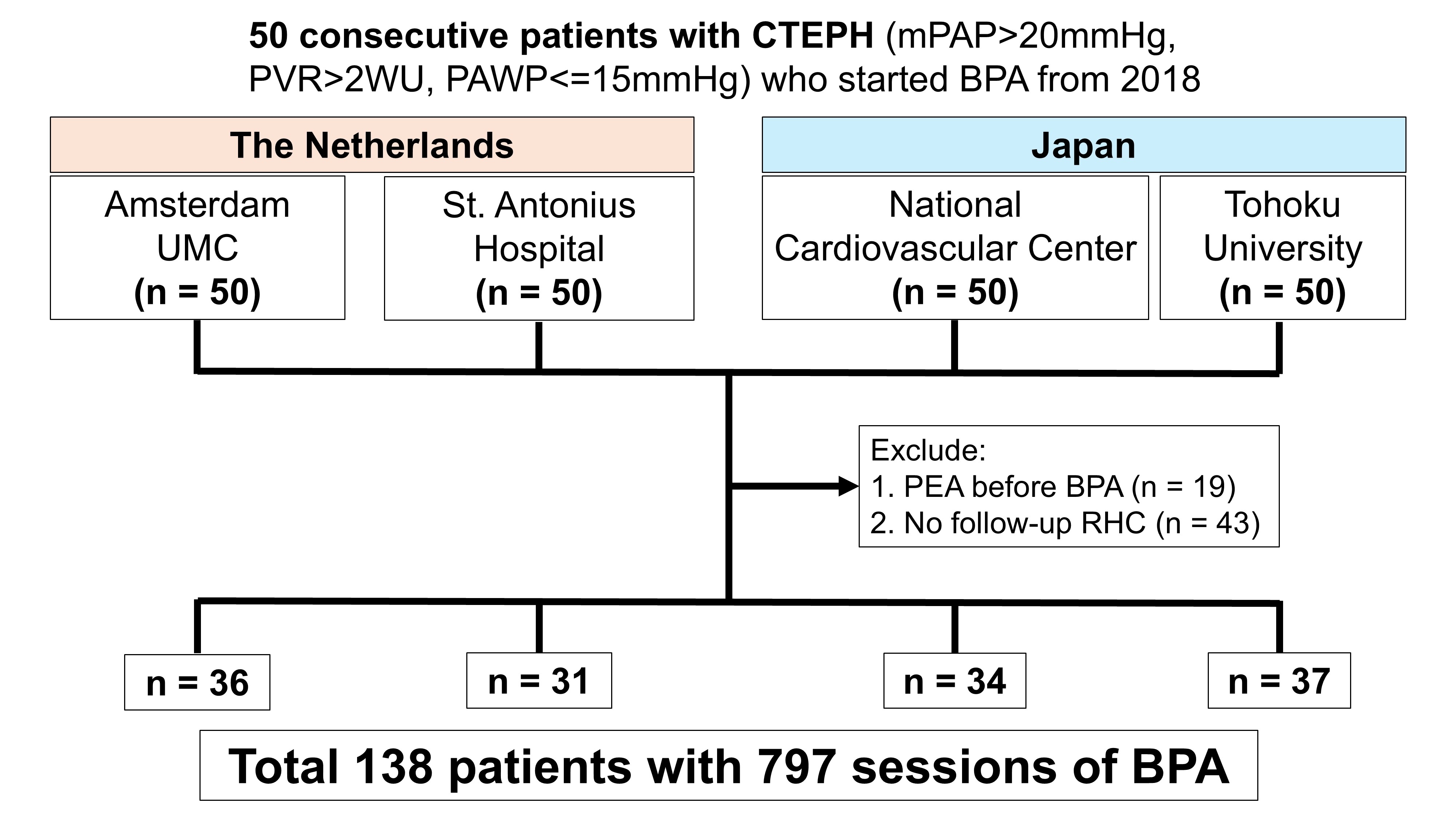
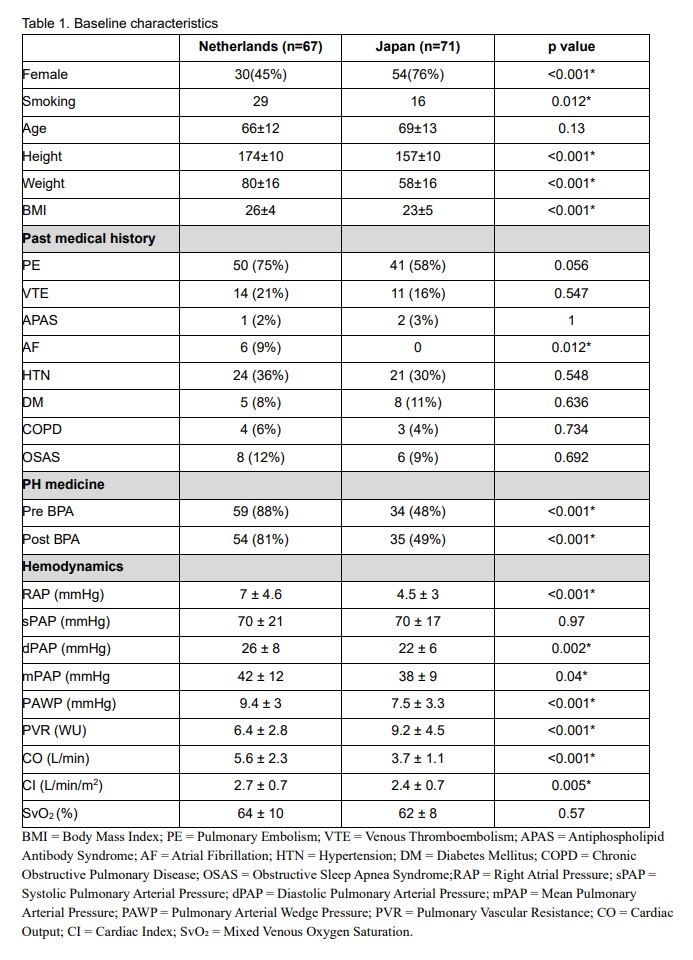
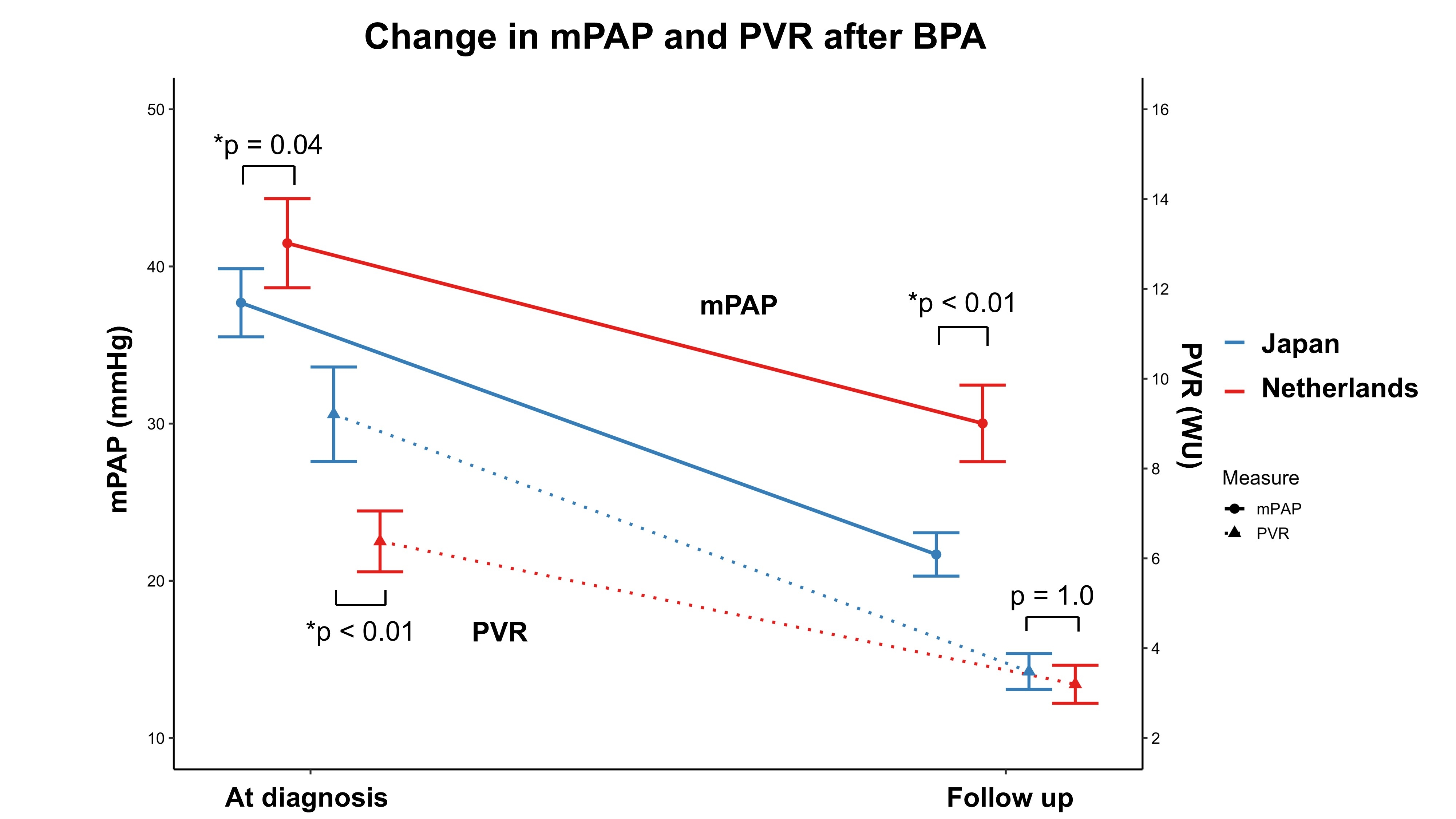
Abstract Body (Do not enter title and authors here): Introduction Prior studies showed notable hemodynamic differences in the response to balloon pulmonary angioplasty (BPA) for chronic thromboembolic pulmonary hypertension (CTEPH) between Japan and European countries. These findings may be explained by differences in patient backgrounds. Research Question This study aims to investigate international differences in hemodynamic outcomes of BPA and to explore the associations between these outcomes and patient backgrounds. Methods Retrospective data was collected from two centers in the Netherlands and two centers in Japan; 50 consecutive patients diagnosed with CTEPH in 2018 were included from each center (Figure 1). Patients scheduled for pulmonary endarterectomy or without follow-up right heart catheterization were excluded. Statistical analyses included chi-square test, independent t-test, and repeated-measures ANOVAs with Bonferroni-corrected post-hoc comparisons. Results A total of 67 patients from the Netherlands and 71 from Japan were included in the analysis (Figure 1). The proportion of male patients, smoking rate, body mass index, and prevalence of atrial fibrillation were significantly higher in the Netherlands (Table 1). At the time of diagnosis, Dutch patients exhibited significantly higher right atrial pressure, mean pulmonary arterial pressure (mPAP), pulmonary arterial wedge pressure (PAWP), cardiac index (CI), and significantly lower pulmonary vascular resistance (PVR) than Japanese patients (Table 1). PH medications were more frequently prescribed in the Netherlands. The median number of BPA sessions was 5 in the Netherlands and 6 in Japan (p = 0.161). Both cohorts demonstrated significant reductions in mPAP and PVR (mPAP: 42 to 30 mmHg in the Netherlands vs. 38 to 22 mmHg in Japan, p < 0.001, PVR: 6.4 to 3.2 WU in the Netherlands vs. 9.2 to 3.5 WU in Japan, p<0.001), and significant increases in PAWP and CI. However, the magnitude of reduction in mPAP and PVR was significantly greater in the Japanese group (p = 0.03 for mPAP and p<0.001 for PVR) (Figure 2). Conclusion Although the number of BPA sessions were similar between the Netherlands and Japan, the effect of BPA on PVR and mPAP was much larger in Japan. Dutch patients had higher CI at baseline and at follow-up, possibly related to a higher use of PAH specific medication. Future multivariate regression analyses will determine which factors contribute to the distinct response to BPA of the 2 cohorts.
Satoshi Higuchi:DO NOT have relevant financial relationships
| Rutger Lelij:No Answer
| TETSUYA FUKUDA:No Answer
| Hideki Ota:DO NOT have relevant financial relationships
| Frances De Man:DO NOT have relevant financial relationships
| Marco Post:DO have relevant financial relationships
;
Research Funding (PI or named investigator):Johnson & Johnson:Active (exists now)
| Takeshi Ogo:DO NOT have relevant financial relationships
| Anton Vonk Noordegraaf:No Answer
| lilian meijboom:DO NOT have relevant financial relationships
| Harm Bogaard:DO have relevant financial relationships
;
Employee:LinXis Biopharmaceuticals:Active (exists now)
; Consultant:Vivus:Past (completed)
; Consultant:Liquidia:Past (completed)
; Research Funding (PI or named investigator):Ferrer:Active (exists now)
; Research Funding (PI or named investigator):MSD:Active (exists now)
; Speaker:MSD:Active (exists now)
; Consultant:Merck:Active (exists now)
| Takatoyo Kiko:No Answer
| Konstantinos Mantzios:DO NOT have relevant financial relationships
| Taijyu Satoh:No Answer
| Staal Diederik:No Answer
| Tamara Rodenburg:No Answer
| Jan Peter van Kuijk:No Answer
| Sanne Boerman:No Answer
| M Beijk:DO NOT have relevant financial relationships