Logo

American Heart Association

  17
  0


Final ID: MP1498

Impact of LDL-C and Apolipoprotein B Discordance and Associated Lipoprotein Particle Changes on Major Adverse Cardiovascular Events in a Large Primary Prevention Cohort

Abstract Body (Do not enter title and authors here): Background: Emerging evidence suggests that ApoB outperforms LDL-C in predicting cardiovascular risk, especially in cases of discordance with the two. However, the specific type and composition of lipoprotein particles in this situation remain unclear. Therefore, our study aimed to assess cardiovascular risk in individuals with discordant LDL-C and ApoB levels and explore the associated changes in lipoprotein particles.
Research Question: What are the associated changes in lipoprotein particle composition in individuals with discordant ApoB and LDL-C levels?
Methods: 274,243 individuals were enrolled from the UK Biobank without baseline cardiovascular disease, not on lipid-lowering therapy, and with available lipid nuclear magnetic resonance (NMR) data. Based on whether the absolute difference in baseline percentile of LDL-C and ApoB level was over 10 units, participants were categorized into concordant group, discordantly high ApoB group (ApoB percentile rank minus LDL-C percentile rank > 10 units), and discordantly low ApoB group (LDL-C percentile rank minus ApoB percentile rank > 10 units). The median follow-up duration was 10.9 years, with major adverse cardiovascular events (MACE) as the primary endpoint.
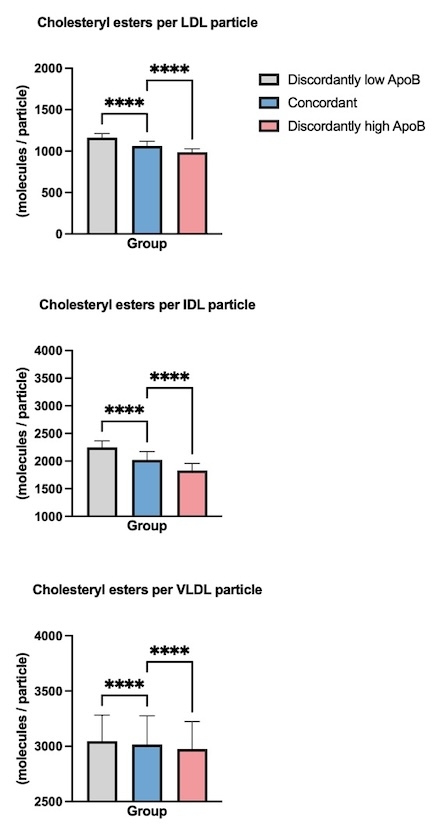
Results: Cox regression analysis (Image 1) showed that the risk of MACE was increased in the discordantly high ApoB group (HR, 1.15; 95% CI, 1.10-1.21; P < 0.001) and reduced in the discordantly low ApoB group (HR, 0.75; 95% CI:0.71-0.81; P < 0.001). Compared to the other two groups, the discordantly high ApoB group exhibited the highest concentrations of VLDL-C, VLDL cholesteryl ester (CE), and VLDL particles. However, the CE content per LDL, IDL, and VLDL particle was lower in this group (Image 2). Mediation analysis (Image 3) revealed that VLDL-C and VLDL particle concentration mediated 41.13% and 25.46% of the MACE risk, respectively, in the discordantly high ApoB group (P < 0.001).
Conclusion: ApoB is a more comprehensive marker of cardiovascular risk, with increased ApoB in discordant group mainly driven by VLDL particles, highlighting the importance of VLDL management in individuals with discordant LDL-C and ApoB levels.
  • Du, Yuan  ( Fuwai hospital , Beijing , China )
  • Guo, Yuanlin  ( Fuwai hospital , Beijing , China )
  • Author Disclosures:
    Yuan Du: DO NOT have relevant financial relationships | Yuanlin Guo: DO NOT have relevant financial relationships
Meeting Info:

Scientific Sessions 2025

2025

New Orleans, Louisiana

Session Info:

Cholesterol Chronicles: Lipid Markers and Cardiovascular Disease

Sunday, 11/09/2025 , 11:50AM - 01:05PM

Moderated Digital Poster Session

More abstracts on this topic:
A Health Coach-Based Multi-Level Personalized Strategy Lowers LDL-Cholesterol and Enhances Lipid Control in Veterans with Atherosclerotic Cardiovascular Disease – The VA Lipid Optimization Reimagined Quality Improvement Project at VA New York Harbor Healthcare System

Chen Tina, Ingerman Diana, Haley Leah, Salovaara Priscilla, Nicholson Andrew, Illenberger Nicholas, Natarajan Sundar

A 3-Year, Pre-Trial, Real-world Data Analysis of Patients Enrolled in VICTORION-INITIATE: Insights Using Tokenization

Rodriguez Fatima, Cosmatos Irene, Desai Nihar, Wright R, Ross Elsie, Ali Yousuf, Kumar Biswajit, Han Guangyang, Cai Beilei, Abbas Cheryl, Ryan Amy

You have to be authorized to contact abstract author. Please, Login
Not Available