Logo

American Heart Association

  18
  0


Final ID: MP1194

Integrating Polygenic and Clinical Risk Factors Enhances Stability of Coronary Artery Disease Risk Prediction

Abstract Body (Do not enter title and authors here):
Introduction
The interest in using Polygenic Risk Scores (PRSs) for CAD risk assessment is growing, but variability in individual risk estimates between different PRS models is a significant concern for their use in primary prevention treatment guidance. This study examines the impact of integrating PRSs with an established clinical model in reducing variability and stabilizing the classification of high-risk individuals.
Methods
Using a cohort of 195,688 participants (6,751 incident cases) from the UK Biobank, who were CAD-free at baseline, we compared the stability of PRS-only models with those integrated with the Pooled Cohort Equations (PCE) for 10-year atherosclerotic cardiovascular disease (ASCVD) risk assessment. We analyzed 14 CAD PRSs from the PGS catalog, developed independently of UK Biobank, and ensemble PRS models combining multiple scores. We used the coefficient of variation (CV) as a scale-independent metric to compare individual-level prediction variability between PRS percentiles and absolute risk estimates from integrated PRS models. To evaluate agreement in classifying high-risk participants, we used the Jaccard index.
Results
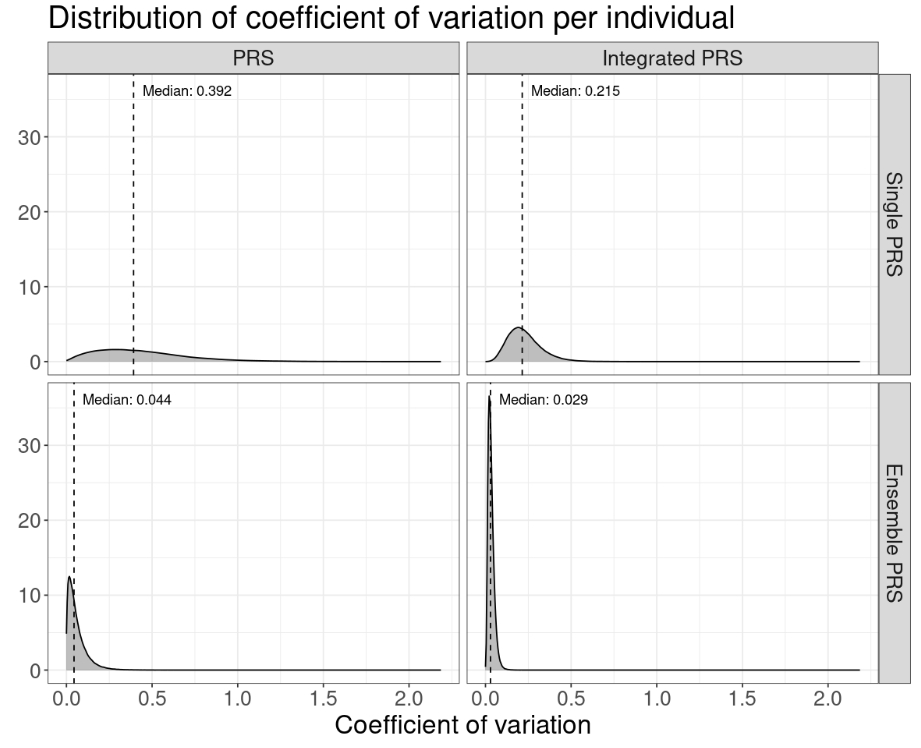
The variability in individual-level risk estimates from models integrating PRS with ASCVD-PCE was lower than predictions based solely on PRS. The CV of individual-level predictions across the top 5 PRSs was 0.392, compared to 0.215 for the corresponding integrated models. Combining PRSs into ensembles further stabilised predictions, with a median CV of 0.044 and 0.029 across the top 5 PRS ensembles and their integrated models, respectively.
Consistency in classifying high-risk individuals also improved upon integrating PRS with ASCVD-PCE. The median Jaccard index for single PRS-based classifications (top 5%) was 0.113, compared to 0.497 for the integrated PRS (≥7.5% absolute risk). Similarly, the median Jaccard index was 0.262 for ensemble PRSs and 0.59 for their integrated PRS. Notably, classification concordance improved with successive PRS ensemble iterations (incorporating newly released PRSs), with the Jaccard index ranging from 0.86 to 0.97 between the 5 latest integrated PRS ensembles.
Conclusions
Integrating PRSs with clinical risk factors enhances the accuracy and stability of CAD risk predictions, making it superior in comparison to classification based solely on PRS percentiles. Ensemble PRS models present a promising method for incorporating newly developed PRSs, further boosting performance and stability.
  • Ratman, Dariusz  ( MyOme, Inc , Menlo Park , California , United States )
  • Maier, Robert  ( MyOme, Inc , Menlo Park , California , United States )
  • Kumar, Akash  ( MyOme, Inc , Menlo Park , California , United States )
  • Im, Kate  ( MyOme, Inc , Menlo Park , California , United States )
  • Rabinowitz, Matthew  ( MyOme, Inc , Menlo Park , California , United States )
  • Fahed, Akl  ( Massachusetts General Hospital , Boston , Massachusetts , United States )
  • Author Disclosures:
    Dariusz Ratman: DO have relevant financial relationships ; Employee:MyOme, Inc:Active (exists now) | Robert Maier: No Answer | Akash Kumar: DO have relevant financial relationships ; Executive Role:MyOme:Active (exists now) | Kate Im: DO have relevant financial relationships ; Employee:MyOme Inc:Active (exists now) | Matthew Rabinowitz: No Answer | Akl Fahed: No Answer
Meeting Info:

Scientific Sessions 2025

2025

New Orleans, Louisiana

Session Info:

Multi-Omic Insights into Coronary Artery Disease 1

Saturday, 11/08/2025 , 03:15PM - 04:15PM

Moderated Digital Poster Session

More abstracts on this topic:
A multi-task deep learning algorithm for detecting obstructive coronary artery disease using fundus photographs

Zeng Yong, Ding Yaodong

Age-Varying Implications of Recalibration of Cardiovascular Disease Risk Prediction in a New England-Based Healthcare System

Cho So Mi, Natarajan Pradeep, Rivera Rachel, Koyama Satoshi, Kim Min Seo, Honigberg Michael, Bhattacharya Romit, Paruchuri Kaavya, Allen Norrina, Hornsby Whitney

More abstracts from these authors:
Multidomain Risk Profiles and Disease Progression Across Atherosclerotic Vascular Beds

Supriami Kelvin, Flores Alyssa Monica, Urbut Sarah, Aragam Krishna, Natarajan Pradeep, Ellinor Patrick, Fahed Akl

Interactions Between Polygenic Risk Scores and Social Determinants of Health in Coronary Artery Disease: Insights from the UK Biobank

Sadek Carl, Lambermont Jul, Supriami Kelvin, Natarajan Pradeep, Fahed Akl

You have to be authorized to contact abstract author. Please, Login
Not Available