
Logo

American Heart Association

  17
  0


Final ID: MP21

Burden of coronary artery disease in cryptogenic ischemic stroke patients aged ≥50 years: A multimodality-imaging study

Abstract Body (Do not enter title and authors here): Background/Purpose: Cryptogenic stroke (CS) is defined as an ischemic stroke with no identifiable cause. We investigate the burden of obstructive and non-obstructive coronary artery disease (CAD) in patients with CS and the impact of CAD on new vascular events and mortality during a 6-year follow up.
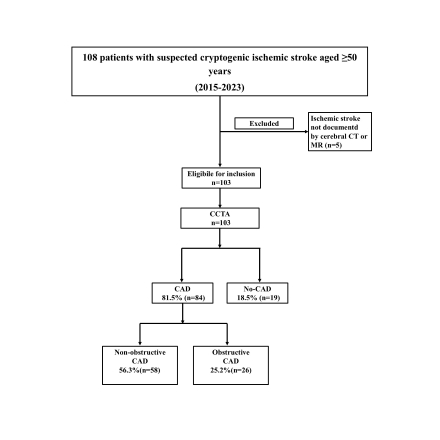
Methods: A total of 103 patients were enrolled in the present prospective observational NORSTROKE (Norwegian Stroke Research Registry) sub-study of patients ≥50 years with a documented CS (Figure). Clinical characteristics, echocardiographic, coronary imaging, vascular ultrasound, and 24-hour Holter-monitoring data were analysed.
Results: The mean age was 67.9 (±8.2) years, with 70.9% (n=73) males. CAD was present in 81.5% (n=84), (non-obstructive 56.3% (n=58) and obstructive 25.2% (n=26)). New-onset atrial fibrillation was detected in 15.5% (n=16), two had thrombus in left atrial appendage (LAA) on cardiac CT. During a mean follow-up of 6.2 (±2.3) years, 14 (13.6%) died, and 29 (28.2%) experienced a composite endpoint of new stroke and/or death. In the multivariate Cox regression model CAD was an independent predictor of the composite endpoint of death or recurrent ischemic stroke (HR 2.70; 95% CI 1.13-6.21, p=0.024) adjusted for age, gender, smoking, new-onset atrial fibrillation, hypertension, and cardiac Troponin T.
Conclusion: In patients with CS, CAD was highly prevalent and an independent predictor of recurrent stroke and mortality. While new-onset atrial fibrillation was observed in nearly every sixth patient, the incidence of LAA thrombus was very low, suggesting other mechanisms may contribute to stroke in these patients. Cardiovascular assessment is important in patients with CS to identify high-risk individuals to potentially reduce stroke recurrence and mortality.
  • Jibril, Khuluud  ( Haukeland University Hospital , Bergen , Norway )
  • Saeed, Sahrai  ( Haukeland University Hospital , Bergen , Norway )
  • Skaar, Elisabeth  ( Haukeland University Hospital , Bergen , Norway )
  • Nawaz, Beenish  ( Haukeland University Hospital , Bergen , Norway )
  • Waje-andreassen, Ulrike  ( Haukeland University Hospital , Bergen , Norway )
  • Ali, Abukar  ( Haukeland University Hospital , Bergen , Norway )
  • Gradek, Grzegorz  ( Heart and Lung Center , Bergen , Norway )
  • Larsen, Terje Hjalmar  ( Haukeland University Hospital , Bergen , Norway )
  • Bleie, Øyvind  ( Haukeland University Hospital , Bergen , Norway )
  • Naess, Halvor  ( Haukeland University Hospital , Bergen , Norway )
  • Author Disclosures:
    Khuluud Jibril: DO NOT have relevant financial relationships | Sahrai Saeed: No Answer | Elisabeth Skaar: DO NOT have relevant financial relationships | Beenish Nawaz: DO NOT have relevant financial relationships | Ulrike Waje-Andreassen: No Answer | Abukar Ali: DO NOT have relevant financial relationships | Grzegorz Gradek: DO NOT have relevant financial relationships | Terje Hjalmar Larsen: No Answer | Øyvind Bleie: DO NOT have relevant financial relationships | Halvor Naess: No Answer
Meeting Info:

Scientific Sessions 2025

2025

New Orleans, Louisiana

Session Info:

Stroke Mortality, Mechanisms, and Disparities: Trends, Timing, and Technologies

Saturday, 11/08/2025 , 01:45PM - 02:55PM

Moderated Digital Poster Session

More abstracts from these authors:
Burden of coronary artery disease predicts mortality in ischaemic stroke patients: The Norwegian Stroke in the Young Study

Jibril Khuluud Abdi, Saeed Sahrai, Nawaz Beenish, Waje-andreassen Ulrike, Naess Halvor, Fromm Annette, Ali Abukar, Larsen Terje Hjalmar, Bleie Oyvind, Kuiper Kier Jan

You have to be authorized to contact abstract author. Please, Login
Not Available