Mortality Trends Among Insulin-Dependent Diabetics Developing Ischemic Heart Disease: A CDC Wonder Retrospective Analysis 1999-2023
Abstract Body (Do not enter title and authors here): Background: Ischemic heart disease (IHD) is one of the most common causes of sudden cardiac death, with insulin-dependent diabetes mellitus (IDDM) affected patients emerging with more disease burden in said population. The correlation between IDDM and IHD hasn't been explored thoroughly enough, including the intersection of variables that affect both conditions.
Research Question : The purpose of this study was to observe national trends in IHD-related mortality among adults ≥25 years with comorbid IDDM in the U.S from 1999 to 2023 and how these vary by year, gender, race, and region in the U.S.
Methods: We utilized the CDC WONDER(Centers for Disease Control and Prevention Wide-Ranging Online Data for Epidemiologic Research) Database to examine the mortality rates among adults aged ≥ 25 years affected with IHD and IDDM from 1999 to 2023. The International Classification of Diseases, Tenth Revision(ICD-10 codes) were used to associate deaths due to IHD (I20-I25) and IDDM (E10). The annual percentage change (APC) for age-adjusted mortality rates per 100,000 (AAMRs) was calculated using Joinpoint regression with a 95% confidence interval (CI).
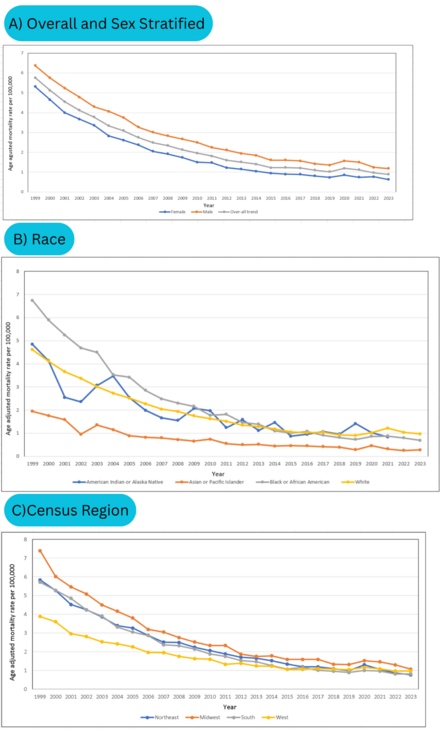
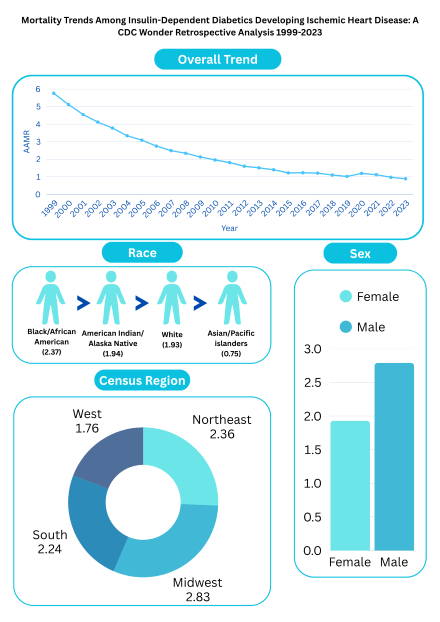
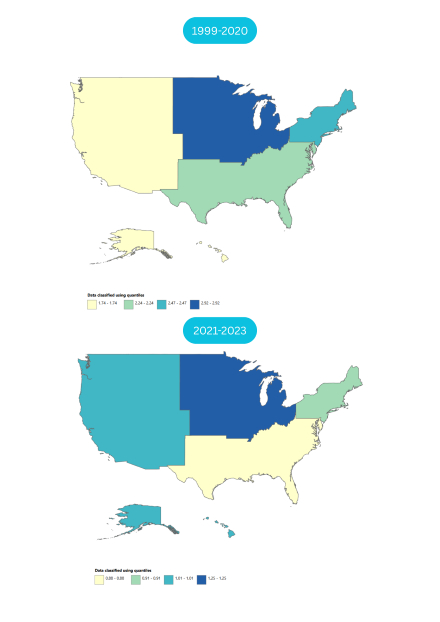
Results: Between 1999 and 2023, there were a total of 118,810 deaths (males=62,908, females=55,902) among adults aged ≥25 years with IDDM and IHD. The overall AAMR decreased from 5.76 per 100,000 in 1999 to 1.22 in 2015, with an average APC of -9.04 (95% CI: -9.39 to -8.68), then to 1.12 in 2021 (APC: 1.65, 95% CI: -4.44 to 1.22), followed by a slow decline to 0.89 in 2023(APC: -10.51, 95% CI: -24.12 to 5.54). Mortality was consistently higher in males (1999=6.37, 2023=1.18) compared to females (1999=5.31, 2023=0.63). Among racial groups, Black/African Americans had the highest average AAMR (2.37), followed by American Indian or Alaska Native(1.94), Whites(1.93), and Asian or Pacific Islanders(0.75). The Midwest region had the highest average AAMR(2.83), followed by the Northeast(2.36), South(2.24), and West(1.76) regions.
Conclusion: While there has been a significant overall decrease in IHD-related mortality among insulin-dependent diabetics in the U.S, there are continuing disparities between different regions and demographic segments. The highest AAMRs were noted among males, Black or African Americans, and residents of the Midwest region. These findings underscore the importance of tailored health interventions and further research to address these disparities.
Jadoon, Muhammad Salar Khan
(
Shifa College of Medicine
, Islamabad , Pakistan )
Ahmed, Ibrahim
(
Shifa College of Medicine
, Islamabad , Pakistan )
Sibt E Haider, Syed
(
Shifa College of Medicine
, Wah Cantt , Pakistan )
Al Zora, Fatima
(
Jinnah Medical And Dental College
, Karachi , Pakistan )
Rafiq, Anusha
(
Sindh Medical College
, Karachi , Pakistan )
Touseef, Muhammad
(
Univ. College of Medicine and dent.
, Lahore , Pakistan )
Rehman, Amtul
(
Dow University of Health Sciences
, Karachi , Pakistan )
Author Disclosures:
Muhammad Salar Khan Jadoon:DO NOT have relevant financial relationships
| Hafsa Javed:No Answer
| Shaiza Maryam:DO NOT have relevant financial relationships
| Laiba Warraich:DO NOT have relevant financial relationships
| Affaf Mahmood:DO NOT have relevant financial relationships
| Anusha Rafiq:No Answer
| Muhammad Touseef:DO NOT have relevant financial relationships
| Amtul Rehman:No Answer
| Ibrahim Ahmed:DO NOT have relevant financial relationships
| Syed Sibt E Haider:DO NOT have relevant financial relationships
| Fatima Al Zora:No Answer
| Duaa Jaffar:No Answer
| Fatima Naveed:No Answer
| IFFAH ZAFAR GONDAL:No Answer
| Marian Harrison:No Answer
| Eisha Abid:DO NOT have relevant financial relationships
Buhadur Ali Muhammad Khan, Shahzaib Muhammad, Qureshi Muhammad Ahmad, Ammar Ur Rahman Mohammad, Munir Luqman, Khalid Amna, Hayat Malik Saad, Shoaib Muhammad Mukarram