
Logo

American Heart Association

  19
  0


Final ID: MP679

Jugular Approach for Leadless Pacemaker Implant: A Single-Arm Meta-Analysis of Efficacy and Safety Across Adult and Pediatric Populations

Abstract Body (Do not enter title and authors here):
Background: Leadless pacemaker therapy has emerged as a transformative alternative to conventional transvenous systems, mitigating lead- and pocket-related complications. While the femoral vein remains the standard access route, anatomical constraints and vascular complications have prompted exploration of the internal jugular vein (IJV) as a viable alternative for successful procedure in both adult and pediatric populations.

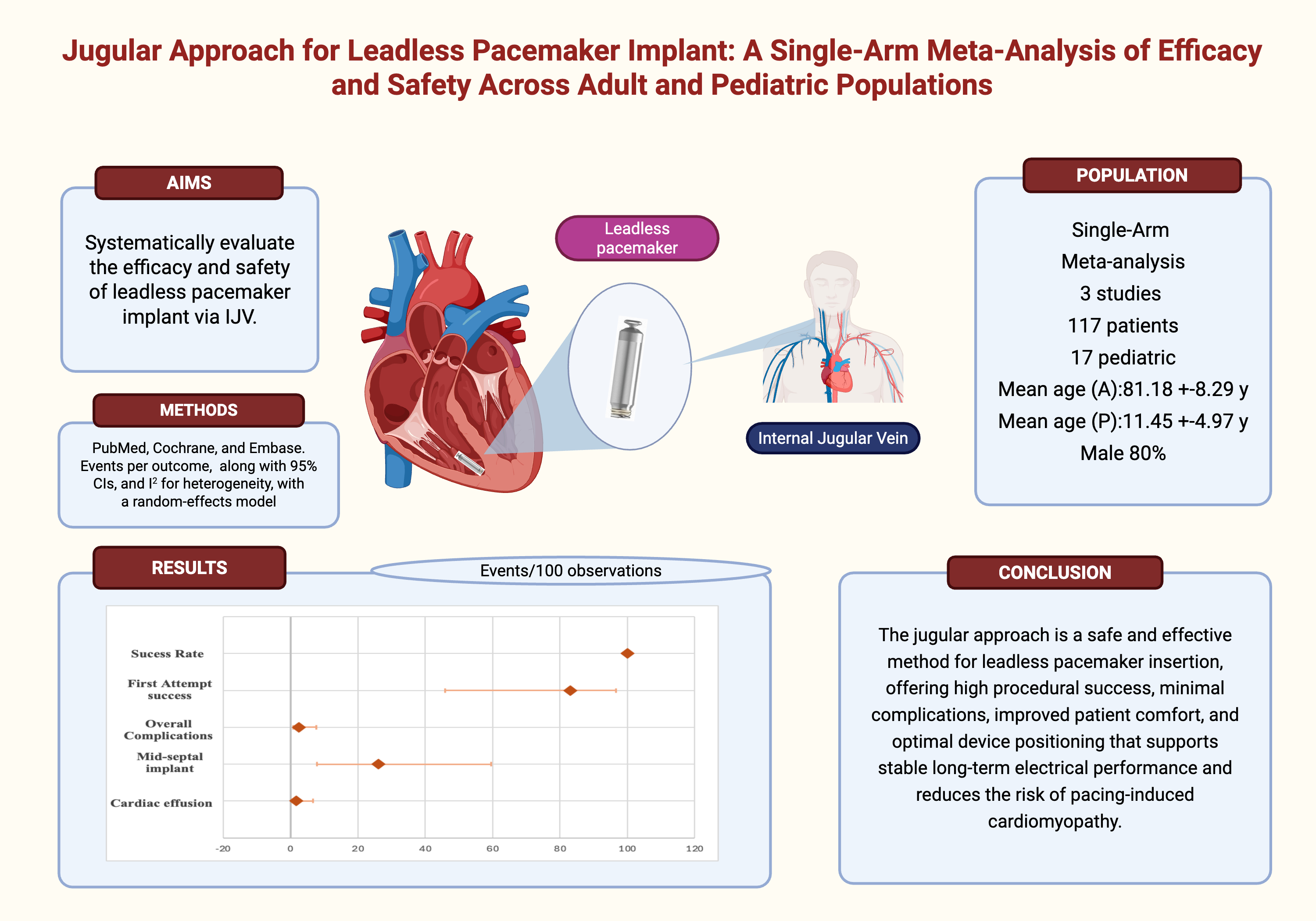
Purpose: Systematically evaluate the efficacy and safety of leadless pacemaker implant via the IJV.

Methods: Multiple databases were searched up to May 2025 for studies evaluating the efficacy and safety of leadless pacemaker implant IJV access. The extracted data of three studies included procedural success rates, complication incidence, and electrical performance parameters. Prevalences were pooled using events per outcome group and mean differences (MDs), along with 95% confidence intervals (CIs), and I2 for heterogeneity, employing the Mantel-Haenszel random-effects model.

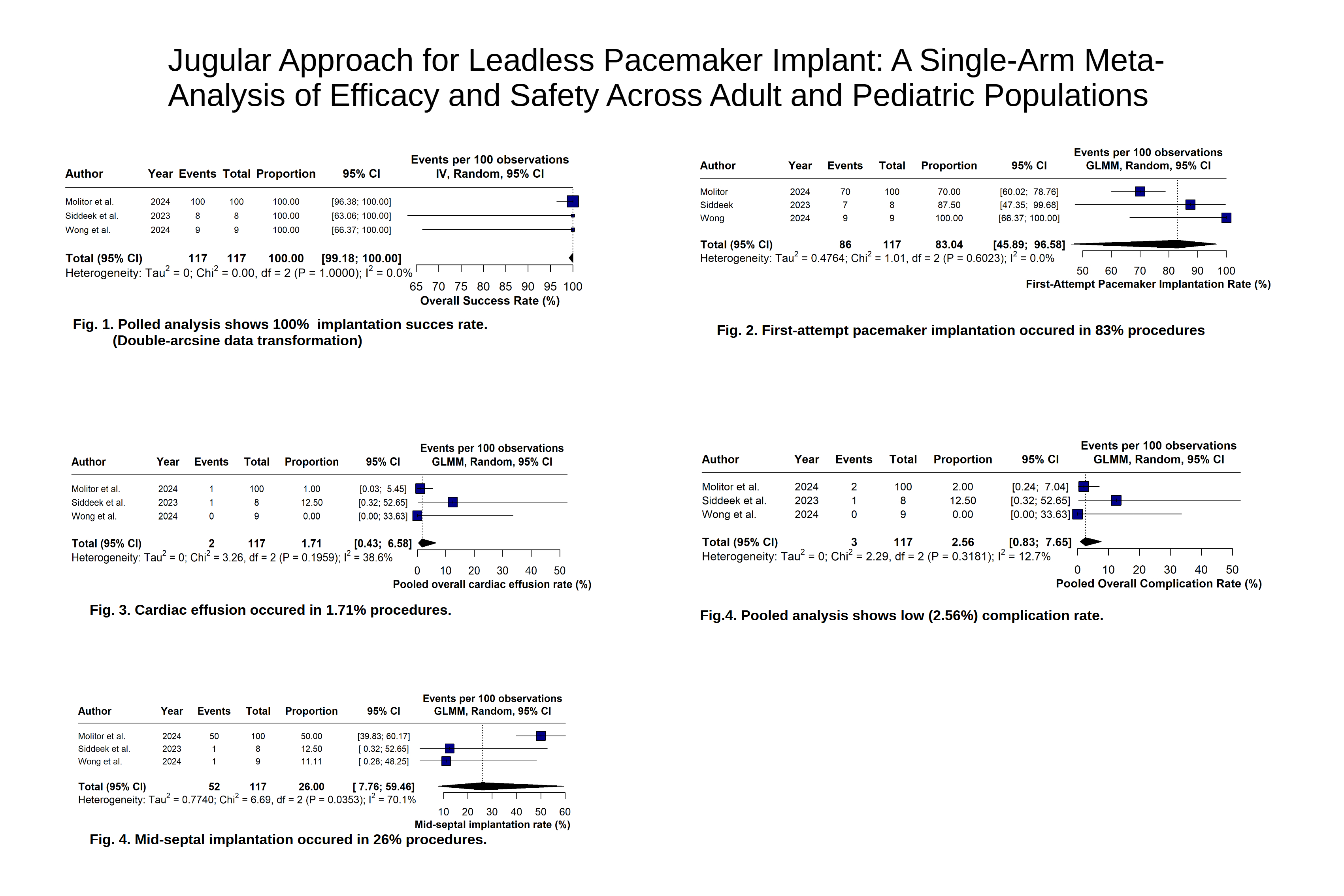
Results: Three observational studies comprising 117 patients were included, with 100 adults (mean age: 81.18 ± 8.29 years) and 17 children (mean age: 11.45 ± 4.97 years). The IJV achieved a 100% procedural success rate (95% CI: 99.18%–100%) in both adult and pediatric populations, with no need for femoral bailout access or reported vascular complications. The pooled first-attempt success rate was 83% (95% CI: 45.89%–96.58%). The overall complication rate was low at 2.56% (95% CI: 0.83%–7.65%), including a 1.71% incidence of cardiac effusion (95% CI: 0.43%–6.58%). Successful mid-septal implantation was achieved in 26% of cases (95% CI: 7.76%–59.46%). Post-procedural pacing parameters as impedance, R-wave sensing, and threshold, were within acceptable limits at procedure completion and remained stable during follow-up (range: 0.5 - 43 months).

Conclusion: The IJV approach has emerged as a highly effective and safe strategy for leadless pacemaker implantation. It offers several compelling advantages, including high procedural success, low complication rates, and improved patient comfort. Notably, IJV access enables optimal non-apical device positioning, which may reduce the risk of pacing-induced cardiomyopathy while maintaining favorable and stable long-term electrical parameters. Further large-scale, randomized studies are needed to validate these promising outcomes and support broader adoption of the IJV approach.
  • Gminski, Wiktor  ( Polyclinical Hospital in Torun , Torun , Poland )
  • Nathan, Chetna  ( Gandhi Medical College , Hyderabad , Telangana , India )
  • Chekhava, Darya  ( St Barnabas Hospital , New Rochelle , New York , United States )
  • Stefanis, Athanasios  ( Third Faculty of Medicine, Charles University , Prague , Czechia )
  • Dandamudi, Mrunalini  ( Montefiore Einstein Hospital , New rochelle , New York , United States )
  • Torpoco Rivera, Midori  ( UPMC , West Mifflin , Pennsylvania , United States )
  • Giorgi, Juliana  ( HOSPITAL SIRIO LIBANES , Sao Paulo , Brazil )
  • Author Disclosures:
    Wiktor Gminski: DO have relevant financial relationships ; Speaker:AstraZeneca:Past (completed) ; Other (please indicate in the box next to the company name):Biotonik, workshop fees:Past (completed) ; Other (please indicate in the box next to the company name):Abbott, workshop fees:Past (completed) | Chetna Nathan: No Answer | Darya Chekhava: DO NOT have relevant financial relationships | Athanasios Stefanis: DO NOT have relevant financial relationships | Mrunalini Dandamudi: DO NOT have relevant financial relationships | Midori Torpoco Rivera: DO NOT have relevant financial relationships | Juliana Giorgi: DO NOT have relevant financial relationships
Meeting Info:

Scientific Sessions 2025

2025

New Orleans, Louisiana

Session Info:

Novel Innovations and Techniques for Leadless Pacing

Saturday, 11/08/2025 , 01:45PM - 02:55PM

Moderated Digital Poster Session

More abstracts on this topic:
A Phase 2a randomized controlled trial of once-daily versus twice-daily remote ischemic conditioning in vascular cognitive impairment (TRIC-VCI)

Ganesh Aravind, Mccreary Cheryl, Sahlas Demetrios, Sharma Mukul, Swartz Richard, Smith Eric, Barber Philip, Black Sandra, Corbett Dale, Field Thalia, Frayne Richard, Hachinski Vladimir, Ismail Zahinoor, Mai Lauren

Accelerated Pacing Reverses Ventricular Stiffening in a Rodent Model of Diastolic Dysfunction

Kabir Raihan, Hancock Emmaleigh, Wetzel Melinda, Shrier Julia, Palmer Bradley, Habel Nicole, Caporizzo Matthew

More abstracts from these authors:
You have to be authorized to contact abstract author. Please, Login
Not Available