Temporal Trends in Cardiometabolic Risk Among U.S. Women Veterans: Widening Racial and Age-Based Disparities over a 20-year period
Abstract Body (Do not enter title and authors here): Introduction: Cardiometabolic risk factors remain the leading cause of cardiovascular disease (CVD) and death in the US. US women veterans (WV) are a growing, high-risk population with higher rates of chronic conditions and increasing engagement with veteran affair (VA) healthcare yet remain understudied.
Objectives: This study aimed to investigate the potential ethnic/racial and age group differences in the life-long prevalence of traditional cardiometabolic risk factors among US WV from 2000-2019.
Methods: The national VA electronic health records (her) were used to assess the prevalence of diabetes, hypertension, hyperlipidemia, smoking, and neuroendocrine disorders among US WV who visited a VA facility from 1/1/2000 to 12/31/2019. Diagnoses were based on international classification of disease (ICD)-9 and -10 codes. Participants were stratified by races/ethnicities (non-Hispanic White, Black, Asian, American Indian/Pacific Islander, and Hispanic/Latino) and age group (18-39, 40-59, 60+). Age-standardized lifelong prevalence of CVD risk factors was assessed overall, by races/ethnicities, and by age groups. Age-standardized lifelong prevalence represents the sum of raw age-specific risk factor rates multiplying the standard age-specific proportion in the 2000 U.S. census reference population
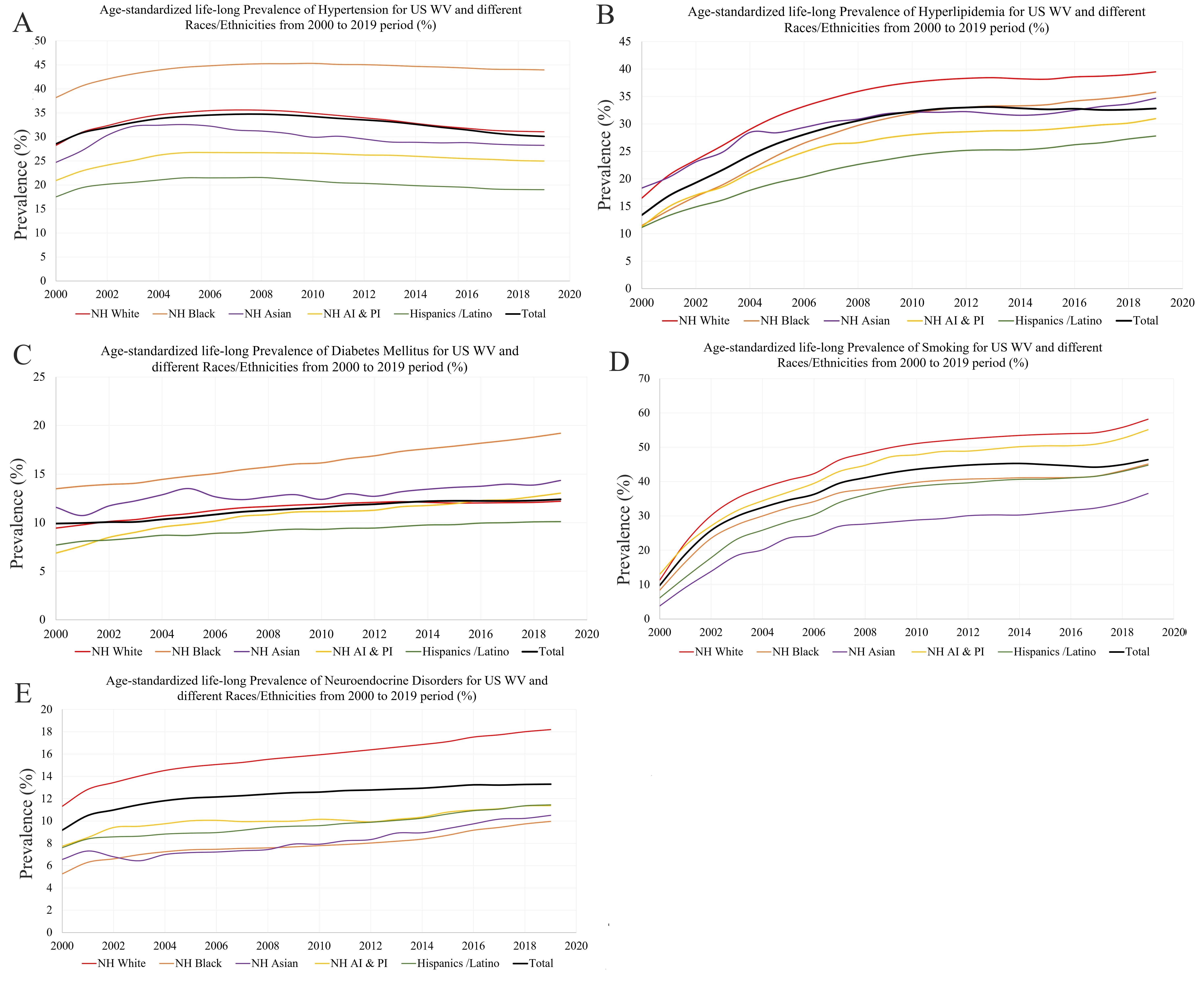
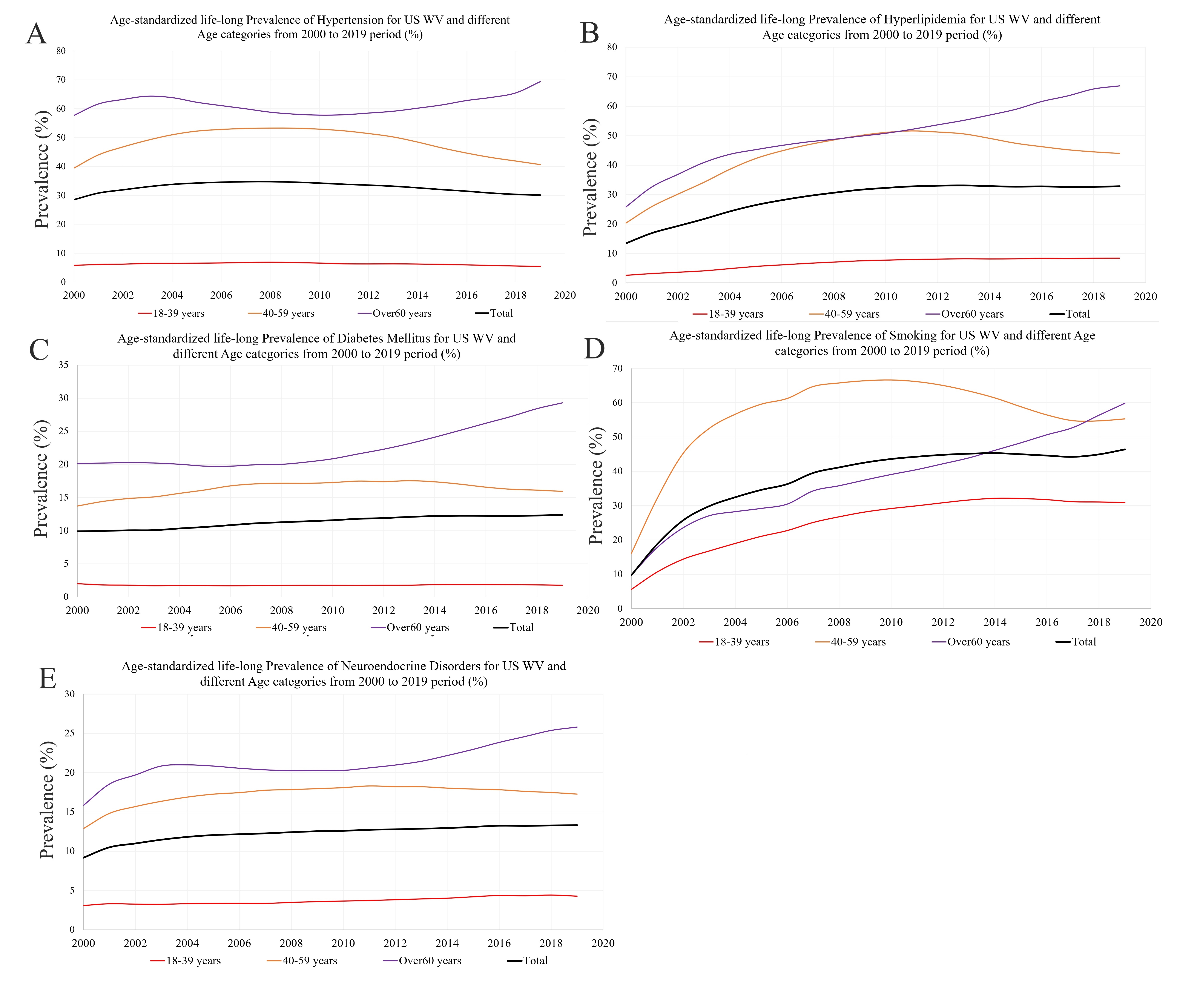
Results: The WV cohort expanded from 80,707 in 2000 to 739,309 in 2019. Significant racial/ethnic disparities emerged. Blacks demonstrated the highest prevalence of diabetes (from 13.5% to 19.2%) and hypertension (38.2% to 43.9%). Notably, American Islanders showed the most rapid escalation in diabetes (1.9-fold increase). Whites maintained the highest prevalence of smoking, hyperlipidemia, and neuroendocrine disorders. Asians experienced a 9.6-fold surge in smoking (3.8% to 36.5%), while Black saw a 3.1-fold rise in hyperlipidemia (11.5% to 35.8%) and a 3.1-fold rise in neuroendocrine disorders. The remaining subgroups exhibited absolute prevalence increases of approximately 40% for smoking and 20% for hyperlipidemia. Marked age-related patterns also emerged. The 60+ age group had the highest prevalence of risk factors from 2000-2019, except smoking. This group also exhibited the greatest fold increases in every category except hypertension.
Conclusion: The cardiometabolic risk burden among U.S. women veterans has reached critical levels, with pronounced racial/ethnic and age group disparities, necessitating immediate targeted public health interventions.
Xu, Lingyu
(
University of Pennsylvania
, Philadelphia , Pennsylvania , United States )
Galal, Bayan
(
University of Pennsylvania
, Philadelphia , Pennsylvania , United States )
Zarrinfar, Eli
(
University of California Berkeley
, Berkeley , California , United States )
Xu, Yuancheng
(
Baoan Central Hospital of Shenzhen
, Shenzhen , China )
Hrybouski, Stanislau
(
University of Pennsylvania
, Philadelphia , Pennsylvania , United States )
Ebrahimi, Ramin
(
UCLA
, Los Aeles , California , United States )
Author Disclosures:
Lingyu Xu:DO NOT have relevant financial relationships
| Bayan Galal:DO NOT have relevant financial relationships
| Eli Zarrinfar:DO NOT have relevant financial relationships
| Yuancheng Xu:No Answer
| Stanislau Hrybouski:No Answer
| Ramin Ebrahimi:DO NOT have relevant financial relationships
Ali Muhammad Faizan, Khan Muhammad, Sharif Aleena, Hossain Mohammad, Ahmad Husnain, Eltawansy Sherif, Faizan Muhammad, Ahmed Ashraf, Abdul Malik Mohammad Hamza Bin, Pahwani Ritesh, Patel Rahul, Mehdi Hassan