
Logo

American Heart Association

  19
  0


Final ID: MP2183

Differential impact of aging on cardiovascular disease risk in male military service members

Abstract Body (Do not enter title and authors here): Introduction: Atherosclerotic cardiovascular disease (ASCVD) is the leading cause of death in male service members and veterans. This study assessed the 10-year ASCVD risk in male military service members and veterans using the model construct of the VA women CVD risk score and the 2013 ACC/AHA ASCVD risk calculator using direct military health system and Veterans Affairs (VA) Electronic Health Records (EHR) data extracted from national VA corporate data warehouse (CDW) database.
Research hypothesis: Military exposure at earlier life may lead to poorer health and ultimately decreased longevity. We hypothesize that military services in earlier life may alter aging trajectory and ASCVD risk—elevated risk of ASCVD events at a younger age than 40.
Methods: We retrospectively followed 3.6 million Non-Hispanic (N-H) White (n=2,823,446) and Black (n=734,940) male military service members aged 20-79 from 2012 to 2024 (development cohort). Risk factors and ASCVD events (non-fatal myocardial infarction, non-fatal stroke, cardiac arrests, and cardiac deaths) were identified using diagnostic and procedural codes from Electronic Health Records (EHR) data. Following the same constructs of the VA women CVD risk score and the 2013 ACC/AHA ASCVD risk calculators, coefficients for risk factors were estimated for men by applying time-varying Cox models to the study male development cohort data.
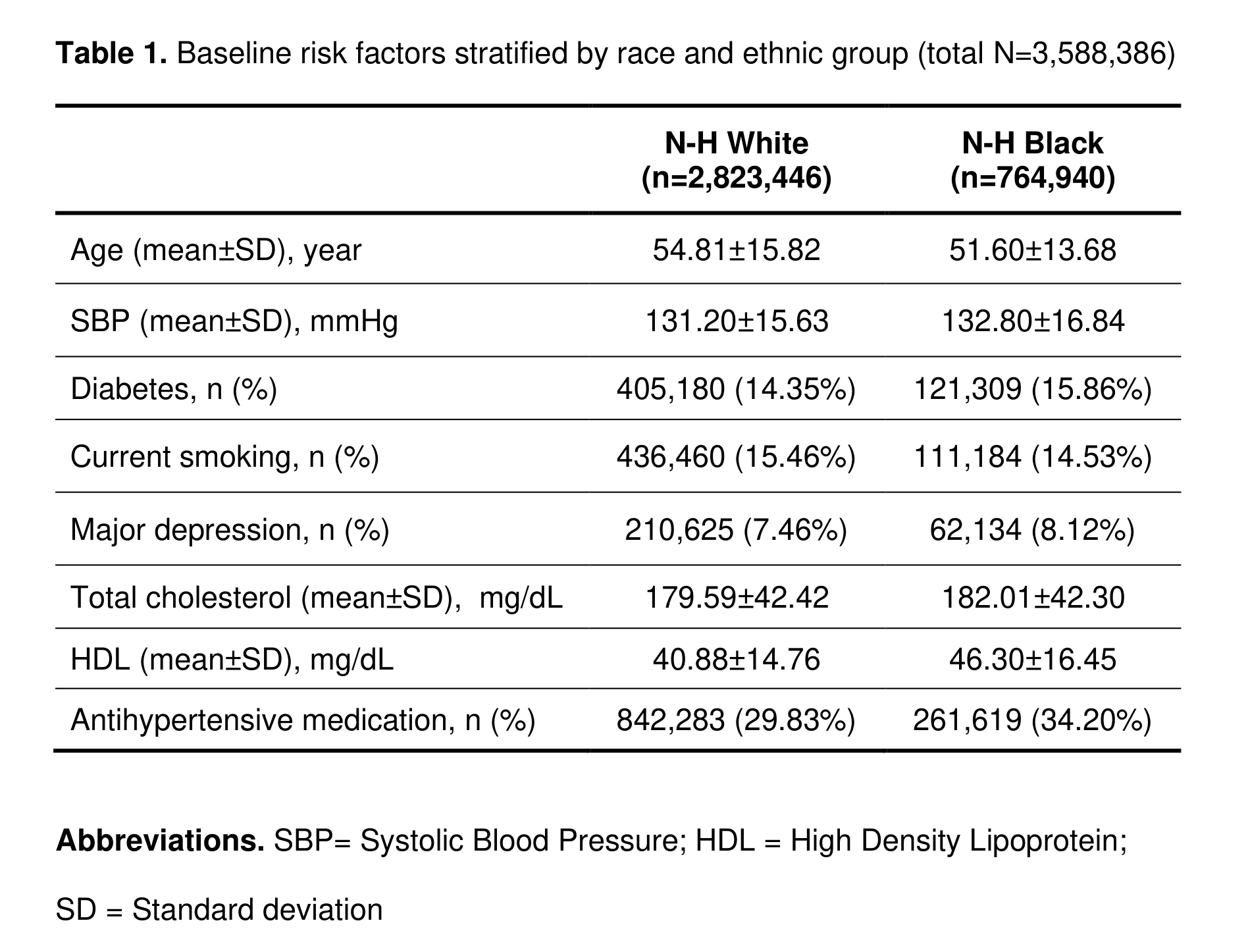
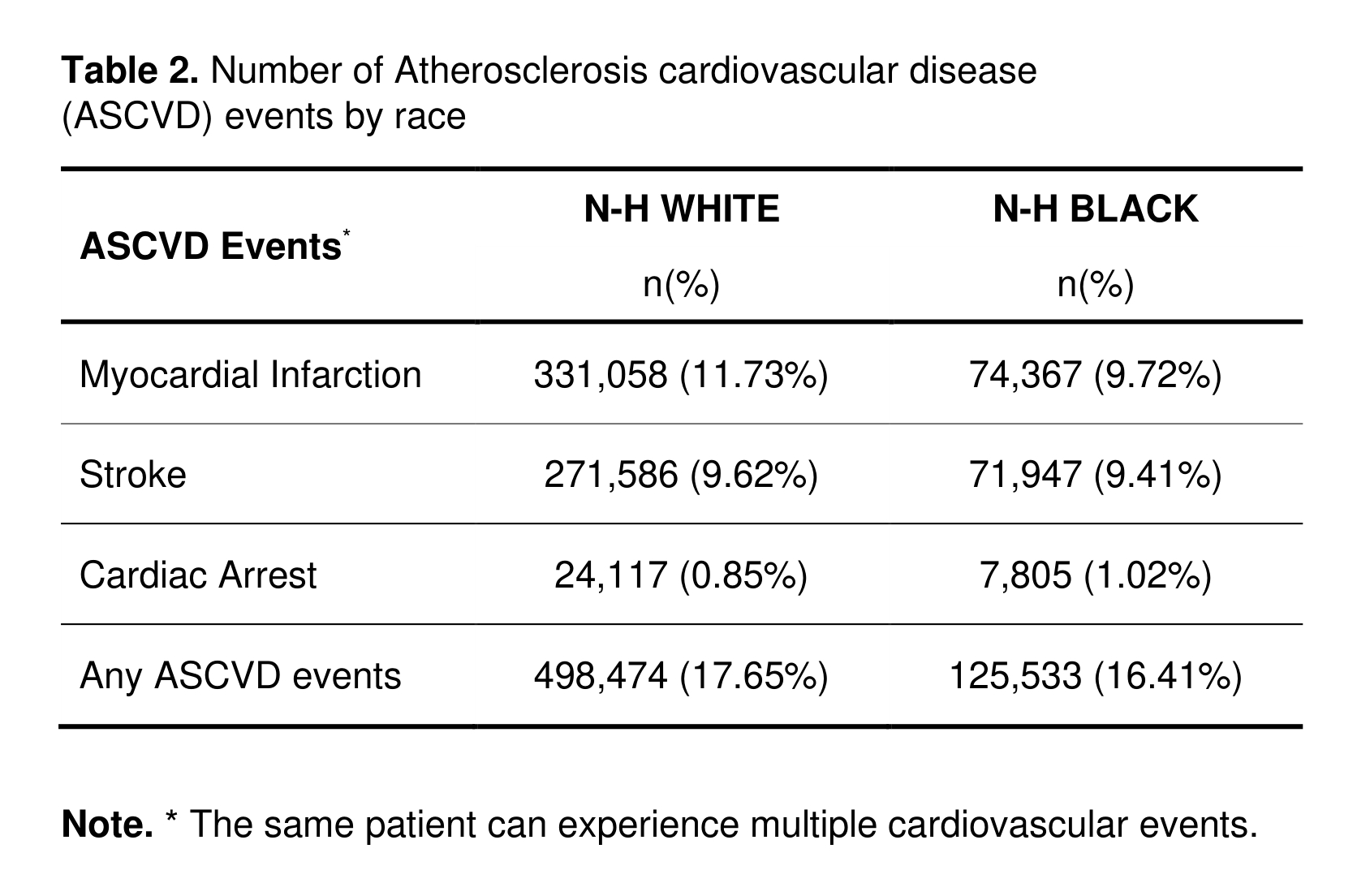
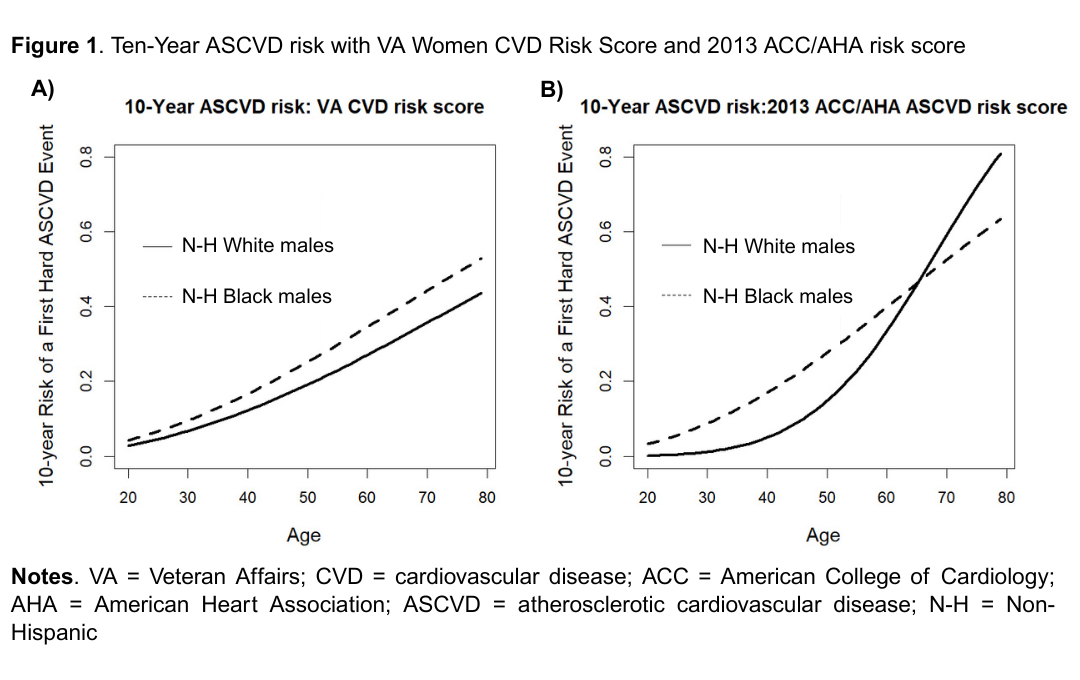
Results: N-H Black male service members, on average 3 years younger than their white counterparts, had significantly higher systolic blood pressure, total cholesterol, HDL-C, and were more likely to be treated with anti-hypertensive medications (Tables 1 and 2). We found a log-linear association of aging with increased risk of 10-year ASCVD event in military service male members starting at ages as young as 20 years old (Figure 1.A.) across both N-H White and Black groups in contrast with the ACC/AHA ASCVD risk score (Figure 1.B.). The VA CVD risk model performed well in predicting ASCVD events at 10 years for men (C statistics N-H White 0.72 and N-H Black 0.71), while the ACC/AHA ASCVD risk calculator showed a moderate performance (C statistics N-H White 0.69; N-H Black 0.69).
Conclusions: Our results point to a log-linear association of aging with increased ASCVD risk in military males starting at age 20. We call to action the need to create a better cardiovascular risk calculator that adequately assesses young male (<40 years old) military service members’ ASCVD risk.
  • Jeon-slaughter, Haekyung  ( VA North Texas and UT Southwestern , Dallas , Texas , United States )
  • Whyne, Erum  ( VA North Texas Care System , Richardson , Texas , United States )
  • Ebrahimi, Ramin  ( UCLA , Los Angeles , California , United States )
  • Author Disclosures:
    Haekyung Jeon-Slaughter: DO NOT have relevant financial relationships | Erum Whyne: DO NOT have relevant financial relationships | Ramin Ebrahimi: DO NOT have relevant financial relationships
Meeting Info:

Scientific Sessions 2025

2025

New Orleans, Louisiana

Session Info:

Aging, Biological Age & Cardiovascular Risk

Monday, 11/10/2025 , 10:45AM - 11:45AM

Moderated Digital Poster Session

More abstracts on this topic:
A Focus for Improvement - Factors for Lab Adherence in a Pediatric Preventive Cardiology Program

Holsinger Hunter, Porterfield Ronna, Taylor Makenna, Dresbach Bethany, Seipel Brittany, Igwe Chukwuemeka, Alvarado Chance, Tran Andrew

Association Between Vertebral Artery Hypoplasia and Atherosclerotic Stenosis of Subclavian Artery, Vertebral Artery and Basilar Artery: An Observational Cohort Study

Zhang Zhao, Luo Anling, Yang Yujia, Li Xuzi, Deng Yiting, He Li, Zhou Muke

You have to be authorized to contact abstract author. Please, Login
Not Available