Long-Term Outcomes in Patients with Lone Elevated Coronary Artery Calcium and No Traditional Risk Factors: A 5- and 10-Year Propensity-Matched Analysis
Abstract Body (Do not enter title and authors here): Introduction: Coronary artery calcium (CAC) scoring improves cardiovascular risk prediction, especially in patients with intermediate risk. However, the long-term implications of elevated CAC in otherwise low-risk individuals remain uncertain.
Hypothesis: We hypothesized that CAC >100 and no traditional risk factors would be associated with worse cardiovascular outcomes compared with those with CAC = 0 and ≥1 risk factor.
Methods: We performed a retrospective cohort study using a de-identified national database with over 113 million patients (TriNetX Research Network, Cambridge, MA; IRB exempt). We identified adults ≥18 years without established coronary artery disease who underwent CAC scoring. Group A included patients with CAC >100, no history of hypertension, hyperlipidemia, diabetes, chronic kidney disease, or nicotine dependence. Group B included patients with CAC = 0 and ≥1 traditional risk factor. Propensity score matching (1:1) was performed on age, sex, and race, yielding 11,746 patients per group. The primary outcome was 5- and 10-year rates of myocardial infarction (MI), ischemic stroke, coronary revascularization, and all-cause death. Outcomes were analyzed using odds ratios and Kaplan-Meier survival curves.
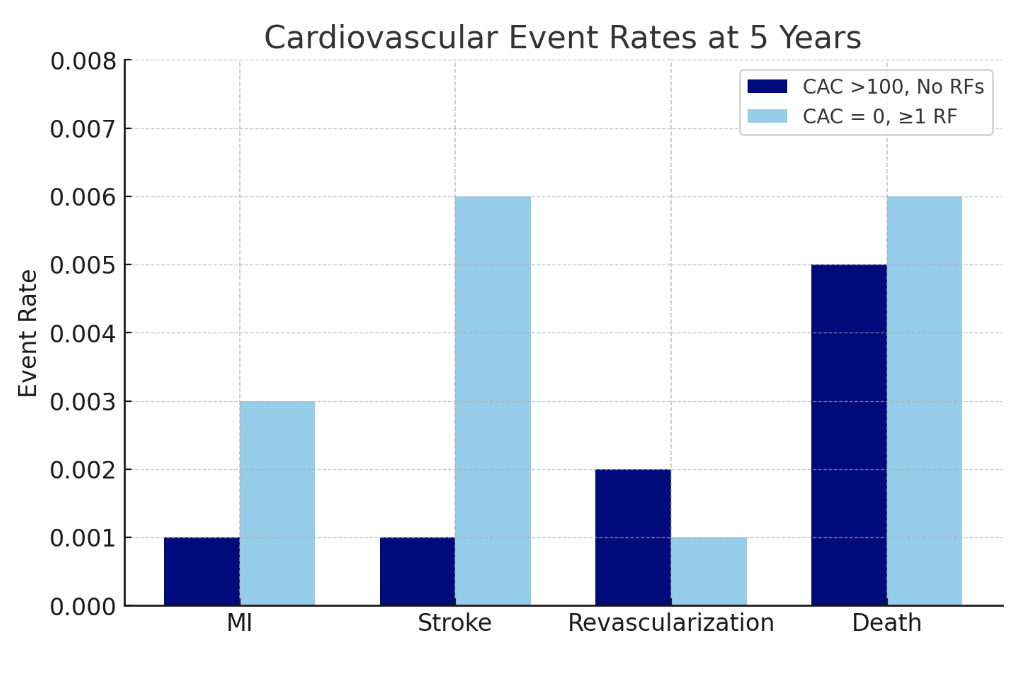
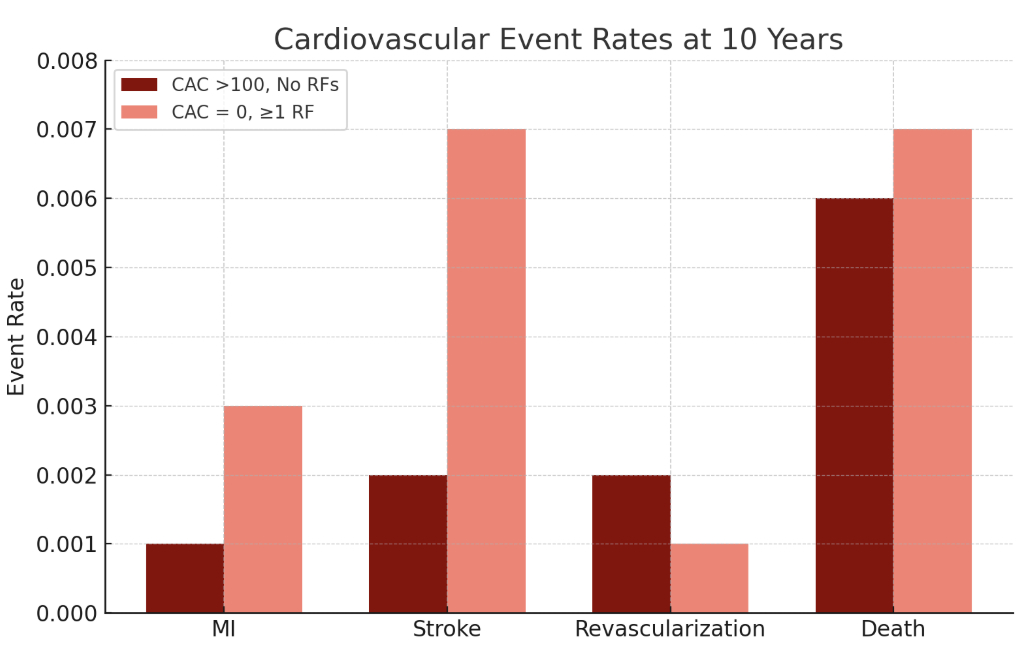
Results: At 5 years, those with lone CAC were less likely to have an MI (0.1% vs. 0.3%, OR 0.34, 95%, p=0.029) or stroke (0.1% vs. 0.6%, OR 0.18, p<0.001), but were more likely to undergo revascularization (0.2% vs. 0.1%, OR 2.03, p=0.047). Similar findings were seen at 10 years: MI (0.1% vs. 0.3%, OR 0.52, p=0.024), stroke (0.2% vs. 0.7%, OR 0.22, p<0.001), revascularization (0.2% vs. 0.1%, OR 2.28, p=0.019). There were no significant differences in mortality at 5 and 10 years (0.5% vs. 0.6%, p=0.27; 0.6% vs. 0.7%, p=0.21, respectively).
Conclusion: Patients with CAC >100 and no traditional risk factors were less likely to have an MI or stroke, and more likely to undergo coronary revascularization compared with CAC = 0 with traditional risk factors. These results support CAC scoring as durable, independent prognostic test and supports its use in refining preventive strategies.
Kandi, Sneha
(
University Hospitals - Case Western
, Cleveland , Ohio , United States )
Wilgor, Abigail
(
University Hospitals
, Cleveland Heights , Ohio , United States )
Neeland, Ian
(
University Hospitals - Case Western
, Cleveland , Ohio , United States )
Author Disclosures:
Sneha Kandi:DO NOT have relevant financial relationships
| Abigail Wilgor:DO NOT have relevant financial relationships
| Ian Neeland:DO have relevant financial relationships
;
Consultant:Boehringer Ingelheim:Past (completed)
; Advisor:MJH Life Sciences:Active (exists now)
; Advisor:Novo Nordisk:Past (completed)
; Speaker:Bayer:Active (exists now)
; Speaker:Eli Lilly:Active (exists now)
; Consultant:Eli Lilly:Past (completed)
; Speaker:Boehringer Ingelheim:Active (exists now)