Logo

American Heart Association

  22
  0


Final ID: MP329

Diagnostic 12-lead ECGs at Rest and during Stress in a 3T MR Scanner: A Novel System for In-bore Cardiac Monitoring and Ischemia Detection

Abstract Body (Do not enter title and authors here): Background
Electrocardiographic (ECG) signals collected inside the magnetic resonance (MR) scanner bore are distorted by gradient artefacts and magnetohydrodynamic effects, making them nondiagnostic except for R-peak detection. We developed, implemented and validated a novel hardware/software system that collects diagnostic 12-lead ECGs inside the 3 Tesla(T) MR scanner bore and is capable of measuring ischemic changes during adenosine.
Methods
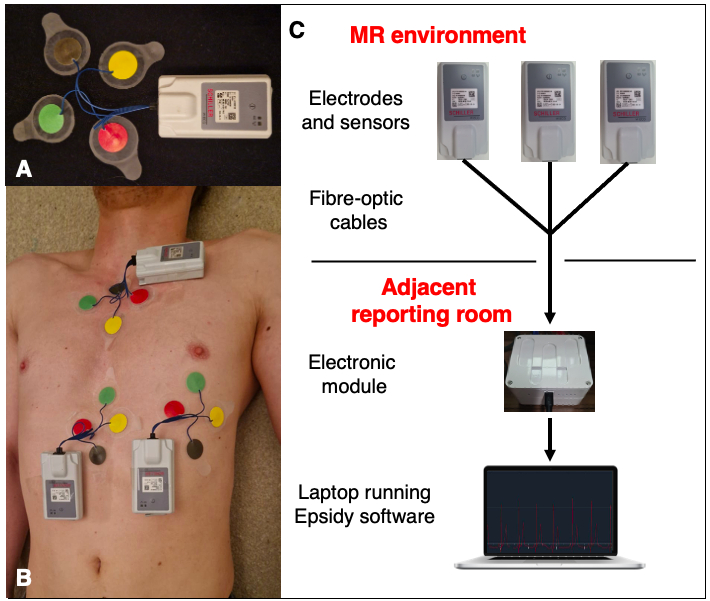
Reference standard 12-lead ECGs were first recorded outside the MR-environment before the CMR scan. Using 3 MR-safe electrode patches connected to signal modules and fibre-optic cables (Figure 1), in-bore ECGs were then recorded for 30 seconds prior to and during adenosine infusion (preceding image acquisition). Post-processing filters removed artefact and a subject-specific matrix was applied to reconstruct 12-lead ECGs from the raw signal. In-bore and reference ECGs were compared using Pearson’s correlation coefficient on the PQRST waveform and by manual measurements of QRS and QT durations, with repeat measurements to assess intra- and inter-observer variability. New ischemic changes during the adenosine infusion were compared with corresponding anatomical territories on quantitative and qualitative in-line stress perfusion maps.
Results
26 participants were prospectively recruited (70.8±13.0years; 34.6% female). In-bore ECGs were successfully recorded with no additional scan time. ECG reconstruction took <2 minutes per participant.
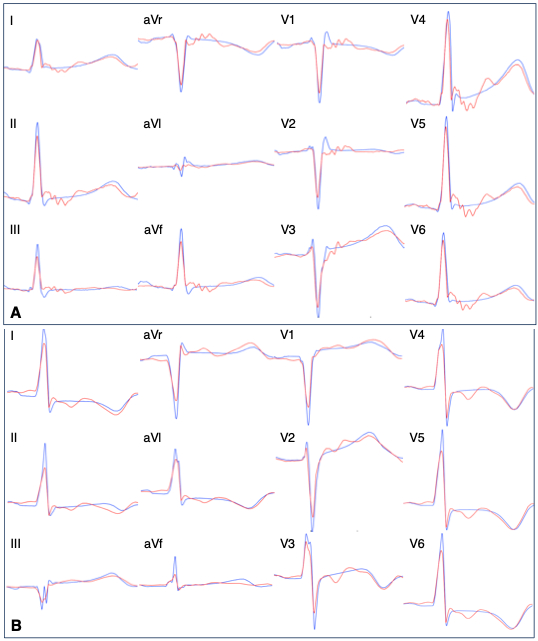
In-bore and reference ECGs (Figure 2) were strongly correlated (r=0.81, interquartile range 0.720.88), and mean differences in QRS and QT durations were small (12.5ms [95% limits of agreement -42.5, 17.5ms], and -5.5ms [-54.6, 43.6ms] respectively).
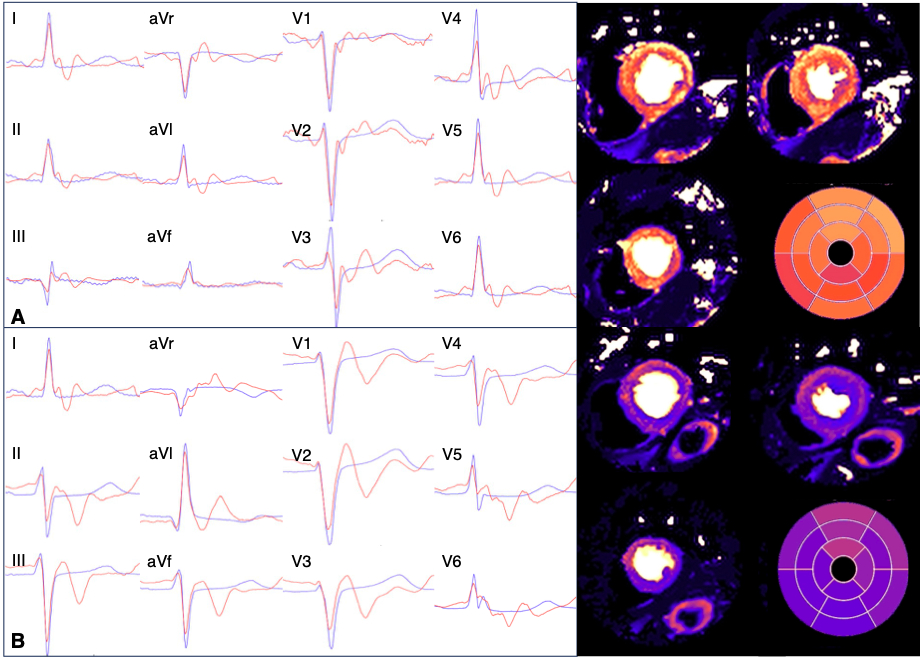
Ischemic ECG changes (Figure 3) during adenosine predicted inducible ischemia (stress myocardial blood flow <1.75ml/g/min) with sensitivity 91.7% (95% confidence interval (61.5, 99.8), specificity 59.3% (45.0, 72.4), positive predictive value 33.3% (18.0, 51.8), negative predictive value 97.0% (84.0, 99.9) and area under curve 0.74 (0.61, 0.86).
Conclusion
Diagnostic-quality ECGs can be reconstructed in the bore of a clinical 3T CMR scanner. In this proof-of-concept study, in-bore ECGs correlated closely with reference ECGs and showed high specificity and NPV for predicting inducible ischemia. Diagnostic in-bore ECGs have the potential to improve R-peak detection, patient monitoring and the interpretation of quantitative stress perfusion maps.
  • Falconer, Debbie  ( University College London , London , United Kingdom )
  • Moon, James  ( UCL , London , United Kingdom )
  • Hughes, Alun  ( UCL , London , United Kingdom )
  • Odille, Freddy  ( L'Institut national de la santé et de la recherche médicale , Nancy , France )
  • Calmon, Guillaume  ( Epsidy , Vandoeuvre-les-Nancy , France )
  • Captur, Gabriella  ( UCL , London , United Kingdom )
  • Mehri, Maroua  ( Epsidy , Vandoeuvre-les-Nancy , France )
  • Bhiri, Mohammed  ( Epsidy , Vandoeuvre-les-Nancy , France )
  • Webber, Matthew  ( University College London , London , United Kingdom )
  • Whitmore, Isabelle  ( University College London , London , United Kingdom )
  • Martin, Emma  ( University College London , London , United Kingdom )
  • Vagliani, Giovanni  ( Epsidy , Vandoeuvre-les-Nancy , France )
  • Kellman, Peter  ( NIH , BETHESDA , Maryland , United States )
  • Lambiase, Pier  ( Heart Hospital, UCL , London , United Kingdom )
  • Author Disclosures:
    Debbie Falconer: DO NOT have relevant financial relationships | James Moon: No Answer | Alun Hughes: DO NOT have relevant financial relationships | Freddy Odille: No Answer | Guillaume Calmon: No Answer | Gabriella Captur: No Answer | Maroua Mehri: DO NOT have relevant financial relationships | Mohammed Bhiri: DO NOT have relevant financial relationships | Matthew Webber: DO NOT have relevant financial relationships | Isabelle Whitmore: No Answer | Emma Martin: No Answer | Giovanni Vagliani: No Answer | Peter Kellman: No Answer | Pier Lambiase: No Answer
Meeting Info:

Scientific Sessions 2025

2025

New Orleans, Louisiana

Session Info:

Stress Matters: Innovations in Physiologic Testing Across Multimodality Imaging

Saturday, 11/08/2025 , 03:15PM - 04:25PM

Moderated Digital Poster Session

More abstracts on this topic:
Advanced Cardiac MRI Parameters Phenomapping to Predict Outcomes in Patients with Nonischemic Cardiomyopathy

Ammoury Carl, Tang Wai Hong, Wang Xiaofeng, Kwon Deborah, Wu Yanjun, Korkerdsup Theerawat, Wang Tom Kai Ming, Rizkallah Diane, Bodi Kashyap, Calcagno Tess, Chen David, Nguyen Christopher

Anomalous Origins: Hereditary Transthyretin Cardiac Amyloidosis Mimicking Ischemia in a Patient with Congenital Coronary Anomalies

Labin Jonathan, Carmona Rubio Andres, Liu Joseph, Hanna Mazen, Menon Venu, Higgins Andrew

More abstracts from these authors:
Cumulative Life-course Blood Pressure Burden and Steepness of Increase Are Associated with Reduced Myocardial Perfusion in Older Age: Insights from MyoFit46

Topriceanu Constantin-cristian, Wong Andrew, Pierce Iain, Davies Rhodri, Lambiase Pier, Chaturvedi Nishi, Kellman Peter, Hardy Rebecca, Moon James, Hughes Alun, Captur Gabriella, Webber Matthew, Shiwani Hunain, Chan Fiona, Martin Emma, Falconer Debbie, Bennett Jonathan, Gonzalez Martin Pablo, Shah Haytham

Genome-wide association study of aortic stiffness derived from deep learning in CMR images of 45,789 individuals identifies loci linked with cell-matrix structure

Paliwal Nikhil, Henry Albert, Finan Chris, Davies Rhodri, Hughes Alun, Williams Bryan, Malarstig Anders, Lumbers Tom, Hingorani Aroon

You have to be authorized to contact abstract author. Please, Login
Not Available