
Logo

American Heart Association

  18
  0


Final ID: Sa3139

Long-term follow-up of patients undergoing radial artery recanalization via distal transradial access

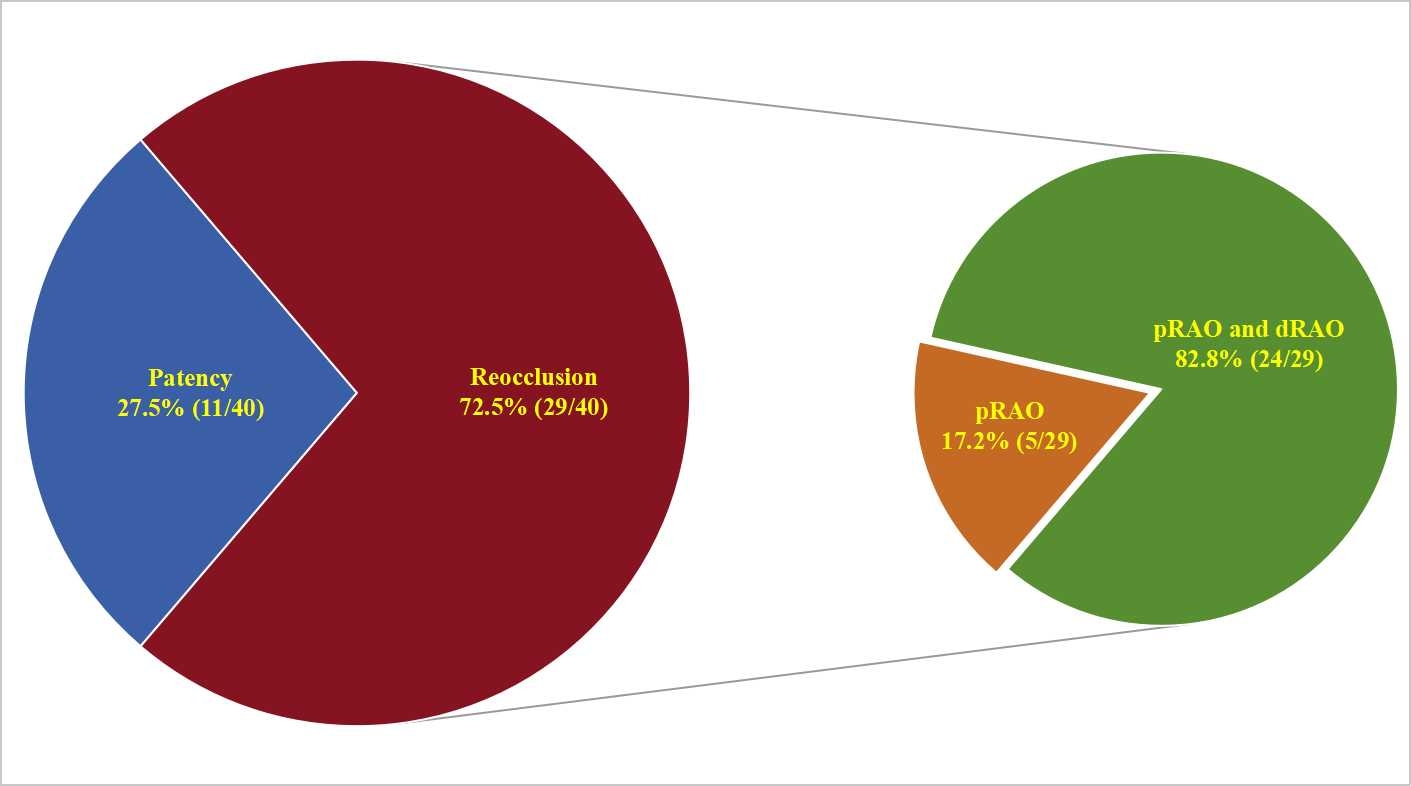
Abstract Body (Do not enter title and authors here): Background: Recanalization of occluded radial arteries via distal transradial access is being increasingly performed. However, few studies have focused on the long-term follow-up of patients undergoing this procedure. This study investigated the long-term effects of recanalization of the occluded radial artery on vascular and hand function. Methods: In this retrospective cohort study, long-term follow-up of patients who had successfully undergone recanalization of an occluded radial artery was conducted over six months using a portable ultrasound and a hand function test kit. Results: A total of 40 patients were included in the study; 57.5% (23/40) were male, and the mean age was 65.9 years. During the follow-up period of 29.6 ± 15.4 months, 72.5% (29/40) of patients experienced radial artery reocclusion, of which 82.8% (24/29) had distal radial artery occlusion. A history of coronary heart disease (82.76% vs. 18.18%, P < 0.001) and multiple interventions via the radial artery (34.48% vs. 0.0%, P = 0.038) were more prevalent in the reocclusion group than in the patency group. The follow-up ultrasound results indicated that the diameters of the proximal and distal radial arteries in the patency group was significantly greater than those in the reocclusion group. In addition, the diameters of the proximal and distal radial arteries on the patent side were also significantly larger than those on the reocclusion side. The intima thickness of the proximal radial artery on the reocclusion side was significantly greater than that on the contralateral side (0.44 ± 0.08 mm vs. 0.34 ± 0.05 mm, P = 0.003). There were no significant differences in the Quick DASH scale score or hand sensorimotor function between the reocclusion group and the patency group. Two-point discrimination on the reocclusion side was worse than that on the patent side (11.30 ± 3.25 mm vs. 10.39 ± 3.27 mm, P = 0.035). Conclusion: It is technically safe and feasible to recanalize an occluded radial artery via the distal radial artery. However, the long-term reocclusion rate is high after recanalization. More importantly, this procedure can lead to distal radial artery occlusion. Hence, a strategy of "leave it alone unless necessary" is recommended.
  • Zhou, Tong  ( Wujin Hospital , Changzhou , China )
  • Fan, Xinyu  ( Nanjing Medical University , Changzhou , China )
  • Huang, Hui  ( Jiangyin Hospital of Traditional Chinese Medicine , Wuxi , China )
  • Li, Lamei  ( Wujin Hospital , Changzhou , China )
  • Chen, Tao  ( the First Affiliated Hospital of Ningbo University , Ningbo , China )
  • Li, Feng  ( Wujin Hospital , Changzhou , China )
  • Shi, Ganwei  ( Wujin Hospital , Changzhou , China )
  • Cai, Gaojun  ( Wujin Hospital , Changzhou , China )
  • Author Disclosures:
    Tong Zhou: DO NOT have relevant financial relationships | Xinyu Fan: DO NOT have relevant financial relationships | Hui Huang: No Answer | Lamei Li: No Answer | Tao Chen: No Answer | Feng Li: No Answer | Ganwei Shi: No Answer | Gaojun Cai: DO NOT have relevant financial relationships
Meeting Info:

Scientific Sessions 2025

2025

New Orleans, Louisiana

Session Info:

PAD Medical Therapies

Saturday, 11/08/2025 , 02:30PM - 03:30PM

Abstract Poster Board Session

You have to be authorized to contact abstract author. Please, Login
Not Available