
Logo

American Heart Association

  18
  0


Final ID: 4360927

Flow Matters: Prognostic Value of Sex-Specific Transvalvular Flow Rate in PLFLG Aortic Stenosis

Abstract Body (Do not enter title and authors here): Background
Paradoxical low-flow, low-gradient (PLFLG) severe aortic stenosis (AS) is a high-risk phenotype characterized by low transvalvular gradients despite preserved left ventricular ejection fraction (LVEF). While stroke volume index is conventionally used to define flow state, transvalvular flow rate (Q)—a measure incorporating both volume and ejection duration— offers a more physiologic assessment of forward flow. Given known sex-based differences in flow dynamics, we aimed to evaluate whether sex-specific Q thresholds are associated with adverse outcomes in PLFLG severe AS.
Methods
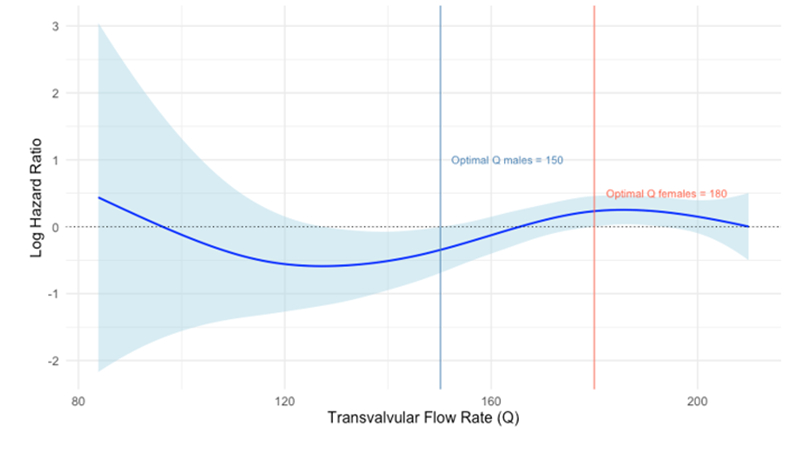
We included 1,189 patients with adjudicated PLFLG severe AS (aortic valve area <1.0 cm2, mean gradient <40 mmHg, LVEF ≥50%, and Q ≤210 mL/sec) from an institutional echocardiographic database. Sex-specific Q thresholds were derived using the maximally selected rank statistic (≤150 mL/sec in males, ≤180 mL/sec in females). The primary outcome was a composite of all-cause mortality and aortic valve replacement (SAVR/TAVR).
Results
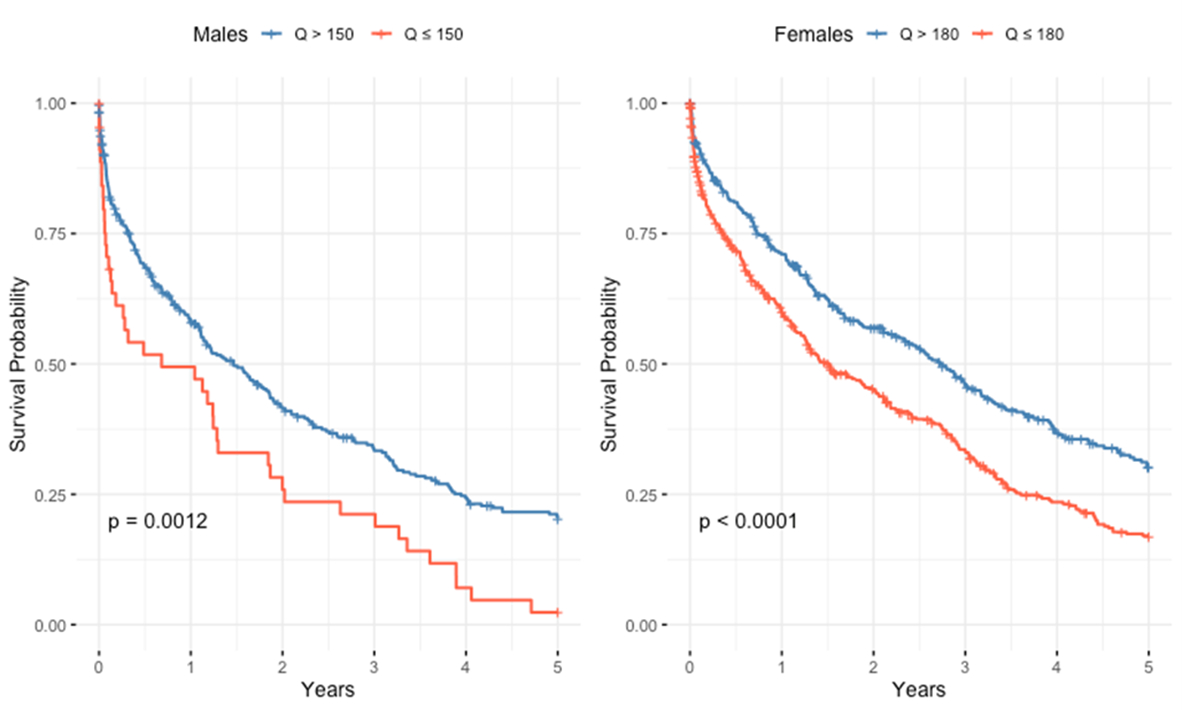
In both sexes, lower Q was associated with a smaller aortic valve area, lower stroke volume index and reduced transvalvular gradients. Patients with low Q had significantly lower event-free survival, particularly among females, for both all-cause mortality and the composite outcome (log-rank p<0.001)(Figure). In a multivariable analysis, low Q independently predicted adverse composite outcome in both males (HR 1.54, 95% CI: 1.10–2.16) and females (HR 1.39, 95% CI: 1.16–1.65).
Conclusion
Sex-specific transvalvular flow rate thresholds are independently associated with adverse outcomes in paradoxical low-flow low-gradient severe aortic stenosis. These findings support the clinical utility of sex-specific Q, particularly in women, for refining risk stratification and guiding timely intervention.
  • Dahan, Shani  ( Massachusetts General Hospital , Boston , Massachusetts , United States )
  • Dal-bianco, Jacob  ( Massachusetts General Hospital , Boston , Massachusetts , United States )
  • Rodriguez Cabrera, Carmen  ( Massachusetts General Hospital , Boston , Massachusetts , United States )
  • Passeri, Jonathan  ( Massachusetts General Hospital , Boston , Massachusetts , United States )
  • Yucel, Evin  ( Massachusetts General Hospital , Boston , Massachusetts , United States )
  • Suero-abreu, Giselle  ( Massachusetts General Hospital , Boston , Massachusetts , United States )
  • Goldberg, Rachel  ( Massachusetts General Hospital , Boston , Massachusetts , United States )
  • Levine, Robert  ( Massachusetts General Hospital , Boston , Massachusetts , United States )
  • Hung, Judy  ( Massachusetts General Hospital , Boston , Massachusetts , United States )
  • Author Disclosures:
    Shani Dahan: DO NOT have relevant financial relationships | Jacob Dal-Bianco: No Answer | Carmen Rodriguez Cabrera: No Answer | Jonathan Passeri: DO NOT have relevant financial relationships | Evin Yucel: No Answer | Giselle Suero-Abreu: DO NOT have relevant financial relationships | Rachel Goldberg: No Answer | Robert Levine: No Answer | Judy Hung: DO NOT have relevant financial relationships
Meeting Info:

Scientific Sessions 2025

2025

New Orleans, Louisiana

Session Info:

Valve Science Spotlight: Top Research in Valve Disease

Friday, 11/07/2025 , 02:15PM - 03:30PM

Abstract Oral Session

More abstracts on this topic:
A Case Series of Papillary Fibroelastomas on the Coumadin ridge

Aboukhatwa Omar, Akiki Elias, Kurmann Reto, Larson Kathryn, Keeney Michael, Bois Melanie, Klarich Kyle

A Hemodynamic Warning Sign: Continuous Mitral Regurgitation and Normal Sinus Rhythm

Mahi Ishani, Chowdhury Mahdi, Madan Hritik, Garg Vaani

More abstracts from these authors:
You have to be authorized to contact abstract author. Please, Login
Not Available