
Logo

American Heart Association

  19
  0


Final ID: Sa2096

Vitamin D Deficiency Is Associated With Increased Risk of Atrial Fibrillation in Black Women

Abstract Body (Do not enter title and authors here): Background
Significant racial disparities exist in the prevalence of both vitamin D deficiency and atrial fibrillation (AF). Blacks demonstrate lower AF rates despite higher vitamin D deficiency prevalence compared to Whites. Vitamin D deficiency is associated with higher AF risk, and women with AF experience elevated CVA and mortality rates compared to men. Understanding the interaction between race, vitamin D status, and AF, may present a potential modifiable risk factor for AF. This study examines whether vitamin D deficiency modifies racial disparities in AF distribution between White and Black women and evaluates its impact on CVA incidence and in-hospital mortality rates.
Methods
We analyzed data from the National Inpatient Sample (2016-2020). We compared trends over the 5-year period and evaluated differences in acute stroke and in-patient mortality rates based on race and vitamin D status.
Results
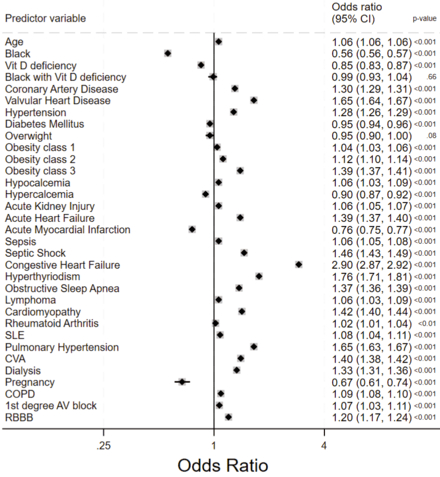
Among 13.4 million hospitalizations (weighted to 67 million), AF was more common in women with vitamin D deficiency (15.6%) vs. those without (13.7%). Vitamin D deficiency was higher in Black women (2.4%) compared to White women (2.1%). White women had higher AF prevalence (15.2%) than Black women (7.8%). However, among Black women, those with vitamin D deficiency had a higher AF rate (8.95%) compared to non-deficient peers (7.74%), with an attributable risk of 13.5%. Adjusted models showed Black women without vitamin D deficiency had 53% lower odds of AF vs. White women without deficiency (OR = 0.47, p < 0.001). Black women with deficiency had similar odds to White women without deficiency (OR = 0.99, p = 0.66).
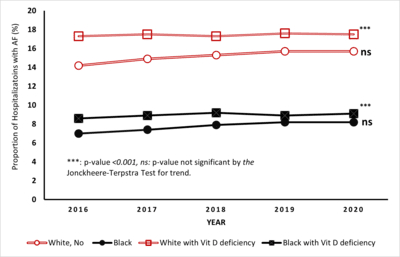
Trends plot revealed increasing AF prevalence in non-deficient women; rates in vitamin D-deficient women remained stable. In both racial groups, vitamin D deficiency was associated with higher prevalence of AF.
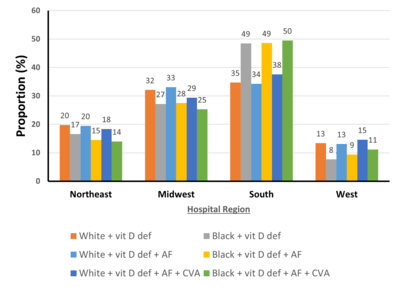
Regional analysis showed an overall increase in vitamin D deficiency, AF and CVA rates in both racial groups in the south compared to other regions.
Vitamin D deficient women had 18.5% increased odds of CVA. Black women with AF had 16.4% increased odds of in-hospital mortality.
Conclusion
Vitamin D deficiency is associated with increased AF prevalence in both racial groups and may attenuate the lower AF risk observed in Black women. Screening for and managing vitamin D deficiency may be a potential strategy for AF risk reduction, particularly in the Black female population. Further longitudinal studies are needed to establish causality.
  • Antwi Amoabeng, Daniel  ( CHRISTUS Ochsner St. Patrick Hospital , Lake Charles , Louisiana , United States )
  • Sado, Ikpemosi  ( Heart Corpration , Lithonia , Georgia , United States )
  • Gbadebo, T David  ( Emory Decatur Hospital , Decatur , Georgia , United States )
  • Author Disclosures:
    Daniel Antwi Amoabeng: DO NOT have relevant financial relationships | Ikpemosi Sado: DO NOT have relevant financial relationships | T DAVID GBADEBO: No Answer
Meeting Info:

Scientific Sessions 2025

2025

New Orleans, Louisiana

Session Info:

Cardiovascular Risk Across the Lifespan of Women and Youth

Saturday, 11/08/2025 , 10:30AM - 11:30AM

Abstract Poster Board Session

More abstracts on this topic:
A Clinical Trial of Healthy Food Subsidies and Behavioral Interventions to Increase Fruit and Vegetable Purchasing in an Online Store

Hua Sophia, Klaiman Tamar, Dixon Erica, Volpp Kevin, Putt Mary, Coratti Samantha, White Jenna, Hossain Mohammad, Posner Hannah, Wang Erkuan, Zhu Jingsan, John Aileen

Ambulatory Atrial Fibrillation Ablation is Underutilized Among Women and Racial/Ethnic Minority Groups

Makmal Noam, Koplan Bruce

More abstracts from these authors:
Black Patients Have Higher Odds of Discharge with Wearable Cardioverter-Defibrillators

Antwi Amoabeng Daniel, Sado Ikpemosi, Beutler Bryce, Governor Samuel, Gbadebo T David

You have to be authorized to contact abstract author. Please, Login
Not Available