Dose-Dependent Association between E-Cigarette Use and Sleep Duration among U.S. Adults
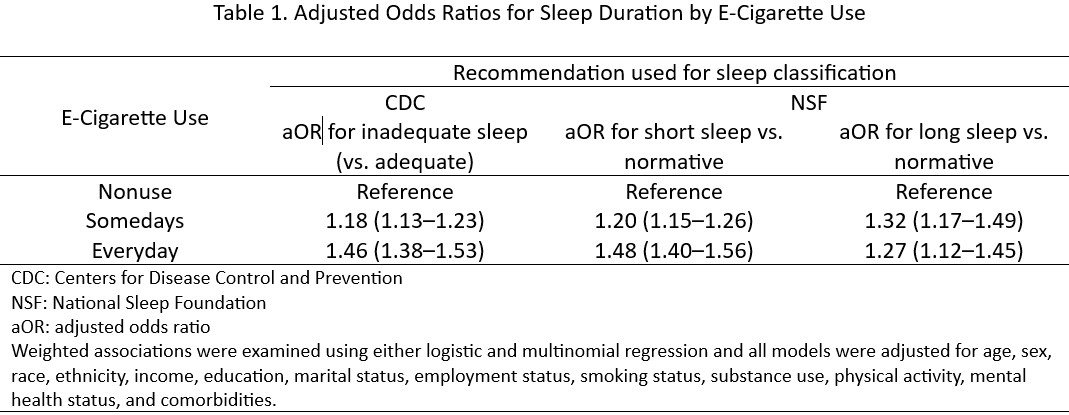
Abstract Body (Do not enter title and authors here): Background: While tobacco use is associated with poor sleep hygiene, there is a paucity of nationally representative data examining whether e-cigarettes (EC) may have a similar link. Our study assessed the relationship between EC use pattern and sleep duration. Methods: We analyzed data from the Behavioral Risk Factor Surveillance System (BRFSS) with available EC and sleep duration assessments (2016, 2018, 2020, and 2022). EC current use was categorized as nonuse, somedays, or everyday use. Sleep duration was classified based on two national recommendations- Centers for Disease Control and Prevention (CDC): adequate ≥7 hours vs. inadequate <7 hours; and National Sleep Foundation (NSF): short <7, normative 7–9, long >9 hours. Results: Data of 1,424,949 adults were analyzed. Overall, 94.3% of respondents reported never/former EC use. Of 5.7% current EC users, 2.3% reported every day and 3.4% somedays use. A dose-dependent relationship was observed between EC use pattern and adverse sleep duration outcomes. The prevalence of inadequate sleep, per CDC, was 34.4% with nonuse, 44.6% with someday EC use and 48.7% with everyday EC use. Alternatively, normative sleep, per NSF, was 62.2% with non-use, 51.1% with someday EC use, and 47.5% with everyday EC use. EC use pattern was significantly associated (P<.001) with higher odds of inadequate sleep (CDC) and short/long sleep (NSF) compared to nonuse (Table 1). Conclusions: Current EC use was significantly associated with poor sleep hygiene in an overall dose-dependent manner, as defined by both CDC and NSF. Longitudinal and mechanistic studies are needed to better understand the directionality and underlying pathways of this likely association.
Abbasi-kangevari, Mohsen
( NYU Grossman School of Medicine
, New York
, New York
, United States
)
He, Michelle
( NYU Grossman School of Medicine
, New York
, New York
, United States
)
Benjamin, Emelia
( Boston University Chobanian & Avedisian School of Medicine
, Boston
, Massachusetts
, United States
)
Blaha, Michael
( Johns Hopkins Ciccarone Center for Prevention of Cardiovascular Disease
, Baltimore
, Maryland
, United States
)
El-shahawy, Omar
( NYU Grossman School of Medicine
, New York
, New York
, United States
)
Author Disclosures:
Mohsen Abbasi-Kangevari:DO NOT have relevant financial relationships
| Michelle He:No Answer
| Emelia Benjamin:DO NOT have relevant financial relationships
| Michael Blaha:DO have relevant financial relationships
;
Research Funding (PI or named investigator):Novo Nordisk:Active (exists now)
; Consultant:Eli Lilly:Past (completed)
; Consultant:Boehringer Ingelheim:Past (completed)
; Consultant:Astra Zeneca:Past (completed)
; Consultant:New Amsterdam:Active (exists now)
; Consultant:Agepha:Active (exists now)
; Consultant:Merck:Active (exists now)
; Consultant:Idorsia:Past (completed)
; Consultant:Genentech:Past (completed)
; Consultant:Bayer:Active (exists now)
; Consultant:Novo Nordisk:Active (exists now)
; Research Funding (PI or named investigator):Bayer:Active (exists now)
| Omar El-Shahawy:No Answer