Routine Atherosclerotic Cardiovascular Disease Screening in Underserved Primary Care Settings: A Quality and Improvement Study.
Abstract Body (Do not enter title and authors here): Introduction Atherosclerotic cardiovascular disease (ASCVD) is the leading cause of death in the United States and worldwide, and 80% of the disease is preventable. Unlike some malignancies, ASCVD has no single cost-effective screening test to diagnose it early. ACC/AHA recommends tools like the ASCVD plus to risk stratify and initiate statin and antihypertensive therapies. However, the extent such tools are used and integrated in the routine outpatient primary care settings for underserved communities is not well described.
Objectives To assess how often screening tools like ASCVD plus are used in underserved communities and evaluate interventions to improve its use.
Methods Patients age between 40-79 were randomly selected from an underserved community hospital from September 2024 to April 2025. Aged below 40 and above 79, ASCVD disease, LDL>190mg/dl were excluded. Two groups, pre- and post-intervention, formed based on the time interventions were introduced. Interventions applied included raising awareness, distributing surveys and videos, creating shortcuts for documentation, and encouraging all physicians to download the ASCVD plus calculator on their mobile phones. Plan-Do-Analyze-Act and root cause analysis were used to identify factors affecting ASCVD plus use. Independent t-test, chi-square, and logistic regression were used to measure associations.
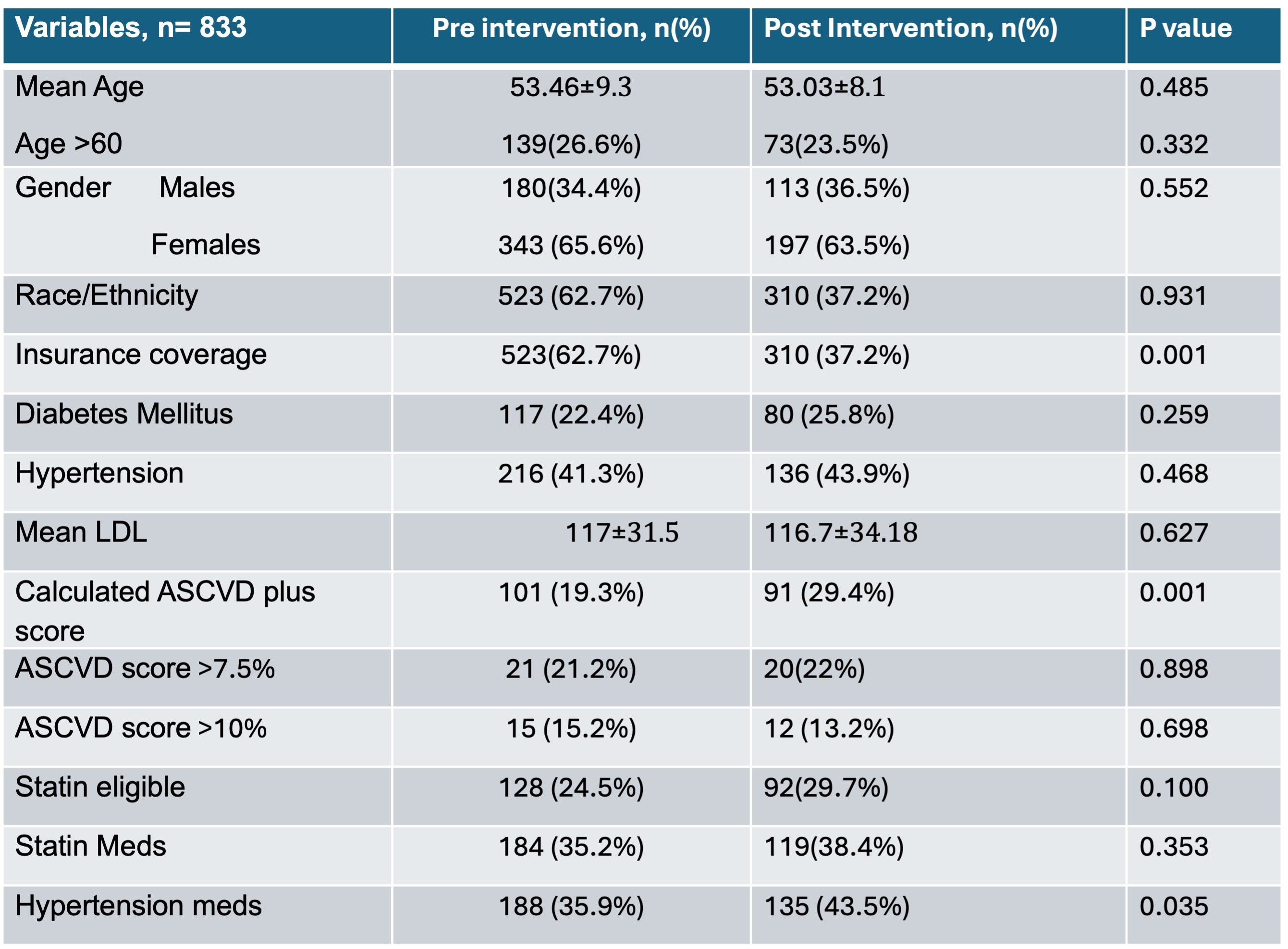
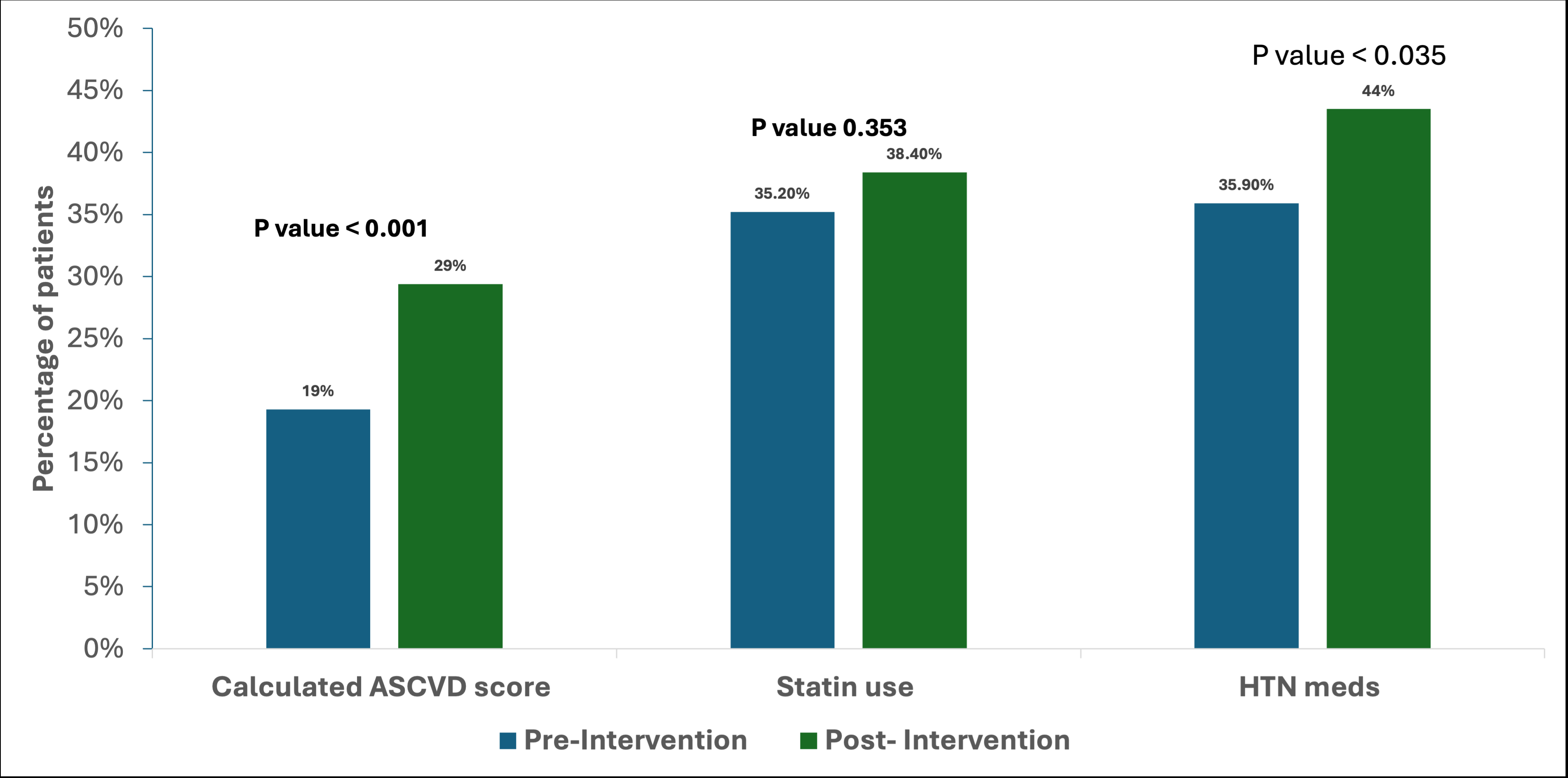
Results A total of 833 patients included. The mean age was 54.07±9.171, where 598 (63.8%) were females, 88.2% Hispanics, 5.8% blacks, 3.3% Whites and 1.1% Asians. 37.4% and 37% had Charity care and Medicaid whereas 8.1% had no insurance. Only 24% had calculated ASCVD score. Interventions improved the use of the ASCVD plus (19% vs 29%, p value < 0.01). Antihypertensive medication use also increased (35.9% vs 43.5%, p value < 0.035), but no change in statin prescriptions (35.2% vs 38.4%, p value < 0.353). Time constraints and excessive workloads, absence of recent lipid profiles, lack of awareness, forgetting, and use of subjective rational thinking for risk stratification were among identified root causes. No single determinant factor was identified from the patients’ associated factors.
Conclusion Routine ASCVD screening using the ASCVD plus is not consistently used in underserved primary care settings and interventions to improve its use are not enough to motivate physicians.This calls for actions to integrate similar risk identifiers with artificial intelligence to improve patient care and prevent ASCVDs.
Weldehana, Amha
(
Westchester Medical Center
, Valhalla , New York , United States )
Hussain, Syed Sadam
(
Westchester Medical Center
, Valhalla , New York , United States )
Tripathi, Ashish
(
Westchester Medical Center
, Valhalla , New York , United States )
Charlat, Maxwell
(
Westchester Medical Center
, Valhalla , New York , United States )
Zhang, Hall
(
Westchester Medical Center
, Valhalla , New York , United States )
Maksymiuk, Victoria
(
Westchester Medical Center
, Valhalla , New York , United States )
Fentie, Meseker
(
Drexel University
, Philadelphia , Pennsylvania , United States )
Canter, Alex
(
Westchester Medical Center
, Valhalla , New York , United States )
Abecasis, Emma
(
Westchester Medical Center
, Valhalla , New York , United States )
Gennarelli, Melissa
(
Westchester Medical Center
, Valhalla , New York , United States )
Goutis, Jason
(
Westchester Medical Center
, Valhalla , New York , United States )
Porrovecchio, Andrea
(
Westchester Medical Center
, Valhalla , New York , United States )
Saha, Animita
(
Westchester Medical Center
, Valhalla , New York , United States )
Author Disclosures:
Amha Weldehana:DO NOT have relevant financial relationships
| Melissa Gennarelli:No Answer
| Jason Goutis:DO NOT have relevant financial relationships
| Andrea Porrovecchio:DO NOT have relevant financial relationships
| Animita Saha:No Answer
| Syed Sadam Hussain:No Answer
| Ashish Tripathi:No AnswerHall Zhang:No Answer
| Victoria Maksymiuk:DO NOT have relevant financial relationships
| Meseker Fentie:DO NOT have relevant financial relationships
| Alex Canter:DO NOT have relevant financial relationships
| Emma Abecasis:DO NOT have relevant financial relationships