Ten-Year Trends in Complication Rates for Catheter Ablation of Atrial Fibrillation at an Academic Medical Center
Abstract Body (Do not enter title and authors here): Introduction Catheter ablation is a commonly performed invasive procedure for management of atrial fibrillation (AF), and offers favorable cardiovascular outcomes and improved quality of life in patients with AF. However, it is associated with procedural complications. Reported complication rates vary in literature, ranging from 1-8% overall, and limited data exists regarding temporal trends of complication rates. Furthermore, as ablation technology has evolved, it is important to understand how these innovations influence the safety profile.
Research Question To determine the trend of AF catheter ablation complication rates over ten years within a single institution.
Methods All patients undergoing left atrial catheter ablation for AF at Johns Hopkins Hospital from January 1st, 2015, to December 31st, 2024, were prospectively enrolled in a comprehensive database. Data including demographics, disease characteristics, procedural data, and 90-day complications were collected via the electronic health record (Epic). Major complications were defined as vascular complications requiring transfusion or surgery, pericardial effusion or tamponade requiring drainage, thromboembolic stroke, sepsis, shock, severe respiratory compromise requiring hospitalization, atrio-esophageal fistula, or death.
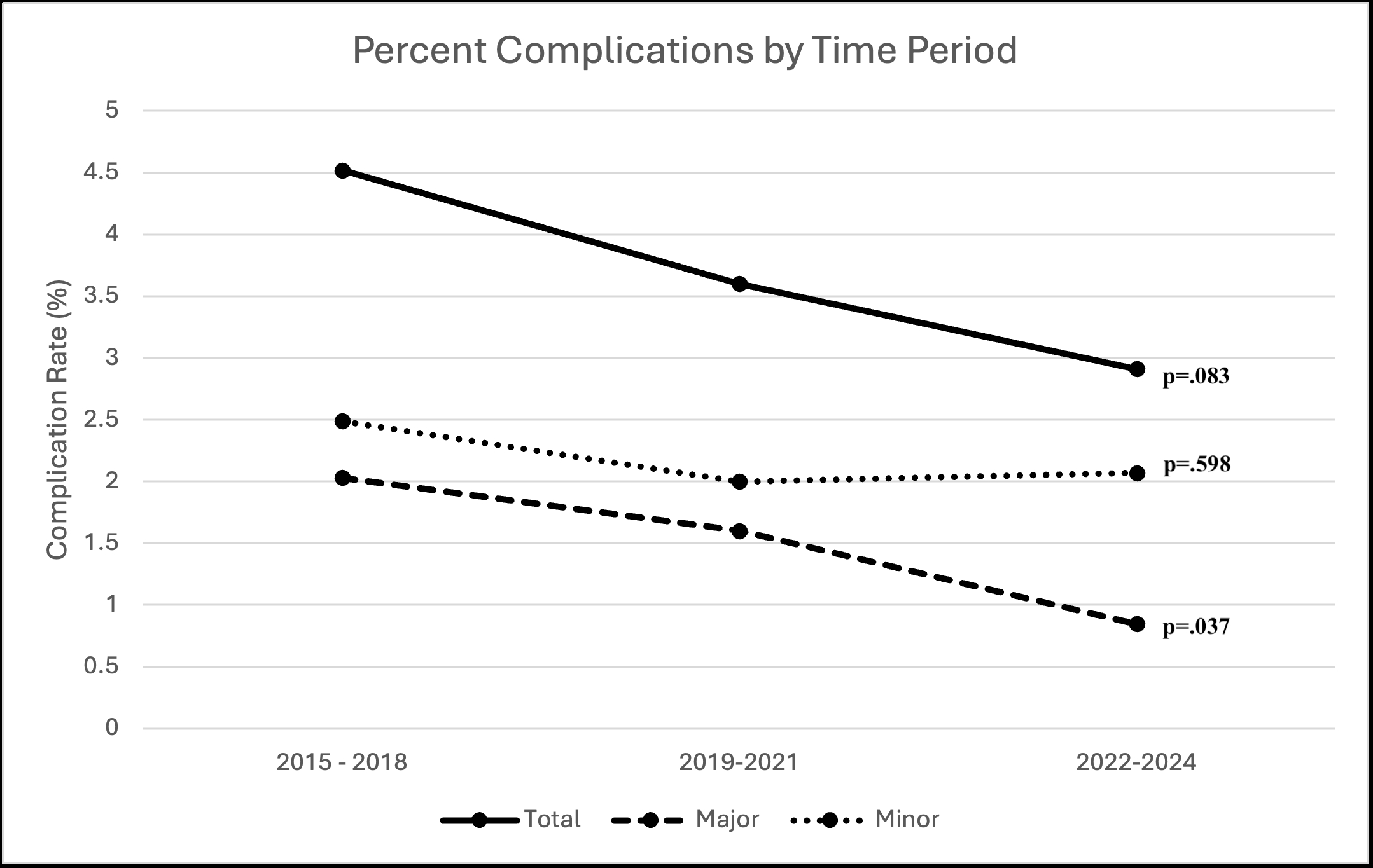
Results A total of 2,453 procedures were included. Ablation procedures were grouped into three time periods: 2015-2018 (N=641), 2019-2021 (N=750), and 2022-2024 (N=1062). A total of 87 procedures (3.55%) were associated with complications, including 34 major complications (1.38%) and 53 minor complications (2.16%). Figure 1 shows trends in total, major, and minor complications over time, with a noted significant decrease in major complications (p=0.037). Complication rates were also analyzed by ablation catheter type, as shown in Figure 2. The total complication rate for pulsed field ablation was 2.26% (5/221) compared to an overall complication rate of 3.55%, although this difference was not statistically significant.
Conclusion Major complications from catheter ablation for AF significantly decreased over time within our single-institution cohort. This may be attributed to increasing operator and institutional experience, and incorporation of newer technologies and safety techniques. No statistically significant difference was observed between ablation catheter types. However, this may have been limited by sample size and statistical power, and warrants future investigation.
Weinstein, Robert
(
Johns Hopkins School of Medicine
, Baltimore , Maryland , United States )
Satti, Danish Iltaf
(
Johns Hopkins School of Medicine
, Baltimore , Maryland , United States )
Reddy, Tina
(
Johns Hopkins School of Medicine
, Baltimore , Maryland , United States )
Hutto, David
(
Johns Hopkins School of Medicine
, Baltimore , Maryland , United States )
Karius, Alexander
(
Johns Hopkins School of Medicine
, Baltimore , Maryland , United States )
Yadav, Ritu
(
Midwestern University GME
, Cottonwood , Arizona , United States )
Isakadze, Nino
(
Johns Hopkins School of Medicine
, Baltimore , Maryland , United States )
Milstein, Jenna
(
Johns Hopkins School of Medicine
, Baltimore , Maryland , United States )
Aronis, Konstantinos
(
Johns Hopkins School of Medicine
, Baltimore , Maryland , United States )
Marine, Joseph
(
Johns Hopkins School of Medicine
, Baltimore , Maryland , United States )
Berger, Ronald
(
Johns Hopkins School of Medicine
, Baltimore , Maryland , United States )
Calkins, Hugh
(
Johns Hopkins School of Medicine
, Baltimore , Maryland , United States )
Spragg, David
(
Johns Hopkins School of Medicine
, Baltimore , Maryland , United States )
Author Disclosures:
Robert Weinstein:DO NOT have relevant financial relationships
| Joseph Marine:DO NOT have relevant financial relationships
| Ronald Berger:DO NOT have relevant financial relationships
| Hugh Calkins:DO NOT have relevant financial relationships
| David Spragg:DO NOT have relevant financial relationships
| Danish Iltaf Satti:DO NOT have relevant financial relationships
| Tina Reddy:No Answer
| David Hutto:DO NOT have relevant financial relationships
| Alexander Karius:No Answer
| Ritu Yadav:DO NOT have relevant financial relationships
| Nino Isakadze:No Answer
| Jenna Milstein:DO NOT have relevant financial relationships
| Konstantinos Aronis:No Answer