
Logo

American Heart Association

  18
  0


Final ID: MP2801

Digital Twin Matching for Real-World Cardiometabolic Medication Effect Estimation using Genomically informed Longitudinal Bayesian Disease Trajectories

Abstract Body (Do not enter title and authors here): Background: Confounding differences between treated and untreated patients in observational studies of medication effects lead to biased estimates of drug effectiveness and safety. We present a digital twin matching framework that pairs treated individuals with highly similar untreated controls, enabling robust, disease-specific estimation of drug effects across 358 phenotypes.
We analyzed prescription and disease event data from over 400,000 participants in a large UK Biobank GP data set, covering 348 disease phenotypes and 5 major drug classes. We identified treated individuals and matched them to untreated controls using our novel approach considering enrollment, sex, and Bayesian time-varying latent health signatures derived from longitudinal genetic and clinical data. Each signature represents an underlying disease process with genetic predisposition and co-occurring disease patterns. We compared post-treatment event rates between matched treated and control groups, contrasting with unmatched and inverse probability weighting.
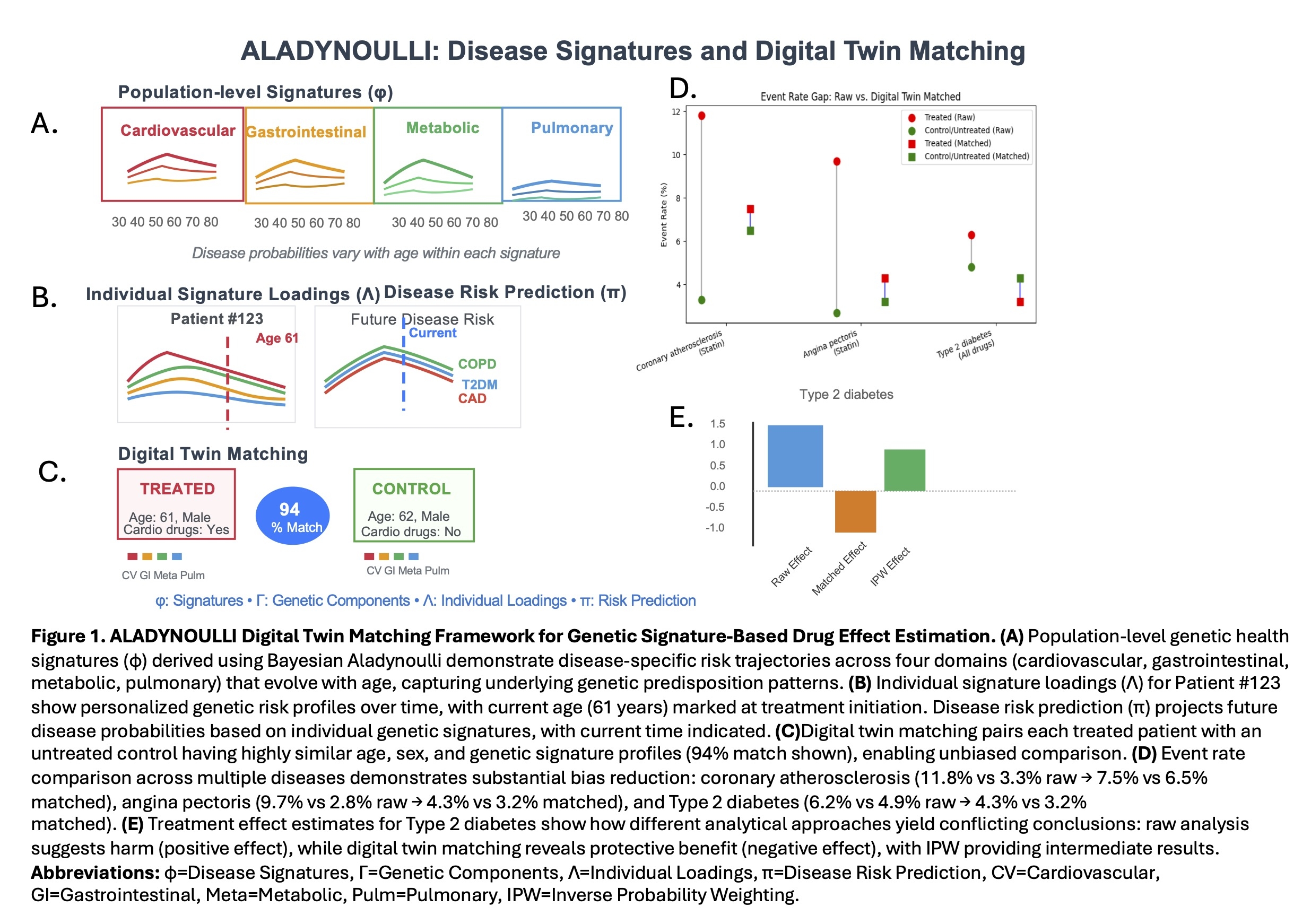
Results: Our novel approach of matching substantially reduced baseline differences between treated and control groups across major drug classes. Unmatched analyses showed inflated event rates in treated patients due to confounding by indication. After matching, event rates in controls closely mirrored those in treated patients, and post-treatment differences more plausibly reflected drug effects. For cardiometabolic drugs and Type 2 diabetes, the raw event rate was higher in the treated group (6.3%) compared to the untreated group (4.9%), persisting with inverse probability weighting (IPW: 6.2% vs 5.0%). After digital twin matching, the treated group correctly demonstrated lower event rate (3.2%) than their matched controls (4.3%). Our matching also substantially reduced the apparent risk difference between treated and control individuals for several statin outcomes. In coronary atherosclerosis, the raw event rate was 11.8% in treated vs 3.3% in untreated, but after matching, rates were 7.5% vs 6.5% (Fig 1).
Conclusions: Digital twin matching offers a scalable, generalizable solution for emulating randomized comparisons in real-world data. By aligning treated and control groups on genetic and clinical latent health features over time, this approach mitigates confounding and enables robust estimation of drug effects by capturing inherited disease susceptibility and clinical propensity to receive treatment and exposure.
  • Urbut, Sarah  ( Massachusetts General Hospital , Boston , Massachusetts , United States )
  • Parmigiani, Giovanni  ( Dana Farber , Boston , Massachusetts , United States )
  • Gusev, Alexander  ( Dana Farber , Boston , Massachusetts , United States )
  • Natarajan, Pradeep  ( Massachusetts General Hospital , Boston , Massachusetts , United States )
  • Author Disclosures:
    Sarah Urbut: DO NOT have relevant financial relationships | Giovanni Parmigiani: DO NOT have relevant financial relationships | Alexander Gusev: No Answer | Pradeep Natarajan: DO have relevant financial relationships ; Researcher:Amgen, Genentech / Roche:Active (exists now) ; Other (please indicate in the box next to the company name):Vertex Pharmaceuticals (spousal employment):Active (exists now) ; Ownership Interest:Bolt, Candela, Mercury, MyOme, Parameter Health, Preciseli, TenSixteen Bio:Active (exists now) ; Consultant:Allelica, CRISPR Therapeutics, Genentech/Roche, HeartFlow, Magnet Biomedicine:Past (completed) ; Consultant:AstraZeneca, Blackstone Life Sciences, Bristol Myers Squibb, Eli Lilly & Co, Esperion Therapeutics, Foresite Capital, Foresite Labs, GV, Merck, Novartis, Novo Nordisk, TenSixteen Bio, Tourmaline Bio:Active (exists now) ; Researcher:Allelica, Novartis:Past (completed)
Meeting Info:

Scientific Sessions 2025

2025

New Orleans, Louisiana

Session Info:

Multi-Omic Insights into Coronary Artery Disease 2

Monday, 11/10/2025 , 01:45PM - 02:45PM

Moderated Digital Poster Session

More abstracts on this topic:
Ambulatory QT Interval Prolongation and Reduced T-Amplitude Help Identify Veterans with Heart Disease

Shah Amit, Colon-motas Kay, De Leon Katalina, Murtala Abdulkareem, Osei Jeffery, Mourad Rama, Chang Sarah, Ko Yi-an, Zeng Zhaohua, Sheikh Shafa-at, Xu Ying, Koscova Zuzana, Kim Kain, Akoto Natalie, Santana Eric, Alexander Abigail, Suvada Kara, Roberts Tatum, Stefanos Lewam, Vaccarino Viola, Clifford Gari, Li Qiao, Sameni Reza, Bahrami Rad Ali, Karimi Sajjad, Lampert Rachel, Mathew Lejy, Alagar Nikila

Generation of induced pluripotent stem cell lines from hypertrophic cardiomyopathy patients carrying MYBPC3 mutations

Wu Catherine, Wu Matthew, Zhao Shane, Woo Y Joseph, Sayed Nazish

More abstracts from these authors:
Aladyn Individual: Dynamic Individual Comorbidity Modeling for Genomic Discovery and Clinical Prediction

Urbut Sarah, Natarajan Pradeep, Ding Yi, Taraszka Kodi, Yeung Ming Wai, Patel Aniruddh, Hornsby Whitney, Duan Rui, Gusev Alexander, Parmigiani Giovanni

Social Deprivation Score Derived from Principal Component Analysis of Survey Data Predictive of Cardiovascular Disease Risk in a National Cohort

Robinson Christopher, Urbut Sarah, Natarajan Pradeep

You have to be authorized to contact abstract author. Please, Login
Not Available