Test-Retest Reliability of Resting-State Pulse Rate Variability in Young Adults
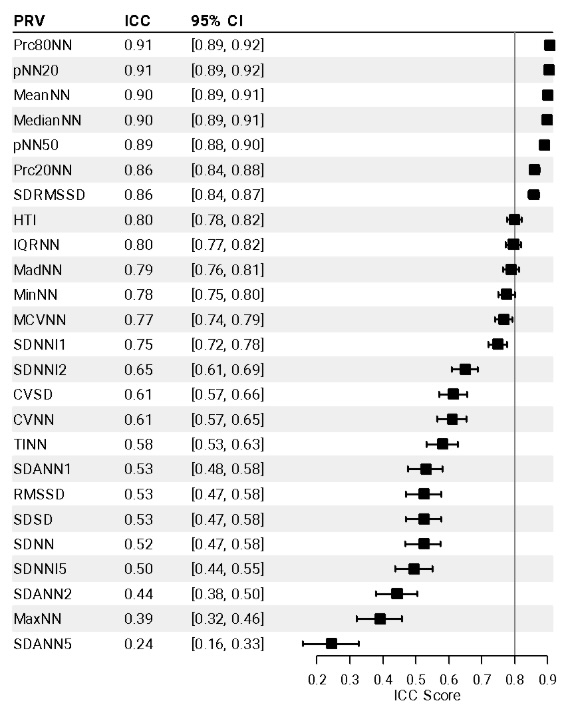
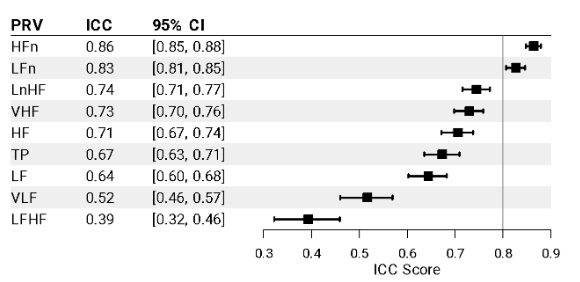
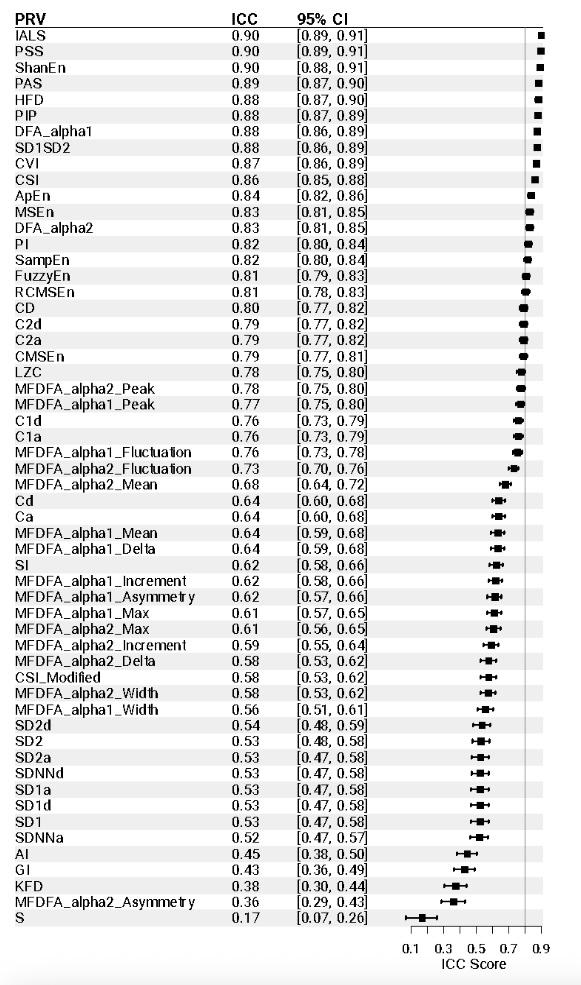
Abstract Body (Do not enter title and authors here): Background: Pulse rate variability (PRV), measured through photoplethysmography (PPG), can serve as an approximate measure of cardiac autonomic regulation. Despite its increasing availability through wearable devices and its emerging clinical significance, the test-retest reliability of PRV measures remains underexplored. Methods: This study assessed PRV reliability in 832 healthy young adults (451 females; median age 28.7 years [interquartile range: 26-32]) from the Human Connectome Project – Young Adult sample. PRV was derived from cardiac signals collected during 15-minute resting-state fMRI sessions using pulse oximetry, with two sessions each day for two days. We extracted 90 distinct PRV metrics from time, frequency, and nonlinear domains using a python package NeuroKit2. Reliability across sessions and within individual days was measured using intraclass correlation coefficients (ICCs), which evaluate both consistency and absolute agreement. Results: Of 832 participants, 625 (72.5%) self-identified as white, and 482 (58.1%) completed at least a college education. The proportion of PRV measures with excellent reliability (ICC ≥0.8) was 54.4% and 41.1% on days 1 and 2, respectively, with only 28.9% demonstrating excellent reliability across both days. Specifically, 9 (28.9%) PRV measures in the time domain (Figure 1), 2 (22.2%) in the frequency domain (Figure 2), and 17 (30.4%) in the nonlinear domain showed excellent reliability (Figure 3). Measures with particularly high reliability (i.e., ICC ≥0.9) included mean (meanNN) and 80th percentile (Prc80NN) of inter-pulse intervals, percentages of successive pulse interval differences greater than 20ms (pNN20), and heart rate fragmentation (IALS). Common PRV measures such as SDNN (ICC=0.52, 95% CI: 0.47, 0.58), RMSSD (ICC=0.53, 95% CI: 0.47, 0.58), LF (ICC=0.64, 95% CI: 0.60, 0.68), and HF (ICC=0.71, 95% CI: 0.67, 0.74) exhibited lower reliability than expected, whereas normalized LF (ICC=0.83, 95% CI: 0.81, 0.85) and HF (ICC=0.86, 95% CI: 0.85, 0.88) demonstrated excellent reliability. Conclusion: Approximately 30% of PRV metrics derived from PPG signals showed excellent reliability in young adults, though validation in clinical populations remains needed. Our finding suggests that these reliable metrics could be prioritized when selecting PRV parameters for autonomic nervous system monitoring in wearable device applications.
Zhao, Yihong
(
Columbia University
, New York , New York , United States )
Han, Xuwei
(
Columbia University
, New York , New York , United States )
Li, Xi
(
Ichan School of Medicine Mt. Sinai
, New York , New York , United States )
Author Disclosures:
Yihong Zhao:No Answer
| Xuwei Han:No Answer
| Xi Li:DO NOT have relevant financial relationships