Social Determinants of Health among Veterans with Peripheral Artery Disease
Abstract Body (Do not enter title and authors here): Background: Patients with peripheral artery disease (PAD) experience a high burden of limb-related hospitalizations and negative impacts on health-related quality of life. Although social determinants of health are known to influence cardiovascular disease outcomes, their role in the progression of PAD is poorly understood. The VA Healthcare System, which uniquely codes for individual health-related social needs (HRSNs), provides a unique opportunity to understand how these needs at influence outcomes at both the individual and population levels.
Methods: In a retrospective cohort study of all patients coded with a new diagnosis of PAD in the national VA Healthcare System from January 1, 2015, to December 31, 2023, logistic regression was used to assess the association between area level SVI quartiles and one-year all-cause mortality, with adjustment for patient characteristics (age, sex, race/ethnicity, Charlson comorbidity index). Prevalence of individual HRSNs within each SVI quartile were identified by ICD-10 Z codes.
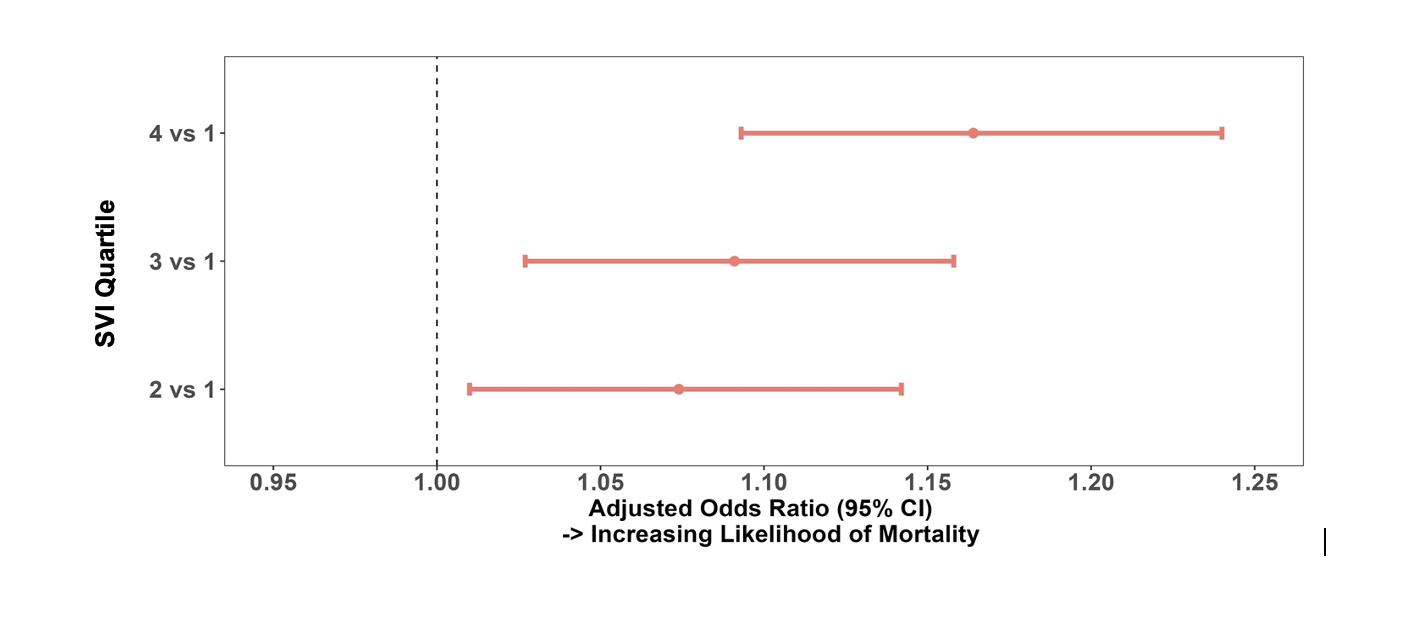
Results: A total of 181,192 Veterans (mean age 72+9.7 years, 97.5% male, 68.1% Non-Hispanic White) with PAD were identified. Across SVI quartiles, significant differences in gender, race, smoking status, and co-morbidities (including coronary artery disease, hypertension, and hyperlipidemia) were identified (p < 0.01 for all). Mortality rates increased across SVI quartiles, ranging from 7.4%-16.4%% (p <0.01). Compared to quartile 1, all other SVI quartiles had a higher likelihood of adjusted one-year mortality, with risk increasing as social vulnerability increased (Figure 1). Higher SVI quartiles had a higher proportion of patients with the presence of at least one HRSN (34.8% vs. 15.0% in Quartiles 4 vs. 1 respectively, p<0.001).
Conclusions: PAD patients experienced higher likelihood of 1-year mortality with increasing population-level social vulnerability. Population level social vulnerability was associated with higher individual level HRSNs, suggesting opportunities for identifying HRSNs at the individual level to mediate poor outcomes among PAD patients.
Tanaka, John
(
Stanford University
, Menlo Park , California , United States )
Beyene, Tariku
(
PAVAHCS
, Palo Alto , United States Minor Outlying Islands )
Yong, Celina
(
STANFORD UNIVERSITY
, Menlo Park , California , United States )
Author Disclosures:
John Tanaka:DO NOT have relevant financial relationships
| Tariku Beyene:DO NOT have relevant financial relationships
| Celina Yong:DO NOT have relevant financial relationships