Logo

American Heart Association

  13
  0


Final ID: MP774

Externally Supported Acellular Tissue-Engineered Vessels Demonstrate Regeneration and Patency as Coronary Artery Bypass Grafts in Preclinical Models and Early Clinical Experience

Abstract Body (Do not enter title and authors here): Background: Coronary artery bypass grafting (CABG) remains the gold standard for severe coronary artery disease, but autologous vessel limitations including early saphenous vein graft failure and unavailability in patients with comorbidities necessitate alternative conduits. We evaluated the acellular tissue-engineered vessel (ATEV) with external support structure (ESS) as an off-the-shelf bypass conduit for coronary artery bypass surgery in preclinical models and through early clinical experience.

Methods: In the preclinical phase, 4mm diameter ATEVs were implanted as coronary bypasses in 22 ovine. ATEV Gen 1 (n=13) without ESS; and Gen 2 (n=9) with ESS were implanted for duration up to 18 months. Follow-up included serial angiography, histopathology, and mechanical testing. With preclinical safety data, a clinical first-in-human feasibility study (VCAB-1, NCT06434935) enrolled three patients with multivessel disease receiving ATEV with ESS as a secondary bypass conduit.

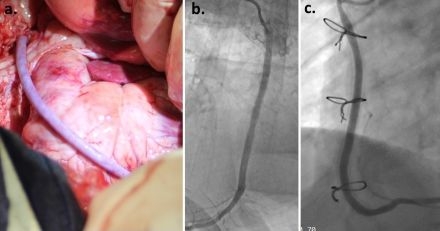
Results: Gen 1 ATEV without ESS experienced 31% (4/13) kink-related thrombotic events. Gen 2 ATEV with ESS achieved 100% patency in all animals surviving perioperative complications (n=5). Planned explants at 180 days (n=3) and on-going (555 days) maintained TIMI-3 flow. Histopathology revealed progressive remodeling with endothelialization, cellular infiltration, and elastic lamina formation without inflammatory response or calcification. Explanted conduits maintained burst pressures (2100-4200 mmHg) exceeding native vessels. In the clinical study, two patients enrolled were successfully implanted with triple bypass which include LIMA to LAD, ATEV and SVG as other the two bypass. No suture hole or conduit wall bleeding was observed for the ATEV with ESS grafts and patients had normal recovery. ATEV with ESS demonstrated 100% patency at 180-day angiography with no evidence of lumen thrombus. SVG bypass in both patients showed substantial stenosis.

Conclusions: Externally supported ATEV eliminates kink-related complications while maintaining excellent patency and favorable remodeling in long-term preclinical studies. Early clinical results demonstrate feasibility and safety at 180 days. These bioengineered conduits represent a promising alternative to autologous vessels for CABG, potentially addressing current limitations in conduit availability and durability.
  • Soule, Matthew  ( University of Minnesota , Minneapolis , Minnesota , United States )
  • Syedain, Zeeshan  ( Vascudyne Inc , Minneapolis , Minnesota , United States )
  • Ebner, Adrian  ( CENTRO DE INTERVENCIONES ENDOVASCUL , Asuncion , Paraguay )
  • Mcmahon, Mariah  ( Vascudyne Inc , Minneapolis , Minnesota , United States )
  • Prunty, Abrielle  ( Vascudyne Inc , Minneapolis , Minnesota , United States )
  • Benkofske, Jacob  ( Vascudyne Inc , Minneapolis , Minnesota , United States )
  • Author Disclosures:
    Matthew Soule: DO have relevant financial relationships ; Consultant:Vascudyne, Inc.:Active (exists now) | Zeeshan Syedain: DO have relevant financial relationships ; Employee:Vascudyne :Active (exists now) | ADRIAN EBNER: No Answer | Mariah McMahon: No Answer | Abrielle Prunty: DO have relevant financial relationships ; Employee:Vascudyne:Active (exists now) | Jacob Benkofske: No Answer
Meeting Info:

Scientific Sessions 2025

2025

New Orleans, Louisiana

Session Info:

Catheter-Based Coronary Interventions

Saturday, 11/08/2025 , 01:45PM - 02:25PM

Moderated Digital Poster Session

More abstracts on this topic:
Acellular Tissue Engineered Vessels as Conduits for Coronary Artery Bypass Grafting

Nash Kevin, Prichard Heather, Niklason Laura, Kypson Alan, Williams Adam, Benkert Abigail, Daubert Melissa, Kirkton Robert, Levitan Garyn, Mccartney Sharon, Mehta Sachin, Naegeli Kaleb

A Systematic Review and Meta-Analysis on the Anesthetic Approaches for Left Atrial Appendage Occlusion: Comparing Conscious Sedation and General Anesthesia

Zaidi Syed Rafay, Ajmal Umna, Rauf Zainab, Maaz Muhammad, Gulzar Sara, Burki Shahid, Nazir Abubakar, Mirza Azka, Hassan Ahmad, Amir Maaz, Jahangir Muhammad Asad, Rasul Minahil, Raza Muhammad, Malik Mohammad

More abstracts from these authors:
Preliminary Results of New Versus Reconditioned Pacemakers for Patients Unable to Obtain a New Device in Low- and Middle-Income Countries: The My Heart Your Heart (MHYH) Randomized Controlled Trial

Crawford Thomas, Ebner Adrian, Martinez Ceci, Oladimeji Oluwaseye, Sani Mahmoud, Akwanalo Constantine, Bahena Jorge, Carrizales Edgar, Damasceno Albertino, Russell James, Bruenger Patricia, Puroll Eric, Pai Chih Wen, Alexandris-souphis Constantina, Froehlich James, Hale Aj, Dunning Joel, Samson George, Klugman Noah, Powell Lane, Goldman Ed, Davis Sheldon, Kline Rogers Eva, Davis Marion, Alllmendinger Craig, Oral Hakan, Wasserman Brad, Eagle Kim, Aponte Azorena, Finizola Vicente, Arends Maria, Arends Eusebio, Monasterios Hector, Edafe Emmanuel Auchi

You have to be authorized to contact abstract author. Please, Login
Not Available