Clinical and Echocardiographic Predictors of Aortopathy in Patients with Bicuspid Aortic Valve: Insights from a Large Community Cohort
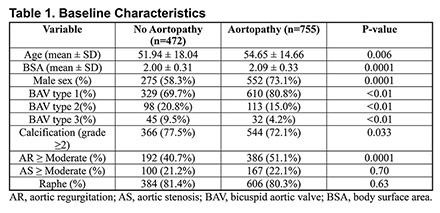
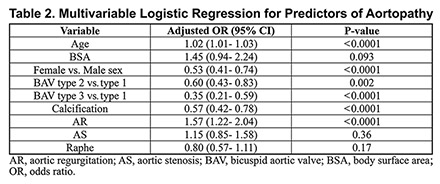
Abstract Body (Do not enter title and authors here): Background The bicuspid aortic valve (BAV) is the most prevalent congenital heart defect and is frequently associated with aortopathy. The etiology of aortic dilation in BAV is multifactorial, involving both hemodynamic stress and intrinsic aortic wall abnormalities. While previous studies have proposed several mechanisms, the specific and valve-related predictors of aortopathy remain unclear. Research question Which clinical and echocardiographic features independently predict the presence of aortopathy in patients with BAV? Goals To identify the patient and value-related characteristics associated with aortopathy in a large, real-world BAV cohort using standardized imaging and statistical approaches. Approach Between 2013 and 2017, across 33 echocardiography labs within a large U.S. health system, 1,227 patients diagnosed with BAV were retrospectively reviewed. BAV morphology, presence of raphe, calcification severity (grades 0-4), aortic regurgitation (AR), aortic stenosis (AS), age, sex, and body surface area (BSA) were collected. Aortopathy was defined based on measurements of the aorta at the sinus of Valsalva and mid-ascending portions, indexed to body surface area. Univariate analysis (Mann-Whitney U and Chi-square) identified candidate predictors. A multivariable logistic regression model was constructed to identify independent predictors of aortopathy. Multicollinearity was assessed using the variance inflation factor and tolerance. Results Among 1,227 BAV patients, 755 (61.5%) had aortopathy. They were older (54.7 vs. 51.9 years, p=0.006), had higher BSA (2.09 vs. 2.00 m2, p<0.001), and were more often male (73.1% vs. 58.3%, p<0.001). Independent predictors of aortopathy included male sex, age, AR severity, and BAV Type 1 (vs. Types 2 and 3). Calcification was inversely associated. AS, BSA, and raphe were not significant predictors. The model demonstrated excellent calibration (Hosmer-Lemeshow p = 0.715). Conclusion Clinical characteristics emerge to differentiate BAV patients with aortopathy. Although the relationships between aortopathy and BAV are complex, specific clinical and echocardiographic variables in this cohort, particularly BAV Type 1, age, Male sex, calcification, and AR severity, were independently associated with aortopathy. These findings support multifactorial pathogenesis of BAV-associated aortopathy and may inform future risk stratification and surveillance strategies.
Javadi, Niloufar
(
Aurora Sinai/Aurora St. Luke's Medical Centers, Aurora Health Care
, Milwaukee , Wisconsin , United States )
Ashraf, Muddasir
(
Aurora Sinai/Aurora St. Luke's Medical Centers, Aurora Health Care
, Milwaukee , Wisconsin , United States )
Hundal, Prabhjot
(
Aurora Sinai/Aurora St. Luke's Medical Centers, Aurora Health Care
, Milwaukee , Wisconsin , United States )
Jan, M. Fuad
(
Aurora Sinai/Aurora St. Luke's Medical Centers, Aurora Health Care
, Milwaukee , Wisconsin , United States )
Galazka, Patrycja
(
Aurora Sinai/Aurora St. Luke's Medical Centers, Aurora Health Care
, Milwaukee , Wisconsin , United States )
Jahangir, Arshad
(
Aurora Sinai/Aurora St. Luke's Medical Centers, Aurora Health Care
, Milwaukee , Wisconsin , United States )
Tajik, A. Jamil
(
Aurora Sinai/Aurora St. Luke's Medical Centers, Aurora Health Care
, Milwaukee , Wisconsin , United States )
Jain, Renuka
(
Aurora Sinai/Aurora St. Luke's Medical Centers, Aurora Health Care
, Milwaukee , Wisconsin , United States )
Author Disclosures:
Niloufar Javadi:DO NOT have relevant financial relationships
| Muddasir Ashraf:DO NOT have relevant financial relationships
| Prabhjot Hundal:DO NOT have relevant financial relationships
| M. Fuad Jan:DO NOT have relevant financial relationships
| Patrycja Galazka:DO NOT have relevant financial relationships
| Arshad Jahangir:DO NOT have relevant financial relationships
| A. Jamil Tajik:DO NOT have relevant financial relationships
| Renuka Jain:DO have relevant financial relationships
;
Consultant:Medtronic:Active (exists now)
; Consultant:Philips:Active (exists now)
; Consultant:GE Healthcare:Active (exists now)
; Advisor:GE Healthcare:Active (exists now)
; Consultant:Edwards:Active (exists now)
; Advisor:Medtronic:Active (exists now)