Associations Between Patient-Physician Race and Language Concordance and Direct Oral Anticoagulant Initiation in Patients with Non-Valvular Atrial Fibrillation
Abstract Body (Do not enter title and authors here): Background: For patients with non-valvular atrial fibrillation (NVAF) and a high risk of stroke who require anticoagulation treatment, guidelines recommend direct oral anticoagulants (DOACs) to reduce risk of mortality and stroke. Previous studies have shown racial and ethnic disparities in the initiation of DOACs in patients with NVAF. However, the associations between patient-physician race and language concordance with DOAC initiation remain understudied.
Research Question: What is the association between patient-physician race and language concordance on DOAC initiation in patients with NVAF?
Methods: A retrospective cohort study was conducted among Kaiser Permanente Southern California (KPSC) adults ≥18 years with a confirmed diagnosis of NVAF and CHA2DS2-VASc ≥2 between 2012 and 2022. DOAC initiation was defined as a DOAC prescription (Dabigatran, Apixaban, Rivaroxaban, Edoxaban) from clinicians within 60 days from an initial diagnosis of NVAF. Multivariable logistic regression was used to determine the associations between patient-physician race and language concordance and DOAC initiation, adjusting for patient age, race and ethnicity, sex, insurance type, and neighborhood deprivation index (NDI).
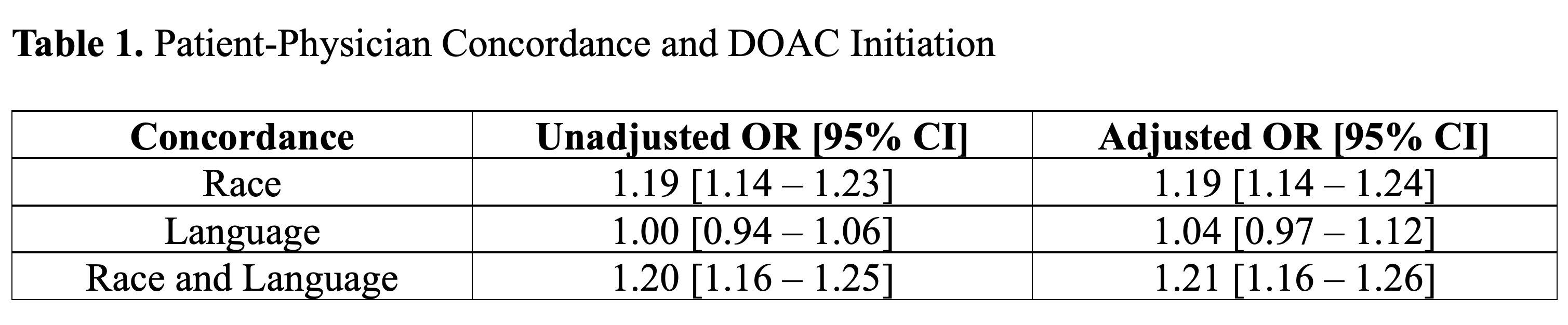
Results: Among this cohort of 59,340 adults, the mean age was 76.9 years, 55.4% were female, 60.1% self-identified as non-Hispanic (NH) White, 21.0% as Hispanic, 9.1% as NH Black, 8.1% as Asian and 89.9% spoke English. A total of 26.1% of adults were race-concordant with their physician, while 91.4% were language-concordant. Patient-physician race concordance (OR = 1.19, 95% CI = 1.14 – 1.24), but not patient-physician language concordance (OR = 1.04, 95% CI = 0.97 – 1.12), was significantly associated with increased odds of DOAC initiation (Table 1). Characteristics independently associated with decreased DOAC initiation included female sex (OR = 0.60, 95% CI = 0.58 – 0.62), NH Black race and ethnicity (OR = 0.84, 95% CI = 0.79 – 0.90), and NDI quartile 4 (OR = 0.83, 95% CI = 0.78 – 0.87) (Table 2).
Conclusion: Patient-physician race concordance – but not language concordance – is independently associated with increased DOAC initiation. These findings suggest that race concordance, which may enhance trust, communication, and care engagement, can have an impact beyond language and is critical for improving treatment initiation.
Au, Michael
(
Kaiser Permanente Bernard J. Tyson School of Medicine
, Pasadena , California , United States )
Zhou, Mengnan
(
Kaiser Permanente Southern California
, Pasadena , California , United States )
An, Jaejin
(
Kaiser Permanente Southern California
, Pasadena , California , United States )
Author Disclosures:
Michael Au:DO NOT have relevant financial relationships
| Mengnan Zhou:No Answer
| Jaejin An:DO have relevant financial relationships
;
Research Funding (PI or named investigator):Bayer:Active (exists now)
; Research Funding (PI or named investigator):Merck:Past (completed)
; Research Funding (PI or named investigator):AstraZeneca:Active (exists now)
Khan Muhammad Aslam, Haider Taimoor, Bhattarai Shraddha, Afzal Hafsa, Khan Bilal, Muhammad Anza, Shafique Nouman, Bhatia Hitesh, Aafreen Asna, Adil Abid Nawaz Khan, Akbar Usman, Khan Alamzaib, Haider Muhammad Adnan
Au Michael, Shah Nilay, Reynolds Kristi, An Jaejin, Zhang Yiyi, Zhou Mengnan, Choi Soonie, Zhou Hui, Harrison Teresa, Mefford Matthew, Lee Mingsum, Yang Eugene